
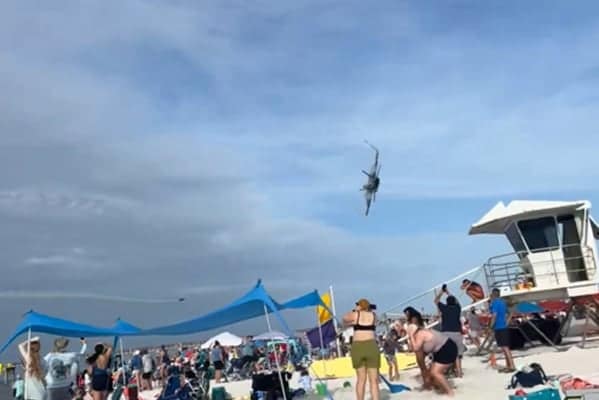
A controversial low-altitude Blue Angels flyby over beachgoers in Florida has ignited a wider debate over military aviation safety, after the pilot reportedly acknowledged making a mistake while senior Trump administration figures defended the stunt.
The incident occurred during preparations for the Pensacola Beach Airshow, when a Blue Angels jet swept dangerously close to the shoreline, sending chairs and umbrellas flying and prompting concerns among spectators.
According to Florida state representative Michelle Salzman, the pilot admitted he had miscalculated a turn and accepted responsibility for the error.
“He didn’t make excuses. He didn’t try to shift blame,” Salzman said after speaking with the pilot, who has not been officially identified by the Navy.
She said the aviator understood the seriousness of the incident and had been carrying the weight of what happened.
The Blue Angels’ leadership took a more cautious view of the episode.
Dramatic video shows the U.S. Navy Blue Angels making a low-altitude flyover above Pensacola Beach, Florida, on Wednesday. Navy officials confirmed in a statement that Blue Angels leadership is "reviewing the circumstances surrounding the maneuver and conducting a thorough safety… pic.twitter.com/ZUa1ryk4X8
— ABC News (@ABC) July 15, 2026
Captain Adam Bryan, commander of the elite demonstration team, said the manoeuvre was not acceptable and would undergo a full review.
“We never intend to fly over the crowd that low,” he said, adding that the team would examine what happened to ensure future demonstrations remained safe.
The Navy has not announced disciplinary action against the pilot.
While military officials focused on safety, members of the Trump administration quickly moved to defend the pilot.
Acting Navy Secretary Hung Cao said the flight review had concluded with no punishment, declaring: “No reprimands. No firings. No problem.”
Other administration figures celebrated the flyby online, framing criticism as an attack on patriotism rather than a legitimate aviation concern.
The response triggered backlash from aviation experts and some military veterans, who warned that public displays should not normalise risky behaviour.
Jeff Guzzetti, a former aviation accident investigator with the National Transportation Safety Board and Federal Aviation Administration, criticised the reaction from political allies of the administration.
He argued that dismissing safety concerns could create a dangerous precedent.
“It’s shocking to me as an aviation safety professional that the top leaders of the military would excuse this type of reckless behavior,” he said.
Former Republican congressman and military veteran Adam Kinzinger also praised the Blue Angels for acknowledging the risk while criticising efforts to turn the incident into a political loyalty test.
The controversy highlights a growing divide between two competing narratives.
Supporters see the flyby as a symbol of military skill and national pride.
Critics argue that elite aviation teams exist precisely because precision and discipline matter — and that mistakes must be examined rather than celebrated.
For the Blue Angels, whose reputation depends on extraordinary levels of control, the incident is less about politics than procedure.
Aviation demonstrations are built on the smallest margins of error.
The debate now is whether the lesson taken from the incident will be one of accountability — or defiance.


Leave a Comment