
Russia launched another major missile and drone assault against Ukrainian cities this week, killing civilians, children, damaging residential buildings and infrastructure, and once again forcing millions to confront the reality of a war now in its fifth year.
It was Vladimir Putin’s birthday, something my wife reminded me of when I explained that I believed we were about to come under another major Russian attack, but while Moscow continued its campaign of aerial bombardment against Ukrainian cities, another significant development was unfolding across the border. Ukraine was taking the war back into Russia on an extraordinary scale.
Here in Dnipro, the warning signs had been apparent throughout the preceding day ,Jet-powered drones, explosions and repeated air-raid alerts suggested another substantial attack was approaching.
Having lived through years of Russian bombardment, I have become familiar with these patterns, so what begins as sporadic drone activity can quickly develop into a coordinated overnight assault.
This time was no different.
According to Ukrainian authorities, at least 11 people were killed and more than 34 injured across the country, with Kyiv, Kremenchuk, Dnipro and several other cities coming under attack.
In Pryluky, Chernihiv region, emergency workers rescued an eight-year-old boy from the ruins of a residential building, meanwhile, police bomb-disposal specialists discovered an unexploded ballistic missile near apartment buildings in Kyiv’s Darnytskyi district.
Read more related news:
Putin’s sycophant issues another yawning threat as France test-fires a new ballistic missile
Algerian Hercules flying weapons to Russia raises fresh airspace security questions for NATO
Kremlin’s war spending hits $199bn whilst a delusional Trump believes the conflict is ending
Russian plague outbreak could lead ‘to anarchy in days’ in a terrifying warning
Sochi’s burning oil joke as Moscow says ‘no pollution’ as stricken ‘tanker has been liquidated’
The danger, therefore, continued long after the explosions stopped.
Russia maintains that its strikes targeted military-industrial facilities and other military-related infrastructure, however, the consequences for civilians remain devastating.
Yet the most strategically significant developments may have been taking place hundreds of kilometres inside Russia.
Russian authorities claimed their air defences intercepted almost 900 Ukrainian drones across Russia, occupied Crimea and the Sea of Azov during an extensive series of attacks.
Those figures remain independently unverified, but if broadly accurate, they would represent one of Ukraine’s largest long-range drone operations since the full-scale invasion began.
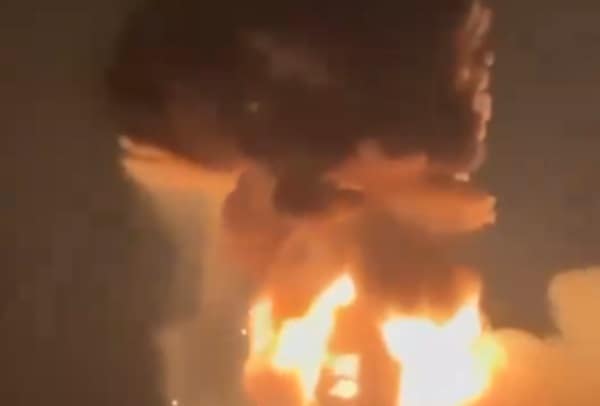
Moscow and its surrounding region reportedly faced considerable pressure, while a fuel facility at Volodarsk in Moscow Oblast, associated with Russia’s Transneft infrastructure, was reportedly struck and set ablaze.
The strategic significance extends well beyond burning fuel installations.
In February 2022, Russian armoured columns were advancing towards Kyiv, with the Kremlin apparently expecting Ukraine’s resistance to collapse within days.
More than four and a half years later, Russia is deploying increasingly substantial resources to defend its own capital and critical infrastructure against Ukrainian attacks, with perhaps the most striking images emerging from the Black Sea resort city of Sochi.
Footage circulating online showed an enormous fire offshore, with flames and thick black smoke rising from a tanker.
Russian authorities identified the vessel as the Liberian-flagged Aframax Rio, reporting that it had been attacked by unmanned surface vessels. All 23 crew members were reportedly rescued.
Sochi is not a border settlement accustomed to the immediate proximity of war, it is one of Russia’s most recognisable resort cities, associated with the 2014 Winter Olympics and President Vladimir Putin’s presidential residence.
The sight of a tanker burning offshore illustrates how dramatically the geography of this conflict has changed.
Ukraine’s growing long-range capabilities are not just increasingly threatening oil refineries, storage facilities, pipelines and logistical networks supporting Russia’s war effort. Russia’s technological infrastructure is now also within reach.
On 8 October, Ukrainian drones struck a major Yandex data centre in Sasovo, Ryazan Oblast, causing a fire and forcing the Russian technology giant to completely suspend operations at the facility. The attack disrupted parts of Yandex Cloud, including computing resources, data storage, databases and networking services, although its principal consumer services remained operational. The full extent of the physical damage remains unclear.
Significantly, the data centre shares an industrial site with the Sasta machine-tool plant, a sanctioned manufacturer whose equipment supports Russia’s defence and aerospace industries. Whether the factory, data centre or both were the intended targets remains unconfirmed.
For Moscow, the implications extend beyond burning oil facilities, with Ukraine increasingly demonstrating that the industrial and digital infrastructure underpinning Russia’s economy is no longer beyond the reach of this war.
Energy infrastructure still represents a particularly important vulnerability, while revenues remain central to the Russian economy and its capacity to finance military operations. Disrupting refining, storage and distribution can impose costs extending far beyond the immediate physical damage.
The consequences are also military.
President Donald Trump has publicly criticised Ukrainian strikes against Russian refineries amid concerns about international fuel prices, although broader global energy disruptions have also contributed to market pressures.
For Kyiv, however, the strategic calculation remains clear: make Russia’s invasion increasingly difficult and expensive to sustain.
None of this suggests Russia is approaching military collapse, Moscow retains substantial missile, drone and manpower resources, as its continued attacks against Ukrainian cities demonstrate, nor does Ukraine’s expanding strike capability mean it has achieved overwhelming battlefield superiority.
But wars are not decided exclusively by territorial advances; they are also shaped by economic pressure, resource allocation and the ability to impose difficult choices on an opponent.
Russia continues to demonstrate its capacity to inflict enormous suffering on Ukrainian civilians, but Ukraine, meanwhile, is increasingly demonstrating that Moscow cannot expect to conduct this war indefinitely while remaining insulated from its consequences.
From the skies above Moscow to occupied Crimea, Russian energy infrastructure and the Black Sea, the strategic map is changing.
Russia started this war believing distance would protect it from the consequences of its invasion.
That distance is disappearing.


Leave a Comment