
Russian President Vladimir Putin is becoming “increasingly cavalier, dangerous and risk-accepting” as the war in Ukraine drags on and Moscow seeks to divide Western allies, a senior NATO commander has warned.
Air Chief Marshal Sir John Stringer, NATO’s deputy supreme allied commander for Europe, issued the warning at a security conference in Estonia amid growing concern over Russian-linked sabotage, espionage and repeated drone and missile incidents across Europe.
Stringer urged NATO members to remain alert to what he described as a “febrile environment”, while cautioning against an “overreaction” that he said Putin could seek to provoke.
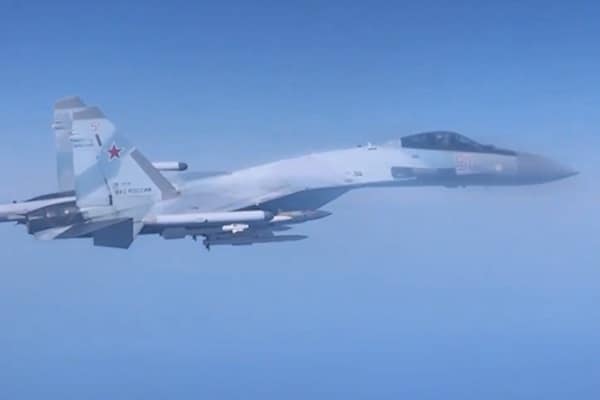
Speaking to The Associated Press, Stringer said the distinction between an accidental and deliberate Russian incursion into NATO airspace could be difficult to establish.
“The line between ‘accidental and deliberate is quite a fine one’,” he said, referring to drones that enter NATO territory after being diverted by Russian electronic warfare or GPS jamming.
He said Moscow could escalate such activity, although that did not mean Russia had decided to do so.
Read more related news:
UK warned we are in the ‘most dangerous era’ as war with Russia may all ready be under way
Kremlin accuses UK of being a ‘Russophobic’ state, but Putin’s war did the damage
Brits on holiday in NATO hotspot warned of Russian explosive drones
ISW warns Russia could try and seize Estonian city in a test of Article 5
The warning comes as European governments debate how seriously to treat the growing number of incidents involving Russian drones, missiles and suspected covert operations.
Polish Prime Minister Donald Tusk has warned that Russia could deliberately target NATO countries with drones or missiles while subsequently claiming the attacks were accidental. French President Emmanuel Macron has also called for preparations to protect critical infrastructure against potential drone and cyberattacks.
Other European officials have urged caution.
A British defence official, speaking anonymously to discuss sensitive security assessments, said the UK did not believe Putin was seeking a direct confrontation with NATO. Estonia, Latvia and Lithuania have similarly taken a more cautious view of the immediate risk of major escalation.
But European governments have already recorded a growing number of incidents that officials have linked to Russian activity.
An Associated Press analysis tracking the covert campaign showed reported incidents rising from 59 in March 2025 to more than 210, covering alleged vandalism, propaganda and influence operations, arson, sabotage and cyberattacks.
Germany last month accused Moscow of involvement in an alleged plot at Leipzig airport, where a drone carrying explosives was reportedly found near a Ukrainian aircraft loaded with jet fuel. British officials have also said they disrupted an alleged Russian sabotage plot targeting a drone factory outside London.
An Estonian defence company was set on fire in August and a weapons storage facility in Bulgaria subsequently exploded, although neither incident has been publicly attributed to Russia.
The difficulty for European governments is that suspected Russian operatives are often recruited online and may not know who ultimately stands behind the missions, making both detection and attribution more complicated.
Putin has rejected accusations that Moscow is conducting a covert campaign against the West.
Asked by AP in May whether Russia was waging such a campaign, he responded: “Name one proven fact.”
Stringer and Estonian Prime Minister Kristen Michal nevertheless argued that the increase in covert activity reflected the broader confrontation created by Western support for Ukraine.
Stringer said Putin was “looking at a whole number of things” to create divisions between NATO allies as Russia’s war effort faces mounting difficulties.
Michal described Putin as a “rat in the corner”, arguing that Moscow was increasing activity in Europe in an effort to weaken Western support for Ukraine.
The military situation in Ukraine remains central to the assessment of Russia’s wider intentions.
According to Air Chief Marshal Sir Richard Knighton, Britain’s chief of the defence staff, Russian territorial gains have been slow and costly, while Ukraine’s deep-strike campaign against Russian energy infrastructure has contributed to fuel shortages across much of the country.
Despite those pressures, there is no indication that Putin has abandoned his objectives in Ukraine.
Michal said Moscow was attempting to undermine NATO’s collective defence by testing member states with covert actions that can be difficult to attribute. But she said a conventional Russian attack on Europe remained “improbable”, citing the likely NATO response and the fact that Russian forces remain heavily committed to Ukraine.
She warned, however, that Russia’s broader campaign of malign activity could continue.
Michal said the activity was “here to stay” until Putin changes his military objectives and argued that the strongest deterrent was to “back Ukraine”.
The competing assessments underline the dilemma facing NATO: European governments must prepare for increasingly sophisticated Russian hybrid activity without allowing individual incidents, particularly those involving drones entering allied airspace, to trigger an uncontrolled escalation.
For Stringer, the danger lies partly in that uncertainty. Russia does not have to launch a conventional attack on NATO to test the alliance. Repeated ambiguous incidents, covert operations and calculated provocations could instead probe how quickly and collectively its members are prepared to respond.


Leave a Comment