
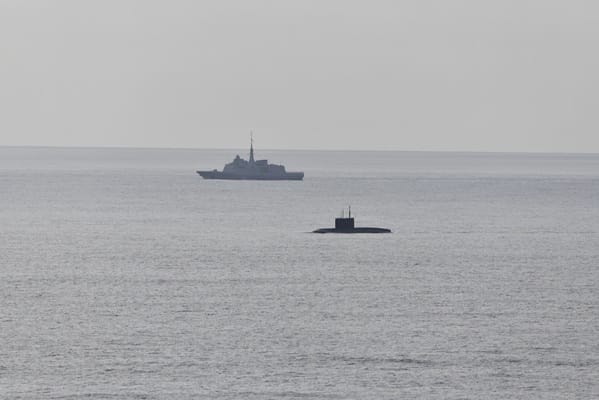
The head of the Royal Navy has warned that Russia could target Britain’s critical undersea infrastructure at the outset of a future conflict, as senior military commanders argue that the UK must prepare for longer and more extensive wars.
First Sea Lord General Sir Gwyn Jenkins said Russia was “probing, testing and mapping” Britain’s maritime infrastructure and warned that the UK faced a level of threat not seen since the Cold War.
Speaking privately at the Department for Naval Research Symposium, Sir Gwyn called for Britain to strengthen its warfighting readiness and develop a larger “hybrid” navy incorporating increasingly uncrewed systems.
Read more related news:
Poland scrambles warplanes as explosion hits just 4km from NATO border
Belarus masses tanks and drones near NATO border presenting preparations for an attack
Military chief warns UK to prepare for long war as Russia ‘raises the stakes’
Five charged over assassination plots as Russian network targets US and Europe
He highlighted the vulnerability of the cables and other infrastructure that connect Britain to the global economy, drawing a parallel with the opening stages of the First World War.
“Critical undersea infrastructure is now part of the strategic landscape.
“The day that the UK declared war on Germany, the Allies severed its transatlantic telegraph cables.
“I pray it does not happen, but were we to go to war again, we know our enemies will try to use the same playbook against us.”
Britain’s action against Germany’s cable network in 1914 forced Berlin to rely more heavily on long-range wireless communications. Sir Gwyn’s warning reflects growing concern among Nato governments about the vulnerability of modern subsea infrastructure to sabotage or disruption.
“Russia is probing us for weakness. And we are facing threats in a way we have not been since the Cold War.
“The greatest threat to our security today is Russia. That threat is felt most acutely in the maritime domain, in the North Atlantic, in the High North.”
Sir Gwyn said Russian submarines were becoming “increasingly difficult to track” and that Moscow possessed specialist systems capable of operating at significant underwater depths.
“It is increasingly active in our domain, and we are spending increasing amounts of time and resource monitoring Russian vessels and the shadow fleet.
“On average, two Royal Navy warships are now being deployed every week for this purpose.
“Russia is probing, testing and mapping. It seeks advantage in the grey zone, particularly around the critical undersea infrastructure on which modern societies rely.
“And among Ukraine’s western allies, Russia considers us to be one of its greatest foes.”
The warnings come amid wider concern among western governments about Russian activity around subsea infrastructure. NATO allies have also been monitoring Russian submarine operations near Svalbard, amid allegations of efforts to develop capabilities that could threaten vital cables.
Air Chief Marshal Sir Richard Knighton, Chief of the Defence Staff, separately said the security environment was the most dangerous he had experienced during his military career.
“This is the most dangerous time I have known in my working life. In my 35-year career, this is the most dangerous period that I have known. And the risks and threats to this country are greater than I have known since the Cold War.”
Speaking to BBC Radio 4’s Today programme, Knighton said British defence planning over the previous two decades had been built around assumptions of shorter and more geographically limited conflicts.
“Over the last two decades, we have been preparing for shorter wars and for conflicts that are confined and limited. What we need to ready ourselves for is potentially much greater, longer conflicts, as we’ve seen in Ukraine.”
He said the changing security environment could require decisions extending beyond military spending and into wider national priorities.
“It is important that society and all of us recognise and understand that, and that may mean that we need to make different choices and different priorities.”
Together, the warnings underline the increasing importance of the maritime domain to Britain’s defence planning, with subsea communications, energy infrastructure and shipping routes becoming potential targets in a prolonged confrontation.


Leave a Comment