
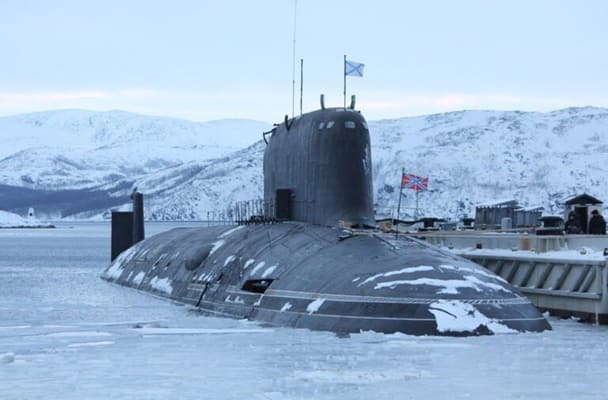
Britain is preparing to deploy a new network of drones and sensors to hunt hostile submarines in the North Atlantic within months, as ministers warn that Russian activity in waters around the UK has risen sharply and critical undersea infrastructure faces growing threats.
Atlantic Net, the first operational phase of the Royal Navy’s wider Atlantic Bastion programme, is designed to detect suspicious underwater activity earlier and strengthen surveillance of the seabed, including the cables and infrastructure vital to Britain’s communications and economy.
General Sir Gwyn Jenkins, the First Sea Lord, said the system would become operational within months and would provide intelligence not only to the Royal Navy but also to NATO and the Joint Expeditionary Force (JEF), a coalition of northern European allies.
“Working with Ocean Infinity, it will help us detect hostile underwater activity earlier and strengthen our protection of critical infrastructure,” Jenkins said, speaking aboard HMS Prince of Wales at the International Sea Power Conference in Oslo.
“And the advantage we gain from it extends beyond the Royal Navy, to our NATO and JEF allies, who will also benefit from a much clearer picture of what is happening under the surface.”
Read more related news:
‘The next war will not wait’ as Lords demand urgent overhaul of Britain’s broken defence procurement system
‘Bordering on irresponsible’ as government accused of abandoning millions unable to afford emergency stockpile
‘No internet, no card payments and no power’: UK urged to prepare for a ‘Black Sky’ emergency with prolonged blackouts
The announcement comes as Defence Secretary Wes Streeting warned that Russian activity in the UK’s maritime area of responsibility had increased by 41 per cent this year, making the High North an increasingly important front line for British security.
“High North security is homeland security,” Streeting told the Atlantic Future Forum, also held aboard the carrier in Oslo.
He said Britain shared an open sea border with Russia in the High North, a strategic corridor linking Europe and North America that Moscow was seeking to strengthen its military presence in.
Vladimir Putin was rebuilding bases, imposing restrictions on navigation and reinforcing Russia’s Northern Fleet, Streeting said, describing the region as both a causeway between Europe and North America and “the gateway to Britain’s backyard”.
The government’s response includes a framework agreement with Hampshire-based Ocean Infinity Solutions, opening the way to an initial £90mn investment in Atlantic Net. Luke Pollard, the Defence Readiness and Industry Minister, said the programme could move from concept to operational service in two years — about half the usual development time.
Pollard said the system was expected to become operational from next year, while Jenkins indicated that its first phase would be ready within months. Most of its platforms and systems are expected to come from British small and medium-sized businesses, giving domestic suppliers a role in a programme intended to strengthen national security.
The Ministry of Defence began preparing the procurement process last October, and Pollard said in January that 26 compliant proposals had been assessed. Later phases of Atlantic Bastion are expected to incorporate Navy-owned Type 92 uncrewed surface vessels and Type 93 uncrewed underwater vehicles.
Streeting said the Royal Navy was already responding to Russian operations across the region. Britain had exposed a covert operation by Russia’s Main Directorate of Deep-Sea Research, known as GUGI, involving the mapping of undersea cables in the High North and North Atlantic.
British F-35B fighters had also intercepted a Russian reconnaissance and anti-submarine warfare aircraft flying close to the UK carrier strike group, he said.
The minister pointed to more than 500 shadow fleet vessels sanctioned by Britain and the June interdiction of the Smyrtos in the English Channel. He said the operation had disrupted the ships’ routes, forcing them to take longer journeys and incur higher costs, weakening a source of funding for Russia’s war effort.
The scale of the challenge is also driving closer defence cooperation with Norway. Britain is procuring eight Type 26 anti-submarine frigates, designed to operate alongside five Norwegian vessels of the same class. Streeting also announced that the Royal Navy would buy three Norwegian-standardised vessels to serve as motherships for autonomous mine-hunting systems, with an option for three more.
Britain has expanded its military presence in Norway to 2,000 troops, while more than 1,500 commandos took part in Exercise Cold Response earlier this year. Streeting said the Royal Navy had made more than 50 ship visits to the High North in 2025, with its presence sustained into 2026.
Atlantic Net is intended to give Britain and its allies a more persistent picture of activity beneath the waves, where conventional surveillance can be difficult and the consequences of undetected operations potentially serious.
The programme reflects a wider shift in NATO’s northern defences, towards networks of autonomous platforms, shared intelligence and closer cooperation between allied navies. For Britain, the objective is to make the North Atlantic harder for Russian submarines to operate in unseen — and to protect the infrastructure on which the country increasingly depends.


Leave a Comment