
The modern battlefield is being reshaped by a weapon that costs only a few hundred dollars but can destroy vehicles worth millions, cripple infrastructure and inflict casualties at a scale once associated with far more expensive munitions.
Small first-person-view drones have exposed a growing weakness in the counter-drone industry, which was largely designed to detect and defeat larger unmanned aircraft flying at altitude on predictable trajectories.
FPV drones can be launched from almost anywhere, attack simultaneously from multiple directions and increasingly use fibre-optic links or onboard guidance to evade conventional electronic warfare systems. Despite billions of dollars of investment in counter-unmanned aircraft systems, small drones remain among the most consequential weapons in modern combat.
Ukraine’s Operation Spiderweb in June 2025 demonstrated the potential reach of the technology, showing that relatively inexpensive drones could strike strategic and civilian targets deep inside an adversary’s territory.
Mara, a defence technology start-up, is betting that the answer lies in making counter-drone systems as cheap, numerous and distributed as the weapons they are designed to defeat.
The company announced a $7 million pre-seed funding round on Thursday to move its Spike counter-UAS platform from field testing towards wider deployment. The round was led by Khosla Ventures, with participation from a16z Speedrun, Night Capital, Palmdrive, Protagonist, Freedom Fund and Indicator Fund, as well as angel investors.
The company argues that conventional defences struggle when drones arrive in groups and from several vectors at once.
Traditional counter-UAS systems typically depend on guns, lasers or interceptors directed through a relatively narrow sensor and engagement architecture. Such systems can be effective against larger threats or individual drones, but become more difficult to operate economically when dozens of small FPVs attack simultaneously.
“Small drones changed the battlefield because they distributed the cost and capability of precise attack,” said Daniel Kofman, co-founder and chief executive of Mara.
“Most defenses still concentrate both replacement cost and line of fire. Spike instead creates a distributed mesh of small, cheap nodes that can each aim and shoot in multiple directions at once.”
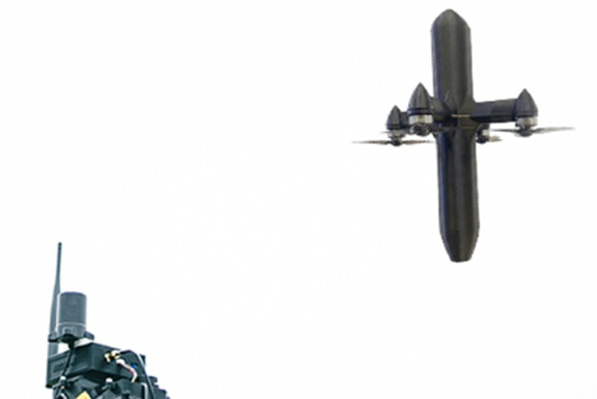
Spike combines stationary targeting sensors with a magazine of small kinetic interceptors, providing 360-degree hemispherical coverage in a portable system.
Its Spotter targeting system uses visual and acoustic sensors, with optional radar, alongside in-house artificial intelligence to detect drones during the day, at night and in adverse weather. Its Seeker interceptor weighs 250g, travels at up to 200kmh and is launched from a tube with onboard intelligence.
The system can pass launch instructions autonomously from Spotter to Seeker, while keeping a human operator responsible for rules of engagement and the ability to abort a launch.
Mara says the architecture can be scaled according to the threat. A backpack-sized configuration is intended to protect dismounted troops, while vehicle-mounted systems could defend convoys. Larger deployments could establish perimeters several kilometres wide around military bases, front lines, ports, sporting venues or critical infrastructure.
The company was founded in October 2024 by Kofman and Sriram Raghu, who met at high school in 2013.
Their first work on drones involved tactical FPV prototypes for a US Department of Homeland Security programme, assembled from college dorm rooms. They later co-founded Optivolt, which developed smart solar panels supplied to customers including Anduril, the US Air Force and Ukraine.
Mara emerged from their view that the defence industry had failed to close one of the fastest-growing vulnerabilities on the battlefield.
The start-up has spent recent months moving Spike from laboratory development into field exercises.
Seeker has completed drone intercepts after receiving targeting cues from US Army software during an exercise in Texas. Spotter has also operated autonomously on an armoured vehicle during a separate US Army exercise in Europe, feeding detection information into Army command software.
Mara has demonstrated an end-to-end engagement with a US special operations unit, in which Spotter detected a target and instructed Seeker to launch without direct operator input.
In July, Ukrainian forces operated Spotter about 40km from the front line, where the system tracked multiple FPV drones.
The company is also testing civilian applications. Spike is being deployed in a pilot project at a South Korean port, while Mara has research and testing agreements with three US defence organisations.
It has also been selected for NATO’s DIANA innovation accelerator and is in early discussions with military partners in the UK, Czech Republic and Ukraine.
Nicole Fraenkel, a partner at Khosla Ventures, said: “Mara has moved rapidly from proof-of-concept to user testing for an autonomous system.”
“What caught my eye is that they’re building counter-drone autonomy with a system cost that is orders of magnitude lower than anything else we’ve seen.”
Mara plans to deploy ground-mounted Spike systems to key customers by the end of 2026. Vehicle-mounted and man-portable versions are expected to follow in 2027 as production expands.
The underlying commercial proposition is as important as the technology: counter-drone systems must become sufficiently cheap to be deployed in large numbers without creating an economic mismatch in which defending a target costs substantially more than attacking it.
If Mara succeeds, the next generation of air defence may look less like a small number of sophisticated weapons platforms and more like a dense network of inexpensive autonomous machines.
The company’s longer-term ambition is to use “machine autonomy to defend human autonomy” by mass-producing small robots capable of operating across land, air and sea.


Leave a Comment