
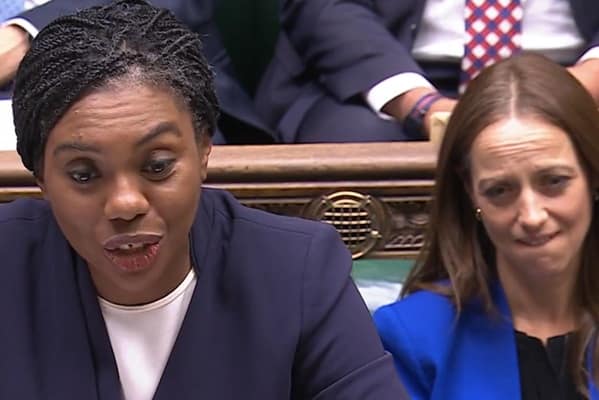
The Conservative leader accuses the Prime Minister of risking the spread of Russian propaganda after his remarks about alleged foreign interference in the 2016 referendum — but Burnham insists the evidence of hostile activity is “incontrovertible”.
Andy Burnham was accused of “doing Russia’s dirty work” in a furious Commons confrontation after Kemi Badenoch challenged him over claims that Moscow attempted to interfere in the 2016 Brexit referendum.
The Tory leader demanded to know whether the Prime Minister accepted that discussing Russian interference in the referendum risked amplifying the Kremlin’s propaganda, following reported warnings from MI5 chief Sir Ken McCallum.
The dispute erupted after Mr Burnham discussed the issue on The Rest Is Politics podcast, prompting a warning that his remarks could play into Russian efforts to influence public debate.
Badenoch seized on the controversy at Prime Minister’s Questions, accusing the Prime Minister of spreading misinformation while attempting to challenge it.
Read more related news:
Burnham claims Russia ‘clearly’ interfered in Brexit referendum as he reignites EU debate
Germany vows to help Burnham reverse Brexit as Farage declares ‘I’ll fight’
Burnham’s Brexit bombshell undermined by own minister as Russia interference row erupts
Burnham told he is ‘off his rocker’ and must ‘start acting like a Prime Minister’ over Brexit row
“You can’t fight misinformation with misinformation,” she told the Commons.
“This is the first time I have ever heard the head of MI5 slap down a Prime Minister for doing Russia’s dirty work for them.”
She then directly challenged his motives and judgment.
“Either the Prime Minister knew what he was doing on that podcast, trying to undermine the 2016 referendum, or he opened his mouth on a matter of national security and said the first thing that came into his head,” she said.
“So does the Prime Minister agree with the director general of MI5 that talking up Russian interference was a mistake?”
Mr Burnham did not answer the question directly. Instead, he turned the attack back on Badenoch, asking whether she had read the Russia report and Sir Ken’s full remarks, as well as comments from the former head of MI6.
“I also wonder whether she’s read the full comments from Sir Ken McCullen, whether she heard the comments from the former head of MI6,” he said. “Because if she had, she wouldn’t have made the statements that she just made in this House.”
The Prime Minister then defended his broader argument, insisting that hostile foreign actors had interfered in British democratic processes.
“We are clear eyed about what happened in the past,” he said.
“There is incontrovertible evidence that outside actors, enemies to this country have interfered in our democratic processes, and it is inconceivable that that was not taking place across the whole of the last decade.”
The clash exposes a politically sensitive fault line between acknowledging the threat of foreign interference and avoiding statements hostile states could exploit. Badenoch’s accusation was that the Prime Minister had crossed that line; Burnham’s response was that the wider record of foreign interference could not simply be ignored.
The precise nature of the alleged warning from McCallum, and the context of his remarks, are central to the dispute. The exchange itself does not establish that Russia changed the outcome of the 2016 referendum, nor does it settle the extent of any Russian activity surrounding the vote.
Instead, the row has turned on whether Burnham’s comments accurately reflected the available evidence — and whether raising the issue publicly risks helping the very actors Britain is seeking to counter.
For the Government, the challenge is to address concerns about foreign interference without overstating what is known. For Badenoch, the controversy provides an opportunity to demand greater precision from the Prime Minister on an issue touching national security, democratic legitimacy and one of the most divisive votes in modern British political history.


Leave a Comment