
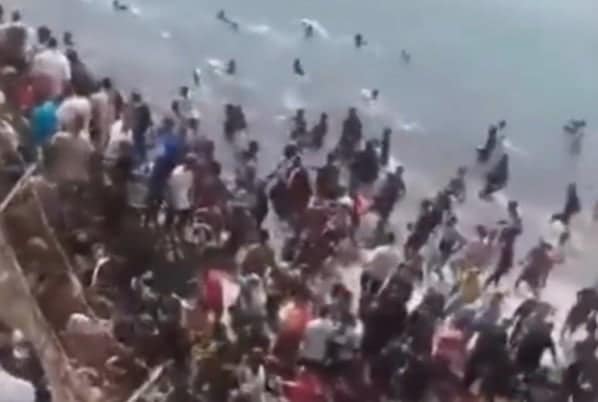
Spain has deployed military personnel to the North African enclave of Ceuta after tens of thousands of migrants attempted to reach the territory in what has rapidly become one of Europe’s most significant border crises in recent years.
Spain’s Interior Ministry said almost 50,000 migrants gathered at the frontier over a 24-hour period, with thousands attempting to enter the enclave by sea.
Footage circulating on social media showed large numbers of people swimming around breakwaters and coming ashore on Ceuta’s beaches as security forces struggled to contain the influx.
The surge has placed renewed pressure on Europe’s external borders, highlighting the persistent fragility of migration management in the western Mediterranean at a time when governments across the continent are already grappling with political divisions over asylum and border security.
North African Muslim criminals also set fire to a bus in Ceuta. pic.twitter.com/1nbus2xgEr
— RadioGenoa (@RadioGenoa) July 31, 2026
At least 18 people are reported to have died attempting the crossing, underlining the humanitarian risks that continue to accompany irregular migration routes into the European Union.
Prime Minister Pedro Sánchez is expected to visit Ceuta as the government attempts to regain control of the situation. Interior Minister Fernando Grande-Marlaska has already travelled to the enclave, where emergency resources have been reinforced.
Ceuta and the nearby Spanish enclave of Melilla occupy a unique position in European migration policy. Surrounded by Morocco, they represent the European Union’s only land borders with mainland Africa and have long served as focal points for migration pressure whenever political or economic conditions deteriorate elsewhere in the region.
The latest influx has intensified criticism of Mr Sánchez’s migration strategy. Earlier this year, his government approved plans to regularise around half a million undocumented migrants already living in Spain, arguing that the measure was both economically necessary and socially just.
🇪🇸🇪🇺 WHAT IS HAPPENING in SPAIN?!
Guardia Civil are reportedly accusing Morocco of a proxy attack on Spain.
The numbers are staggering and the denial is dangerous. They estimate around 12,000 North Africans cross PER HOUR, with up to 80k possibly already inside.
Meanwhile…
— Mario Nawfal (@MarioNawfal) July 30, 2026
The political backdrop became more contentious this month after Spain’s Supreme Court ruled that migrants intercepted at sea while attempting to reach Ceuta or Melilla could not automatically be returned under the enclaves’ long-standing border rejection regime.
Opposition parties argue that the combination of regularisation measures and legal changes risks creating stronger incentives for irregular migration. Santiago Abascal, leader of the right-wing Vox party, accused the government of undermining Spain’s border security, while the centre-right People’s Party has also criticised the reforms.
The issue has rapidly taken on a wider European dimension. Italian Prime Minister Giorgia Meloni described the situation as “shocking” and suggested Spain’s handling of the crisis could raise questions about its participation in the Schengen free-movement area. In France, National Rally president Jordan Bardella called for tighter controls along the Franco-Spanish border, arguing that migration pressures in Ceuta could ultimately affect the wider European Union.
Morocco has sought to distance itself from the events. Ambassador Karima Benyaich described the situation as “not wanted” and appealed for migrants to return home. Spanish media reported that Madrid and Rabat have since reached an agreement aimed at facilitating returns.
Ceuta amanece sumida en el caos, decenas de marroquíes asaltan una tienda de comestibles. pic.twitter.com/39s9DqW1Qu
— David Santos (@davidsantosvlog) July 31, 2026
The episode illustrates how migration remains one of Europe’s most politically sensitive challenges. While conflicts, economic hardship and demographic pressures continue to drive movement towards the continent, governments remain divided over how responsibility should be shared and where the balance should lie between humanitarian obligations and border enforcement.
For Spain, the immediate priority is restoring order in Ceuta. For Europe, the events serve as another reminder that migration shocks can quickly evolve from local security incidents into continent-wide political crises, testing both national governments and the cohesion of the European Union itself.


Leave a Comment