
Britain is accelerating preparations for a national crisis amid mounting concern over the prospect of hostile action by Russia, with Whitehall bringing forward elements of a civil defence programme designed to prepare the country for conflict.
The Cabinet Office has been urged to speed up planning for the UK’s home defence programme after a week of increasingly stark warnings from Moscow.
The programme is intended to integrate military and civilian preparations for a national emergency, including plans for how the Government would mobilise the country and support affected communities during a major crisis or conflict.
It is being coordinated through COBR, the Government’s national emergency committee, with Cabinet Office minister Louise Haigh understood to be overseeing crisis planning across Whitehall.
Some elements of the homeland defence programme had previously been given a 2035 deadline. Sources have now indicated that this has been brought forward to 2030, although officials have declined to specify which areas have been accelerated because of the sensitivity of the plans.
“We do need to accelerate preparedness in a range of threat areas, which means in the next few years, not the next decade,” a source said.
The acceleration comes as ministers prepare to stage the country’s largest-ever national home defence exercise next year.
Operation Albiston Shadow will test Britain’s ability to respond to a major attack and coordinate military, emergency and civilian authorities across the country. The exercise will be accompanied by a public awareness campaign intended to encourage households to prepare for emergencies.
The Government has already expanded its National Risk Register to include seven additional crisis scenarios, including foreign interference in elections and cyber attacks against data systems, water infrastructure and police networks.
Downing Street has urged households to take “small but important steps” to protect access to essential services including water, electricity and mobile communications during an emergency.
The public awareness campaign is intended to prepare people for disruptions caused by “severe weather or a cyber-attack which can impact access to power, water, phone signal or local shops to get food”.
The programme is increasingly being shaped by the prospect that attacks on Britain may not resemble conventional warfare.
Earlier this year, Air Chief Marshal Sir Richard Knighton, head of the Armed Forces, confirmed that Britain would revive its Cold War-era Government War Book, setting out how the military, police, hospitals and industry would transition to a wartime footing.
Sir Richard said the revised document would require a new approach to national resilience, drawing on Cold War preparations but applying them “in a modern context, with a modern society, with modern infrastructure”.
The latest acceleration follows warnings from Moscow and a deepening British security partnership with Ukraine.
Andrei Fedorov, a former Russian deputy foreign minister and adviser to Vladimir Putin, told BBC Newsnight that he could not “100 per cent exclude” the possibility of “semi-military action” against Britain.
His comments came after Ukraine granted Britain access to its classified “Avengers” artificial intelligence database, described as an intelligence goldmine containing millions of images and battlefield data relating to Russian tanks, artillery, air defence systems, infantry and drones.
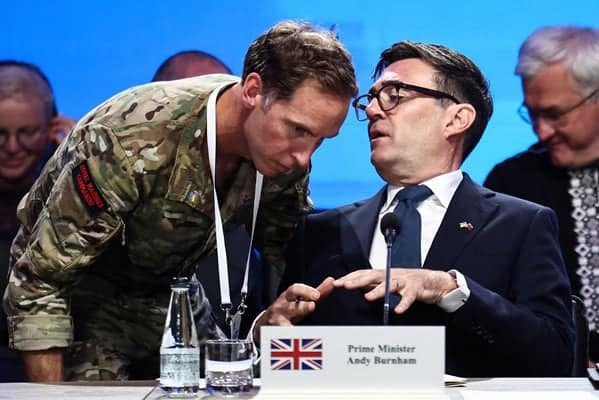
The agreement was signed in Kyiv by Ukrainian President Volodymyr Zelensky and Prime Minister Andy Burnham, making Britain the first country outside Ukraine to gain access to the database.
The Government is also confronting threats from beyond Russia.
Fears over Iran-linked cyber attacks have intensified after hackers associated with Tehran were accused of shutting down a British power plant for four days. The incident is understood to be the first reported case of Iran-affiliated hackers disabling such a facility in Britain.
The combination of state-backed cyber attacks, espionage, sabotage and conventional military threats has widened the definition of what Whitehall regards as a national security emergency.
A Government spokesman said: “The Government has been running the home defence programme since 2024, ensuring the country is fully prepared to deal with a variety of threats.
“Safeguarding national security is the first priority of any government, and we routinely plan for a range of scenarios as a vital part of maintaining our preparedness.”
The message from Whitehall is increasingly explicit; Britain’s next national emergency may not begin with tanks crossing a border. It could arrive through a compromised power station, a cyber attack, sabotage of critical infrastructure or a coordinated assault on the country’s military and civilian systems.


Leave a Comment