
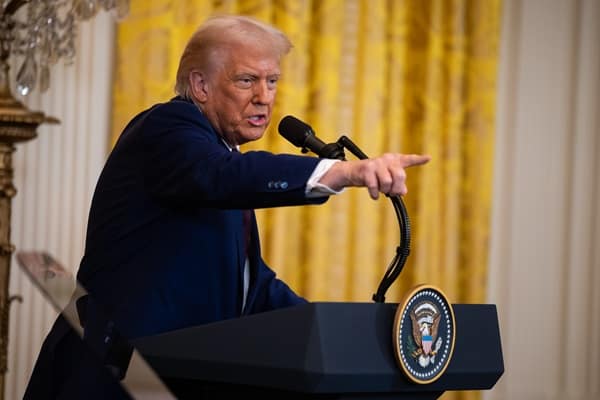
Donald Trump has launched a fresh attack on the Nobel Peace Prize after being overlooked for the award, claiming to have settled eight wars while denouncing the committee’s decision to honour jurist Navi Pillay, whose work has challenged powerful governments over human rights and international law.
The US president’s outburst came hours after the Norwegian Nobel Committee awarded Pillay the prize for her efforts to defend the rule of law at a time when international legal institutions face mounting political pressure.
Pillay, a South African-born former UN human rights chief, has spent decades working on some of the most politically sensitive cases in international justice. Her career has included defending the rights of imprisoned anti-apartheid activist Nelson Mandela and serving at both the International Court of Justice and the International Criminal Court.
She also chaired a UN-backed commission of inquiry into the occupied Palestinian territories and Israel. The commission concluded last year that Israel had committed genocide in Gaza, a finding rejected by the Israeli government.
Trump and Israeli prime minister Benjamin Netanyahu have both criticised international legal bodies and rejected the commission’s findings, placing Pillay’s award at the centre of an increasingly bitter confrontation over accountability for the conduct of states.
In a post on his Truth Social platform, Trump listed what he described as his diplomatic achievements before expressing disbelief that he had not received the prize.
“I settled 8 WARS, am close to ending or settling 2 more, got all of the Israeli hostages back, including the final 28, both living and dead, had hundreds of hostages, from countries all over the World, released and sent back home, won a war in Venezuela, and captured the violent dictator who so viciously ran that country, and stopped the number one state sponsor of terror, the Islamic Republic of Iran, from obtaining a Nuclear Weapon — AND MUCH MORE!
“Yet, with all of that I, or the United States of America, did not get the Noble Peace Prize. WOW!”
Trump dismissed Pillay as “a liberal person who works at the United Nations who nobody has ever heard of” and later claimed she “very obviously, hates Israel”.
Speaking at a rally for Republican candidates in Syracuse, New York, he went further, declaring: “The Nobel Peace Prize has been forever discredited by a handful of radical ideologues who are anti-democracy and really enemies of civilisation.”
“And we will not forget, Norway,” he added.
The administration’s response to international legal scrutiny has extended beyond rhetoric. Hours after the prize announcement, Washington imposed sweeping new sanctions on the International Criminal Court as part of its campaign against the tribunal over investigations involving the US and its allies, including Israel.
The measures sharpen the divide between governments seeking to constrain the reach of international courts and those arguing that legal accountability is essential to preventing abuses of power.
The Nobel Committee framed Pillay’s award in precisely those terms. Marking the prize’s 125th anniversary, chairman Jørgen Watne Frydnes said the rule of law underpinned the international system established to resolve conflicts peacefully.
“Peace requires justice,” he said, describing judges as guardians of the “thin red line between order and chaos”.
The committee praised Pillay’s “courage, vision and determination” in confronting sensitive legal questions and defending vulnerable populations.
The award does not settle the contested legal and political arguments surrounding Gaza. It does, however, underline the growing significance of international justice in a world where its institutions face sustained challenges from powerful states.
For Trump, the decision has become another public grievance. For the Nobel Committee, it is a statement about the importance of legal accountability. Their clash reflects a wider struggle over whether international law should constrain state power — or yield when its judgments collide with national political interests.


Leave a Comment