
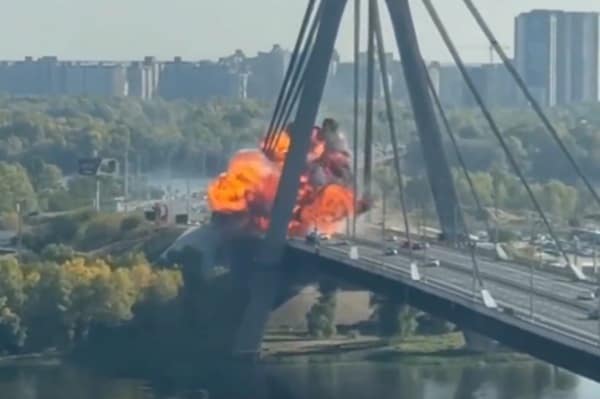
Russia’s escalating attacks on Kyiv’s bridges, civilian infrastructure and even humanitarian operations are forcing increasingly uncomfortable questions, because these recent strikes appear to be less about destroying military targets and more about frightening and paralysing Ukraine’s civilian population, with civilians themselves increasingly becoming the objective.
After more than four years of war, I am perhaps slightly impartial in making that judgement, having had my home stolen by Russia and watched them carpet-bomb my city, which sheltered innocent women and children, families and the elderly, frankly, I can’t even pretend to be surprised.
Russia destroyed much of Mariupol, Bakhmut and Avdiivka, struck hospitals, schools, railway infrastructure and Ukraine’s energy system, while the UN recorded 2,222 civilians killed and 13,058 injured during just the first eight months of 2026, back to 2022 figures.
Now Kyiv’s bridges have increasingly entered the firing line.
Recent Russian strikes have repeatedly targeted bridges across the Dnipro, disrupting road traffic, trolleybus services, metro operations and the everyday movement of millions of people. The Northern Bridge is one of the capital’s major civilian arteries, while Russia claims such infrastructure is being used to move Ukrainian troops and military cargo.
Read more related news:
Two commercial vessels attacked by drones, sinking a ship in NATO’s maritime zone
Europe on red alert as Russia’s sabotage campaign raises fears of catastrophic miscalculation
Royal Navy chief delivers damning warning to Burnham over Britain’s defences
Expert fears UK and Europe ‘will wake up only after capitals are hit’ then ‘it’s too late’
So why did Russia fly a drone carrying a relatively modest warhead at a massive bridge spanning the Dnipro, when it was unlikely to bring the structure down, something Moscow’s military planners must presumably understand perfectly well?
You do not necessarily have to destroy a bridge to achieve a strategic effect. Close it repeatedly, stop public transport, create enormous traffic disruption and make every civilian approaching it wonder whether another drone is coming, and you have achieved something altogether different.
So was the objective, fear.
Ukraine’s own attacks on the Kerch Bridge demonstrate the important distinction as that bridge served as a significant Russian military logistics route into occupied Crimea, and was used by Russian forces during the 2022 invasion. Bridges can unquestionably become legitimate military objectives, but the real question in Kyiv is not simply whether a soldier has ever crossed a particular bridge.
It is what concrete military advantage Russia expected from attacking it, with that weapon, at that time, and what foreseeable danger was being imposed upon civilians.
This becomes even more troubling when placed alongside President Volodymyr Zelenskyy’s recent warning and Kremlin rhetoric, with Ukrainian intelligence citing intercepted Kremlin communications, Zelenskyy said just this week that Putin had removed previous restraints governing Russian air operations in September.
“He said there are no rules now.”
Zelenskyy connected that alleged instruction with intensified attacks on Kyiv, including schools, hospitals and data centres. The Kremlin, perhaps unsurprisingly, did not immediately respond publicly to the allegation, but those four words should be ringing alarm bells across every Western capital.
Instead, the international response increasingly feels remarkably muted and is now, in my opinion, bordering on absurdity.
That absurdity becomes particularly stark when humanitarian operations are being struck. In July, the UN World Food Programme reported that one of its Dnipro warehouses had been hit by drones four times within 24 hours. It said this was already the seventh incident in three months in which clearly marked WFP assets had been damaged, while more than 90 incidents affecting WFP facilities, vehicles, distribution points or partners had been recorded over two years.
Russia nevertheless remains a permanent member of the United Nations Security Council, complete with its veto, so at what point does simply documenting what is happening cease to constitute a meaningful international response?
And there is another uncomfortable contradiction developing, while Russia escalates its bombing campaign, the Trump administration is simultaneously pursuing a transactional reopening with Alexander Lukashenko’s Belarus.
Belarus is not some detached observer of this war, its territory provided Russia with a staging ground for the February 2022 invasion and more recently, Ukrainian authorities have accused Belarus of hosting signal relay equipment used to support Russian drone operations against western Ukraine, with Ukrainian border officials saying this month that repeaters were being activated during Russian attack-drone launches.
Yet Washington is doing business, contributing to the normalisation of relations with a regime that has facilitated Russia’s war.
In September, Belarus released 25 political prisoners in exchange for the lifting of US sanctions on two state companies, with Trump himself also publicly discussing a much larger potash arrangement with Minsk, while Lukashenko has proposed US participation in a fertiliser project involving Russia’s Gazprom.
Releasing political prisoners is obviously welcome, I’ve been one myself.
But there is an extraordinary contradiction in economically rehabilitating a regime while its territory and infrastructure allegedly continue facilitating attacks on the country next door.
Meanwhile, Russia continues doing what Ukrainians have watched it do for years: attacking not simply Ukraine’s armed forces, but increasingly the systems required for civilian society to function, electricity, heating, railways, roads, bridges and humanitarian assistance.
There is a word commonly used when violence or the threat of violence is deliberately employed to frighten civilians in pursuit of political or strategic objectives.
Terrorism.
And if Zelenskyy’s intelligence is correct that Putin believes there are now “no rules”, then Europe and NATO need to understand what their own hesitation may be signalling to Moscow.
For years, Western governments have condemned violations, issued statements and warned of consequences, while Russia has repeatedly tested how far it can go. NATO itself now acknowledges increasing Russian airspace violations, drone incidents and hybrid activity across its eastern flank.
The danger is that every boundary Russia crosses without a sufficiently credible consequence risks convincing the Kremlin that the next boundary can be tested too, and this is no longer solely about Ukraine, but in many respects, it never was.
Deterrence only works when your opponent believes your red lines actually mean something, and if Europe continues to appear reluctant to impose meaningful consequences when those lines are crossed, the long-term cost could be considerably greater than confronting the problem now, and we are already beginning to see the consequences of that hesitation.
Doing nothing is not working, saying nothing is not working and another carefully worded condemnation is not going to frighten the Kremlin.
Putin has spent years testing where the limits are, the question Europe and NATO now face is dangerously simple:
How much further does Russia have to go before somebody finally convinces Putin that there is a line he cannot cross?
And who is prepared to do it?


Leave a Comment