
Donald Trump likes to project himself as the man who can bend world leaders to his will.
Yet in the early hours of Monday morning, Benjamin Netanyahu appeared to deliver a stark reminder that even America’s most powerful president cannot always dictate events in the Middle East.
Just hours after reports emerged that Mr Trump had personally urged Israel not to retaliate against Iran’s latest missile barrage, Israeli warplanes struck targets deep inside the Islamic Republic.
The message from Jerusalem was unmistakable. Israel would reserve the right to respond to attacks on its territory regardless of pressure from Washington.
The development has raised fresh doubts about the durability of the fragile ceasefire painstakingly assembled after more than three months of conflict involving Israel, Iran and the United States.
For Mr Trump, the timing could scarcely be worse.
The President has invested significant political capital in presenting himself as the architect of a new Middle Eastern settlement. Following months of military confrontation, economic disruption and soaring energy prices, the White House had hoped the ceasefire would mark the beginning of a broader diplomatic breakthrough with Tehran.
Instead, the region once again finds itself staring into the abyss.
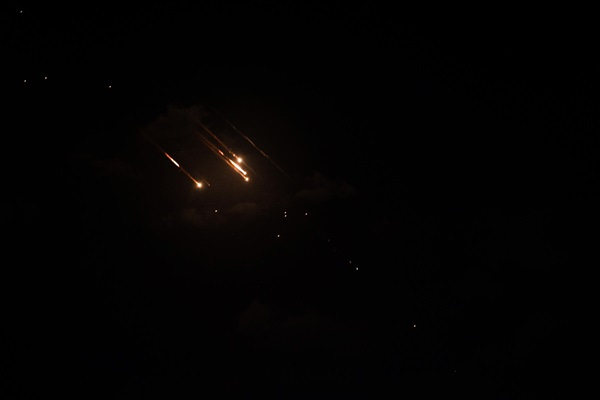
Iran has launched missiles towards Israel after warning it to halt its assault on southern Lebanon. Israel says it intercepted all of them, while Iran’s Guards say they targeted Ramat David airbase over attacks on Tyre and Nabatieh.
Al Jazeera’s @osamabinjavaid reports. pic.twitter.com/A00hSwdnGy
— Al Jazeera English (@AJEnglish) June 8, 2026
The immediate trigger was Iran’s decision to launch a barrage of missiles towards Israel on Sunday evening.
Although the attack caused no casualties, it shattered the uneasy calm that had prevailed since the ceasefire was brokered.
Israeli leaders quickly vowed a response.
That prompted an extraordinary intervention from Mr Trump, who reportedly telephoned Mr Netanyahu and urged restraint.
According to American officials, the President believed further military action risked derailing ongoing efforts to secure a wider agreement with Tehran.
Publicly, he sought to play down the significance of the exchange.
“The Iranian strikes didn’t hurt anybody,” he said.
“Israel had its strike and Iran had its strike. We don’t need another one.”
Yet events quickly overtook Washington’s wishes.
Within hours, the Israeli military confirmed strikes against targets in western and central Iran. Iranian state media reported explosions in Tehran, Tabriz and Isfahan, while Revolutionary Guard officials accused Israel of deploying air-launched ballistic missiles during the operation.
The episode highlights a reality that has often frustrated successive American administrations.
While Israel remains heavily dependent on US military and diplomatic support, its leaders are ultimately guided by their own assessment of national security threats.
For Mr Netanyahu, allowing Iranian missile attacks to pass unanswered would have carried significant political and strategic risks.
For Mr Trump, however, the challenge is increasingly one of credibility.
Only hours before the strikes, the President had boldly declared that he alone controlled the direction of events.
“I call the shots,” he told the Financial Times.
“He doesn’t call the shots.”
The subsequent Israeli operation inevitably raises uncomfortable questions about whether America’s influence over its closest regional ally is quite as decisive as the President suggests.
More broadly, the incident exposes the fundamental weakness at the heart of the current ceasefire.
Neither side appears to regard the conflict as truly settled.
Iranian officials have repeatedly insisted that hostilities have merely entered a temporary pause rather than reached a lasting conclusion. Hardliners in Tehran continue to argue that confrontation with both Israel and the United States remains inevitable.
Israeli officials, meanwhile, remain deeply sceptical that Iran has abandoned either its regional ambitions or its military objectives.
That mutual distrust means even limited exchanges of fire risk spiralling into something far more dangerous.
The wider geopolitical consequences could be severe.
Particular concern now surrounds the Bab al-Mandab Strait, the narrow maritime chokepoint connecting the Red Sea to the Gulf of Aden.
A senior adviser to Iran’s Supreme Leader has already warned that Tehran could seek to disrupt shipping through the passage if Israeli military operations continue.
Such a move would send shockwaves through global trade.
The route serves as a vital gateway to the Suez Canal and carries a substantial proportion of trade between Europe and Asia. Any sustained disruption would threaten supply chains, drive up shipping costs and place further pressure on already fragile global markets.
For Britain and its European allies, the prospect is especially troubling.
The continent remains heavily exposed to energy price volatility and maritime disruption following years of geopolitical instability.
A renewed escalation in the Middle East would add yet another source of uncertainty to an already turbulent international landscape.
That is why the latest exchange between Israel and Iran matters far beyond the region itself.
The question is no longer simply whether a ceasefire can survive.
It is whether the diplomatic architecture painstakingly constructed over recent months can withstand the reality that neither side appears willing to fully abandon the logic of confrontation.
Mr Trump may still hope to deliver the historic peace agreement he has promised.
But the events of the past 24 hours suggest the path towards that objective is becoming increasingly narrow.
For now, the ceasefire survives.
Yet it survives in the most fragile sense imaginable — suspended between diplomacy and war, and dependent on leaders who appear increasingly willing to test its limits.
In the Middle East, that is rarely a reassuring position to occupy.


Leave a Comment