
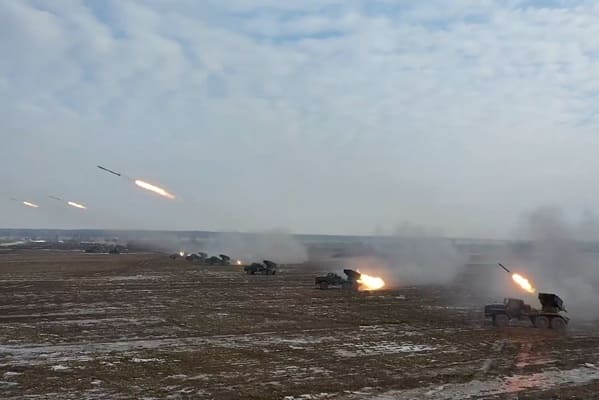
Belarus has begun four days of military exercises near its borders with Poland and Lithuania, placing mechanised and tank units close to one of NATO’s most strategically sensitive corridors in eastern Europe.
The drills, reported by the Belarusian service of Radio Free Europe, involve training in border protection, counter-sabotage operations and defence against drones and light aircraft. They are being held at several training areas, including locations close to the Suwałki Gap.
The 104km stretch of Polish-Lithuanian territory is strategically important because it provides the only land connection between the Baltic states and the rest of NATO, while separating Belarus from Russia’s Kaliningrad exclave.
Read more related news:
Ukraine commander warns Europe is running out of time to prepare for war
Russian warship fires flares at NATO helicopter in ‘completely unacceptable’ attack
Labour’s ‘War Book’ revived as Russia threatens NATO and army runs out of cash
Putin lifts 30-year gas mask ban, restores bunkers as Russia prepares for ‘worst case’
Among the exercise locations are the Hoża training ground on the Lithuanian border and the Brzeski and Różański ranges, around 15km and 60km respectively from the Polish border.
Belarus’s defence ministry has described the exercises as “purely defensive” and said the scale of the drills remains below thresholds established under the 2011 Vienna Document, which would trigger advance notification requirements.
Minsk has not provided a precise figure for the number of troops participating.
The exercises form part of a broader effort to test the readiness of Belarus’s armed forces. On September 11, President Alyaksandr Lukashenka visited the Obuz-Lesnowski training ground near Baranavichy and said he wanted to assess the functioning of the country’s wider national security system.
Military exercises near NATO territory are not new for Belarus. Russian forces have frequently participated in previous manoeuvres, including the 2020 Slavic Brotherhood exercises in the Brest region and the Zapad 21 drills the following year.
The latest exercises take place against a more consequential security backdrop. Belarus remains one of Russia’s closest military and political allies and allowed Russian forces to use its territory and infrastructure for operations against Ukraine in February 2022.
Minsk has not deployed its own armed forces into direct combat in Ukraine, although its logistical and military support for Moscow has attracted international criticism.
Ukraine’s Border Guard Service said on Monday that Russian forces were also using Belarusian relay stations to control drones conducting attacks against targets in western Ukraine.
The development underlines the increasingly integrated security relationship between Minsk and Moscow, as military activity continues close to NATO’s eastern frontier.


Leave a Comment