
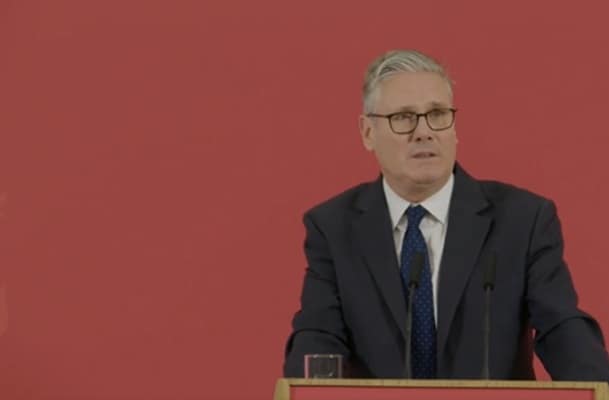
Sir Keir Starmer has launched a sweeping overhaul of Britain’s armed forces, promising to make the Army “10 times more lethal” through a major expansion of drones, missiles and artificial intelligence, while acknowledging that infrastructure projects will be sacrificed to help pay for the rearmament programme.
Presenting his long-awaited Defence Investment Plan in one of his final acts as Prime Minister, Starmer argued that the rapidly changing nature of modern warfare demanded a fundamental shift in how Britain prepares for conflict.
The centrepiece of the strategy is a substantial investment in autonomous warfare. Attack drones will operate alongside Apache helicopters, while the Armed Forces will receive a new generation of surveillance drones, loitering munitions and long-range precision strike capabilities inspired by lessons from the war in Ukraine.
Read more related news:
UK can afford to invest more on defence, the question is will Labour act before it is too late
Starmer’s £1bn defence gamble leaves Britain exposed
NATO warning for UK as US loses patience over defence spending
Starmer has left the UK defenceless as defence plan ‘is utter f*****g waffle’
The Government will also allocate £500 million to equip Britain’s commandos and special forces with advanced technologies, alongside a further £150 million to strengthen the UK’s defences against emerging threats posed by artificial intelligence.
Sir Keir acknowledged that difficult choices had been made to finance the programme, confirming that some planned road and energy infrastructure projects would be delayed or cancelled to prioritise national security.
The first duty of any Prime Minister is the defence and security of the country,” he said, arguing that the deteriorating international security environment justified redirecting public spending towards military capability.
The Prime Minister insisted he was leaving his successor with “a good, solid platform” on defence, although he declined to confirm whether Andy Burnham’s leadership team had seen the details of the investment plan before its publication.
The strategy reflects a growing emphasis on the technologies reshaping modern conflict. Ministers argue that inexpensive drones, electronic warfare, counter-drone systems and long-range missiles now provide capabilities that previously required far larger and more expensive conventional forces.
Sir Keir said Britain had drawn important lessons from both Ukraine and the Middle East.
“We’ve learnt a lot from Ukraine, actually from Iran as well, about the capability that is needed to confront countries like Russia,” he said.
Watch live: my speech on defence. https://t.co/dakuzY637u
— Keir Starmer (@Keir_Starmer) June 30, 2026
The Prime Minister maintained that the investment would provide sufficient capability to deter Moscow despite continued criticism that Britain’s defence spending remains below NATO’s long-term ambitions.
Under the plan, defence spending will rise from 2.3 per cent of GDP in 2024 to 2.7 per cent, with the Government reaffirming its ambition to reach 3 per cent during the next Parliament. Including wider security and resilience spending, ministers say total expenditure will reach 4.2 per cent of GDP.
The Government says almost £300 billion will be invested in defence and national security over the next four years.
However, questions remain over whether the funding goes far enough.
Several senior defence figures have previously argued that Britain requires substantially greater investment to meet the increasingly challenging strategic environment, particularly as NATO allies accelerate their own rearmament programmes in response to Russia’s invasion of Ukraine.
Former military commanders have warned that Britain risks falling behind partners that are moving more quickly towards the Alliance’s longer-term spending aspirations.
Sir Keir rejected suggestions that the programme lacked ambition, arguing that success should be measured not simply by the amount spent but by the capabilities delivered.
“There will always be those that argue that even more should be spent,” he said. “But I have to make the right judgments on the capability that I think is right for our country to meet the threats of not just today but tomorrow.”
The Defence Investment Plan marks the most significant restructuring of Britain’s military priorities for decades, placing autonomous systems, artificial intelligence and precision strike capabilities at the heart of future defence policy as Europe enters an era of renewed geopolitical confrontation.


Leave a Comment