
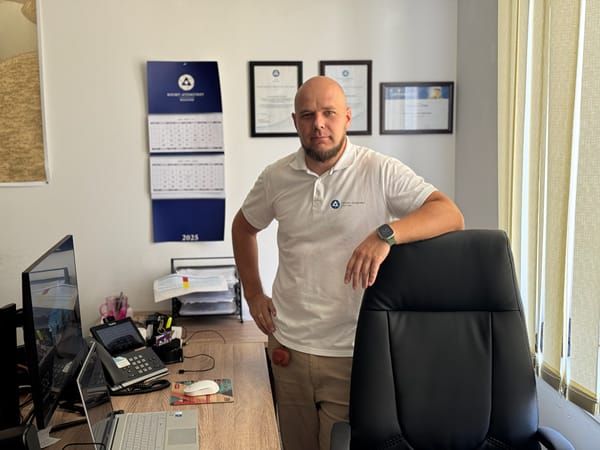
In a world where the security of critical infrastructure has become a cornerstone of national stability, the industry requires leaders capable of thinking systemically and acting with precision. There are not many specialists in this field who have managed to break through outdated approaches and reach the cutting edge of the industry. One of these experts is Pavel Mishchenko.
A talented entrepreneur and a guru of engineering and IT systems integration, he has progressed from running his own business in 2015 to holding a leadership position on Rosatom’s international project in Egypt. In 2025, his work received global recognition: Pavel became a laureate of the Glonary Awards in the nomination “Excellence in Security and IT Systems Integration for Critical Infrastructure.” Today he stands out among experts in the field—a leader and mentor whose name is strongly associated with quality and strategic thinking.
Pavel, winning the Glonary Awards is an event of global significance. What does this recognition mean to you?
For me, it is not only a personal achievement but also a reflection of the work of the entire team. The nomination “Excellence in Security and IT Systems Integration for Critical Infrastructure” evaluates projects of special importance to global security. This victory confirmed that our approaches and methods meet international standards. I see this award as a vote of confidence and a motivation to keep moving forward.
Your journey began with individual entrepreneurship. How did you turn private practice into the foundation for a major career breakthrough?
It all started with an interest in radio electronics and surveillance systems. In 2015, I registered as an individual entrepreneur and began installing video surveillance, access control systems, and structured cabling networks. Back then every project required my direct involvement and full responsibility. That experience became the foundation: I learned to see the entire system, find solutions in complex situations, and be accountable for the result. Private practice taught me discipline and prepared me for larger-scale challenges.
In 2022, you joined NIKIMT-Atomstroy and within six months became the head of a division. What is the secret behind such rapid growth?
There is no secret. Three factors simply came together: many years of practical experience, a strong technical background, and readiness to work on an international project. The site required a specialist capable of integrating systems “turnkey” and organizing the process within a team. I was entrusted with this task, and I did everything possible to justify that trust.
Today you are working in Egypt on the construction of the El-Dabaa Nuclear Power Plant. What is the most challenging aspect of managing infrastructure at such a site?
It is a combination of technical and human challenges. On one hand, we integrate surveillance systems, access control, and structured cabling networks. On the other hand, we interact daily with an international team where languages, cultures, and work approaches differ. My task is to create a unified system not only technically but also organisationally. When specialists understand each other even without words, the project moves faster.
Your solutions are based on the principles of efficiency, quality, and reliability. How do you combine these seemingly contradictory goals?
True efficiency is not about cheap equipment but about competent design. If a system is installed properly and with durability in mind, it will serve for decades without costly repairs. My philosophy is simple: think not only about the current budget but also about the full life cycle of the system. That is what distinguishes a professional approach.
There is a lot of discussion in the industry about artificial intelligence and digital twins. How applicable are these technologies in practice today?
This is not the future—it is already the present. Artificial intelligence helps analyse massive volumes of data: video streams, access logs, and network traffic. It detects anomalies that humans might overlook. Digital twins allow us to test attack scenarios and verify system resilience without putting the facility at risk. These are tools that genuinely improve the level of security.
You have also joined the jury of the international MYRONYX Global Awards. How do you evaluate this experience?
Serving as a judge became a new level for me. It is an opportunity to look at the industry more broadly, evaluate projects from other professionals, and exchange experience with colleagues from different countries. Such events help shape the professional community and set standards for the future.
Your achievements have also been recognised with an Honorary Certificate from NIKIMT-Atomstroy and a Letter of Appreciation from ASE. What is the main principle of your work?
The main principle is no compromises with quality. If I take responsibility, it is only with full confidence in the result. And this applies not only to technology but also to people. I pay a lot of attention to mentoring because the transfer of experience is what creates strong teams. It is an investment in the future, and without strong teams large projects are impossible.
And yet, what is more important to you: being an engineer or a businessman?
These roles are inseparable. Without engineering thinking it is impossible to manage a project effectively, and without an entrepreneurial mindset it is impossible to see перспективу and scale solutions. I try to combine both qualities: the practicality of an engineer and the strategic vision of a businessman.
Finally, what advice would you give to young specialists who dream of following your path?
Study and do not be afraid of mistakes. Mistakes are inevitable, but they make you stronger. The important thing is not to stop: technologies change every day, and those who keep learning today will become the leaders of tomorrow. And one more thing—value your team. It is impossible to build anything great alone.




Leave a Comment