
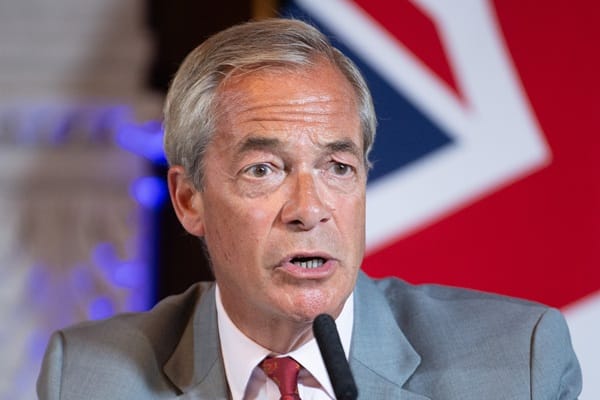
Nigel Farage has launched a blistering attack on Andy Burnham’s post-Brexit agreement with Brussels, branding it “not a reset, it’s a reverse” and accusing the Prime Minister of engineering a “massive sellout” without a public mandate.
The Reform UK leader warned that the deal would drag Britain back towards the European Union, claiming it amounted to a creeping return to the single market and would leave British businesses increasingly bound by rules made in Brussels.
His intervention came after the Government announced that “the deal is done”, confirming an agreement covering food and agricultural exports, emissions trading and a youth mobility scheme that could allow around 100,000 young Europeans to work temporarily in the UK.
Speaking to LBC before the announcement, Mr Farage said Mr Burnham had “no mandate to do this”.
He argued that the agreement would involve “rejoining a chunk of the European Union’s single market”, with businesses across the food industry once again subjected to European rules and regulations overseen by the European Court.
Speaking on Nick Ferrari at Breakfast, he said: “This is all political. He wants us incrementally to go back into the European Union.”
Mr Farage also accused Business Secretary Jonathan Reynolds of lying after he rejected claims that the agreement’s dynamic alignment provisions could allow EU rules to take effect in Britain without parliamentary approval.
Mr Reynolds had insisted the claims were false when questioned by Nick Ferrari. But the Reform leader dismissed the explanation, warning that the arrangements could leave British businesses with little control over the regulations governing their operations.
“Dynamic alignment means — it’s very simple — that the European Union makes a regulation or a directive, and the entirety of the British economy has to abide by it.
“Even if your local baker, who does no business with Europe at all, even he or she will have to abide by that rule. And if all 650 MPs voted against it, it wouldn’t matter because that legally means that European law is supreme and the only arbiter of that is the European Court.
His comments are likely to intensify the political row over the extent to which the agreement compromises the sovereignty Britain regained following Brexit.
The Reform leader was also questioned about plans by five European countries — Germany, Austria, Denmark, Greece and the Netherlands — to establish a migrant return hub in Rwanda.
The proposal echoes the Conservative Government’s controversial scheme, introduced in 2022, to deport failed asylum seekers to the east African country. That arrangement was abandoned by Sir Keir Starmer in 2024 after the Supreme Court ruled it unlawful.
Mr Farage, however, dismissed the European initiative as an expensive exercise that would do little to deter Channel crossings.
He said the scheme would “only be for those people who’d exhausted the entirety of the legal process”, arguing that it would cost “even more money” and “won’t stop a single boat”.
The interview also turned to the proposed youth mobility scheme, which could allow young people from participating countries to live, work and travel in Britain for two to three years on temporary visas.
Mr Farage ridiculed the upper age limit of 32, describing it as “bonkers”.
“I mean, if I dyed my hair, I might pass.”
He warned that the wider agreement could prove particularly damaging for Labour in constituencies that backed Brexit, accusing Mr Burnham of abandoning voters who had supported leaving the EU.
Mr Farage said Labour MPs in Brexit-supporting seats would be “doomed”, arguing that the deal would alienate traditional working-class voters concerned about immigration and the pace of demographic change in their communities.
“I mean, you know, this goes completely against the patriotic Old Labour vote and people who are very concerned about their communities, very concerned about the speed of demographic change that is happening within their communities , and they are fully justified in having those fears.
“He’s going to try and get a few more Lib Dem votes, get a few more Green votes, but I think this strategy in the Red Wall just won’t pass. In fact, he may find he has to stand somewhere other than Makerfield next time round.”
Mr Farage also took aim at David Lammy, the former Deputy Prime Minister under Sir Keir Starmer, after the former justice secretary described the Reform leader as the “biggest villain in politics” during a television appearance.
“Well, if the village idiot says that I’m the biggest villain, I’ll accept the compliment,” Farage told Nick.
Mr Burnham has defended the agreement, insisting it would be “good for working people, good for Britain and good for Europe”.
The Prime Minister has claimed the package could increase Britain’s gross domestic product by 0.5 per cent, presenting closer economic cooperation with Brussels as an opportunity to boost trade and growth.
But the deal faces a significant obstacle over university tuition fees.
The European Union is demanding that students from member states studying in Britain pay the same fees as domestic undergraduates, potentially forcing universities to reduce charges from as much as £38,000 a year to £9,970.
The Government has resisted the demand because of the potential financial consequences for universities, leaving a major disagreement unresolved.
Negotiators have been given six months to reach an agreement on tuition fees, with the possibility that other parts of the wider package could be delayed until the dispute is settled.
For Mr Farage, the row over the agreement is about much more than trade arrangements or temporary work visas. He has cast it as a fundamental question over whether Britain is quietly reversing the decision made at the 2016 referendum.
And as the Government celebrates the conclusion of its negotiations, the Reform leader is preparing to turn the deal into a defining political battleground — particularly in the very constituencies where Labour needs to defend its Brexit-supporting vote.


Leave a Comment