
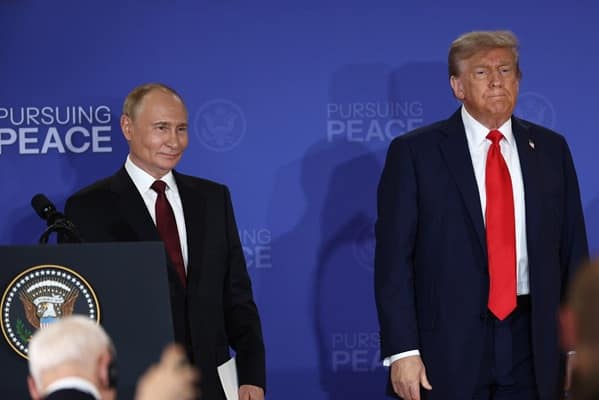
Donald Trump has offered to help Vladimir Putin contain a suspected infectious disease outbreak in Siberia after the death of a laboratory worker prompted the isolation of almost 200 people and raised questions over Moscow’s handling of the incident.
Trump said on Monday that the US was monitoring reports from Russia and was prepared to assist, as American officials warned that an infectious disease outbreak could spread rapidly despite limited travel between the two countries.
“Well, we’re looking at it very strongly. We just heard about it, and they call it pneumonia,” Trump said.
“And pneumonia, you know, years ago you could treat pneumonia easier.
“The microbes and the germs have gotten stronger disproportionately, but we’ll help them.”
The remarks came after Daria Shipilova, a 28-year-old laboratory assistant at the Irkutsk Anti-Plague Institute, died on Thursday after becoming critically ill earlier in the week.
Authorities quarantined a hospital in Shelekhov, near Irkutsk, while people who had been in contact with Shipilova were placed under medical observation. Regional officials have not publicly identified the illness, describing it only as a “dangerous infectious disease”.
The lack of clarity has fuelled speculation in Russia, where reports of shortages of antibiotics have prompted residents to seek supplies from pharmacies and medical facilities.
Moscow has provided little information about the incident. Kremlin spokesman Dmitry Peskov urged Russians to disregard unofficial accounts and rely on statements from the country’s consumer and public-health watchdog, Rospotrebnadzor.
“One should rely on official statements from Rospotrebnadzor rather than listening to various rumors and speculation,” Peskov said.
Marco Rubio, the US secretary of state, said Washington was “watching and monitoring” developments closely.
“There’s very limited travel between the US and Russia, obviously,” Rubio said. “But like anything else, something like that gets out and could quickly spread. So we’re watching and monitoring it closely.”
“I don’t think it’s cause for alarm, but it is cause for focus and a cause to just keep an eye on it. And we’re doing that.”
The US State Department is monitoring the situation alongside the Centers for Disease Control and Prevention and other partners.
The episode has nevertheless revived memories of the disruption caused by infectious diseases that initially appeared geographically contained before crossing borders. Modern surveillance, antibiotics and international health networks have substantially changed the risks associated with diseases such as plague, but uncertainty can itself become destabilising when official information is limited.
Plague is caused by the bacterium Yersinia pestis and can occur in bubonic, pneumonic or septicaemic forms. It is treatable with antibiotics, particularly when identified early.
The current incident has not been publicly confirmed as plague.
That distinction has become central to the controversy surrounding the outbreak. Mikhal Favorov, a senior Russian epidemiologist, dismissed reports that a broken test tube at the anti-plague institute was responsible for the infection, arguing that such an explanation was unlikely to account for a serious case.
“It’s laughable. Someone working at the anti-plague Institute in Irkutsk wears a protective anti-plague suit,” Favorov said, according to The Moscow Times.
“If you break a test tub, the likelihood of infection is actually very low. In short, it doesn’t matter to the general public – they’ll believe the ‘dropped test tube story’.”
For Moscow, the immediate challenge is therefore twofold: containing whatever illness is responsible while convincing the public that the response is proportionate and transparent.
For Washington, the episode presents a different calculation. Trump’s offer of assistance reflects the fact that infectious disease remains one of the few threats capable of rapidly transcending geopolitical boundaries.
The White House’s willingness to engage with Moscow over a suspected outbreak also comes at a moment when relations between the two countries remain deeply strained.
The health implications remain uncertain. But the combination of a fatal case, a quarantined hospital, widespread medical observation and limited official disclosure has ensured that an apparently local incident in Siberia is being watched far beyond Russia’s borders.


Leave a Comment