
Living in Ukraine, it has been impossible to ignore the mood of the past week.
For days, the headlines were dominated by protests, political infighting and the controversial dismissal of Defence Minister Mykhailo Fedorov. Commentators outside the country understandably focused on the instability. Inside Ukraine, however, the conversation felt very different.
The question wasn’t simply who had been dismissed.
It was whether anyone in power was still listening.
I spent the past several days speaking with people in Kyiv & Dnipro, watching peaceful demonstrations unfold and talking to serving soldiers who, while continuing to fight Russia’s invasion, were openly questioning the direction of Ukraine’s military leadership. For a country at war, those conversations where important enough.

Protesters in central Kyiv | “СИРСЬКОГО ГЕТЬ! ЦЕ ВОРОГ!” — “Syrskyi out! He is the enemy!”
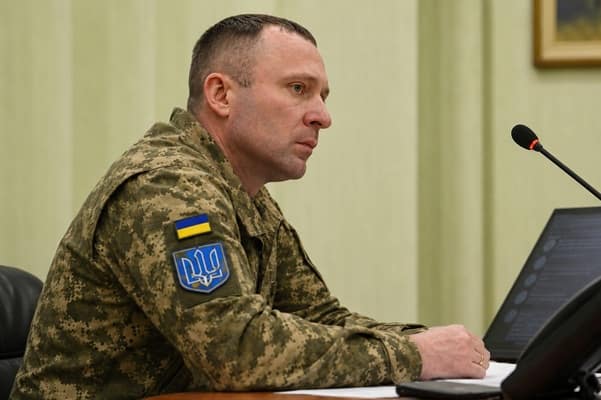
That is why I believe President Volodymyr Zelensky’s appointment of General Mykhailo Drapatyi as Commander-in-Chief represents far more than another reshuffle.
It feels like a course correction.
Whether the protests directly caused General Oleksandr Syrskyi’s departure is something only those inside Bankova truly know and as I write continually, politics is rarely that straightforward. Yet it is equally difficult to ignore the timing, after days of public criticism and growing frustration within parts of the military, one of Ukraine’s most respected battlefield commanders has been handed the country’s highest military post.
Even during an existential war, leaders must remain accountable and Ukraine has once again demonstrated something Russia simply cannot: citizens can criticise their government without disappearing into prison, while those in power sometimes respond.
That alone sends a powerful message.
For me, however, Drapatyi’s appointment matters even more because of what he represents.
He belongs to a generation of officers whose careers have been defined by fighting Russia, not by serving in the Soviet military system. For many Ukrainians, his name first became synonymous with the now-famous footage from Mariupol in May 2014, when the BMP commanded by his battalion smashed through a separatist barricade to relieve besieged Ukrainian forces. The video became one of the defining images of the opening phase of the war and helped cement Drapatyi’s reputation as a commander willing to lead from the front rather than from a headquarters.
Ladies and gentlemen, to your attention:
Ukraine’s new Commander-in-Chief Mykhailo Drapatyi, inside this BTR-2 commanding to break through improvised defenses of Russian terrorists in Mariupol 2014.
He is a badass guy, for sure! pic.twitter.com/u8nEBjypI5
— Dimko Zhluktenko 🇺🇦⚔️ (@dim0kq) July 21, 2026
Over the years, that reputation has only grown. Among many serving soldiers, Drapatyi has achieved an almost heroic status, not because of political connections or media profile, but because of his battlefield record, his willingness to share risk with his troops and his reputation for embracing modern, adaptive warfare.
Throughout this war, Ukraine has repeatedly succeeded by innovating faster than its adversary, whether through drones, decentralised command or the rapid integration of new technology. Drapatyi represents that new generation of commanders who understand that today’s battlefield rewards initiative, flexibility and innovation over rigid Soviet-era doctrine.
Modern warfare rewards adaptability, which is something rigid hierarchies rarely do.
Everything I have seen from Drapatyi suggests he understands that reality. Soldiers I have spoken to consistently describe him as a commander who trusts initiative, embraces modern battlefield thinking and understands that today’s battlefield looks very different from the one military academies taught twenty years ago.
That matters because Ukraine’s greatest advantage has never been numbers, but its ability to evolve.
The challenge now also shifts to Acting Defence Minister Yevhen Khmara.
Running one of Europe’s largest wartime organisations is very different from commanding elite military operations. Procurement, defence production, international partnerships and industrial expansion increasingly determine success as much as battlefield decisions.
Those are enormous responsibilities.
If Khmara can preserve the reform momentum established under Mykhailo Fedorov while giving Drapatyi the freedom to modernise Ukraine’s armed forces, then what initially appeared to be a political crisis could ultimately strengthen the country.
If not, Ukraine risks slowing the pace of reform at precisely the moment it needs it most, sacrificing the momentum and initiative it has worked so hard to build over the past three years.
None of this changes the immediate realities of the war. Ukraine still faces acute manpower shortages, ammunition constraints and relentless Russian missile and drone attacks. Leadership alone will not solve those problems, but it can determine how effectively the country adapts to them—and, ultimately, how successfully it fights the next phase of the war.
But leadership shapes culture.
Culture drives innovation.
Innovation wins wars.
That is why I believe this appointment could prove far more significant than many currently appreciate.
For those who feared Ukraine was beginning to drift backwards into old habits, the events of the past week suggest something different. They suggest a country still capable of questioning itself, correcting mistakes and promoting leaders based on the demands of modern warfare rather than political convenience.
Living here, that feels important.
Perhaps more importantly, it feels hopeful.


Leave a Comment