
Living in Ukraine, it has been difficult not to notice one of the most striking political reversals since Russia launched its full-scale invasion.
Over recent weeks, two of the most recognisable American conservative commentators who spent years criticising Ukraine, Laura Loomer and Tim Pool, have dramatically shifted their public positions.
Both have recently expressed support for Ukraine after years of promoting narratives that many Ukrainians regarded as favourable to Moscow.
People are entitled to change their minds. Indeed, if influential voices now support Ukraine rather than undermine it, that is undoubtedly preferable.
The question, however, is whether such dramatic reversals should be greeted solely with applause, or whether they also deserve scrutiny.
For years, parts of the online political ecosystem regularly portrayed Ukraine as irredeemably corrupt, dominated by extremists, or somehow responsible for provoking Russia’s invasion. Those arguments frequently echoed themes promoted by the Kremlin, including claims that Russia’s security concerns were legitimate, that Western military assistance merely prolonged the conflict, and that Ukraine should surrender territory in pursuit of peace.
Those narratives were not confined to Russian state media. They found large audiences in the United States through influential commentators whose programmes reached millions.
One of the most frequently cited examples was Tim Pool, who publicly described Ukraine as
“one of the greatest enemies of our nation”
WTF!
I know the midterms are just around the corner, but what the……….shut the front door.
Is this another absolute U-turn? pic.twitter.com/2fpKRlbEk5
— Shaun Pinner (@ShaunPinnerUA) July 24, 2026
and argued that the United States should withdraw military support and “apologise to Russia.” Those remarks attracted widespread criticism at the time and continue to be revisited in light of subsequent events.
The issue became more complicated in September 2024, when the U.S. Department of Justice unsealed an indictment alleging that employees of the Russian state broadcaster RT had covertly channelled nearly $10 million into Tennessee-based Tenet Media as part of an influence operation targeting American audiences.
Pool was among several commentators who had produced content for Tenet Media. However, it is important to distinguish between allegations and criminal liability. The criminal charges were brought against RT employees, while prosecutors also alleged that Tenet Media’s founders knew the true source of the funding. Pool and several other commentators have not been charged with any offence and have publicly stated they had no knowledge of RT’s alleged involvement, insisting they retained full editorial control over their work.
Regardless of those legal questions, the public statements themselves remain part of the historical record.
Laura Loomer’s journey has been equally notable.
https://x.com/LauraLoomer/status/1835500110068785536?s=20
Throughout much of the war, Loomer repeatedly questioned Western support for Ukraine and frequently argued that the country harboured extremist elements. In 2023, she published investigations centred on Kent “BoneFace” McLellan, an American neo-Nazi whom she alleged had links to Ukrainian nationalist organisations including Azov. Her reporting reinforced one of Russia’s most persistent propaganda themes—that Ukraine’s defence was inseparable from neo-Nazism. Some of those claims were later challenged by independent reporting.
Today, however, Loomer openly acknowledges that she was influenced by what she has described as a media echo chamber and has said many of her previous assumptions about Ukraine were wrong.
For many Ukrainians, and myself that admission is welcome.
But changing a position and accounting for the role previous reporting may have played in shaping public opinion are not necessarily the same thing.
That distinction is particularly important inside Ukraine, where the consequences of the war are not an abstract political debate but part of everyday life.
Since the invasion began, millions have been displaced, entire cities have been devastated, and countless families continue to wait for news of relatives held in Russian captivity.
Against that backdrop, some Ukrainians have expressed discomfort at how rapidly influential figures are being embraced without confronting their previous rhetoric.
Supporters argue that winning over influential voices is ultimately beneficial for Ukraine, particularly in countries whose governments continue to provide military and financial assistance.
Critics counter that accountability matters precisely because information has consequences.
Narratives that portray Ukraine as fundamentally extremist or responsible for the war helped shape public opinion during some of the conflict’s most critical moments. Whether those views were sincerely held or later abandoned does not erase their impact.
President Volodymyr Zelensky and his government must inevitably balance diplomacy with public perception. Welcoming influential visitors who now advocate for Ukraine may serve broader strategic objectives, particularly as Kyiv continues to seek long-term Western support.
Yet the debate illustrates a wider challenge facing democratic societies.
How should public figures who dramatically reverse long-held positions be treated?
Should their change of heart be welcomed without reservation, or should audiences also ask difficult questions about how those earlier narratives emerged and why they changed?
Ukraine has every reason to welcome new supporters.
But for many people living through the consequences of Russia’s invasion, support alone does not erase the past.
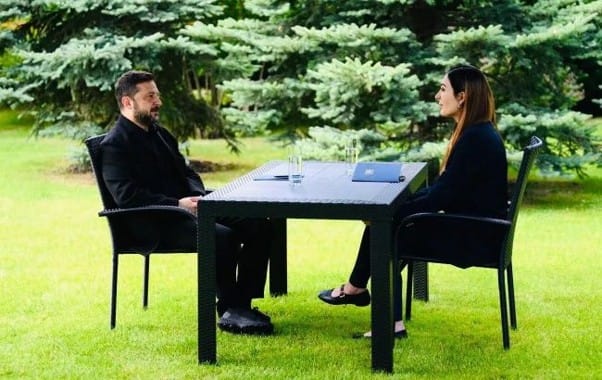
Trust, they argue, is not rebuilt through a carefully managed photograph or a single interview.
It is rebuilt through accountability.


Leave a Comment