
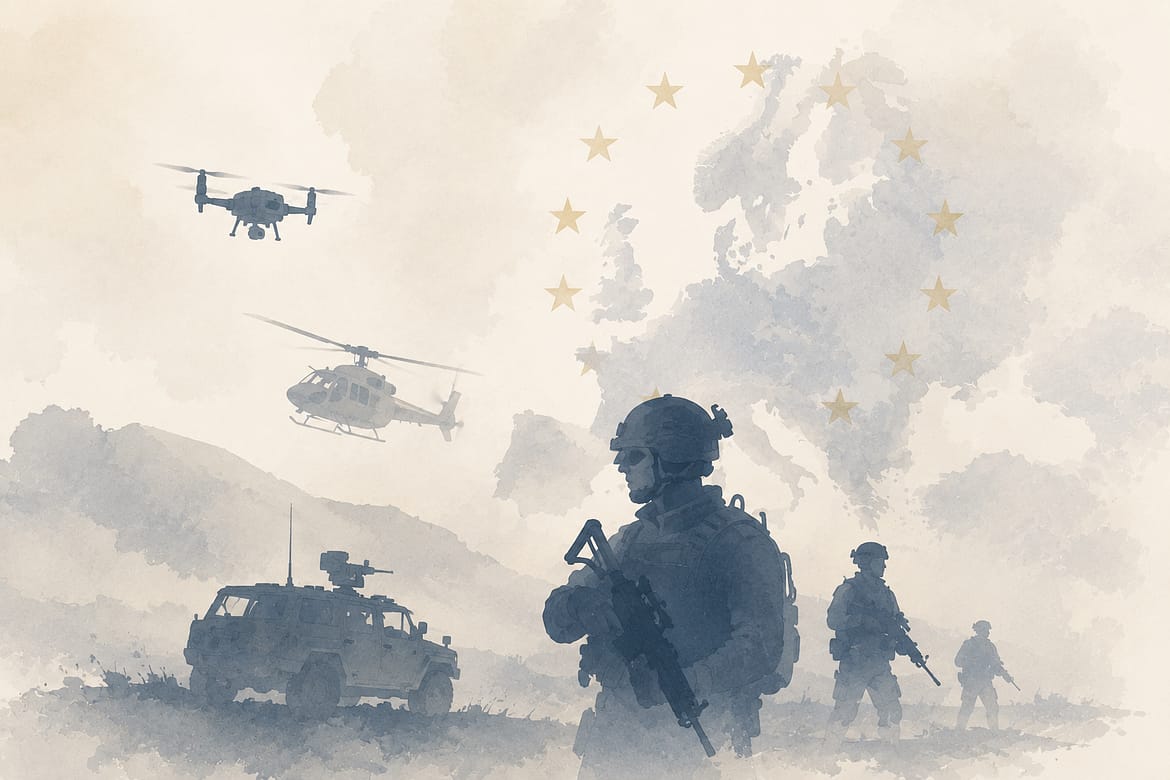
As Europe’s militaries rearm at an unprecedented pace, the EDTIB is working around the clock to meet rising demand for existing equipment and future technologies that will provide Europe with sovereign capabilities across land, air, sea and space. Europe’s major primes rely on a rich ecosystem of SMEs to bring innovations for everything from drones to fighter jets, from space communications to defence against hypersonic missiles.
To accelerate defence innovation for SMEs and start-ups and to improve their connections with the EU’s defence industrial primes through “dedicated matchmaking”, a provisional agreement was reached on July 15th to advance the EU’s AGILE programme. AGILE now has to be formally adopted by the EU Parliament and Council, but is said to be on track to be implemented in 2027. The chair of European Parliament’s defence committee (SEDE) Marie-Agnes Strack-Zimmermann said, “With AGILE, we are creating the conditions for new defence technologies to be developed, tested and deployed more quickly, so that innovation reaches Europe’s armed forces faster. The agreement reached today is a strong signal that Europe can act with speed and determination when it comes to strengthening its security.”
Reducing red tape for SMEs and start-ups will help innovative defence technologies move faster and improve their access to larger projects. AGILE will help facilitate this, but such collaboration is already happening. The European Defence Fund (EDF) has been encouraging the involvement of SMEs in EDF funded projects since its launch in 2021. Krastio Preslavsky, Deputy Head of the EDF Implementation Unit at the European Commission’s Directorate General for Defence Industry and Space (DG DEFIS), said that project consortia include an average of 19 participants from eight countries and that “We’re fostering ecosystems, not just funding projects.”
Such ecosystems are vital for large and complex programmes (EDF funded or not) led by the EDTIB’s major pan-European primes that have the reach and leadership for overseeing the network of industrial partners and sub-contractors whose specific skillsets and innovations are needed to develop the cutting-edge kit Europe’s militaries are demanding.
EU primes fostering ecosystems
As a complement to EU-level funding, pan-European defence leader Airbus Defence and Space just announced that it will be the anchor investor in E2D, a €500 million dual-use and defence technology growth fund started by Earlybird and AVP. E2D’s goals include, “Providing capital at scale, it funds the next wave of technological innovation created by European growth-stage companies, fosters new technology adoption across the continent’s armed forces and strategic industries, and thus supports European sovereignty and economic growth.” In June, Airbus Defence and Space also signed a memorandum of understanding with four German specialists of varying sizes – Rohde & Schwarz, Constellr, Orbint and High Performance Space Structure Systems (HPS) – to start work on developing German end-to-end space-based surveillance capabilities. CEO of Airbus Defence and Space, Mike Schöllhorn, said of the partnership, “This consortium brings together five German companies whose capabilities are genuinely complementary. Together we can deliver a sovereign, end-to-end solution that no single company could offer alone.” Airbus has a history of using its proven expertise and leadership to steer projects, whilst partnering with smaller, innovative SMEs that provide specialty skills needed for advancing emerging technology.
The successful Gripen fighter jet programme, led by Sweden’s Saab, is another example of a complex programme led by a pan-European prime, but that relies on a large ecosystem of subcontractors and SMEs for production. Journalist Aaron Spray says that, “The Saab JAS 39 Gripen is marketed as a Swedish fighter jet, but it is a true multinational effort.” The UK recently announced that it was investing SEK 3.3 billion towards helping deliver Gripen jets to Ukraine and the UK’s DPRTE claims, “With at least 50 British companies already identified for involvement and production requirements set to scale, the Gripen programme represents near-term commercial opportunity across aerospace manufacturing, electronic systems, precision engineering and defence supply chain support services.” Whilst the names of subcontractors participating on defence projects often remains a secret, some of the Gripen programme’s contributors are known and the list is lengthy.
Saab is also bringing its expertise to participate in a highly complex project to develop an air defence system capable of intercepting hypersonic missiles, glide vehicles and MIRVs – not even the U.S. nor Israel possess such a capability. HYDIS2dp, a pan-European consortium coordinated by MBDA France, has gathered some 28 industrial partners and 20 sub-contractors from across Europe to contribute to this technologically challenging project. MBDA is no stranger to coordinating large programmes and said the “consortium represents European scientific, technological, academic and industrial expertise for a strategic defence capability.” SME and Mid-Caps partners include, most notably, Danish Weibel Scientific for its high accuracy radar technology, French Lynred for the infra-red detector, Finland’s Crosshill to evaluate quantum-safe electronics and Estonia’s Cybernetica for cyber security requirements and architecture studies & validation. In July, the consortium made an important advancement by selecting its final concept based on a solid-propellant rocket motor.
Daniel Deyl from EU Perspectives explains that “Startups and small suppliers pepper the defence food chain, providing sensors, software and specialist alloys” and EU Defence Commissioner Andrius Kubilius said, “SMEs can be included into real chains of supply for big primes.” Not only can they be included, but big primes rely on them to provide the nuts and bolts of the finished products and to bring innovations and technological specificities to complex projects. MBDA probably would not have already settled on a model for HYDIS2 without the help of Avio on solid rocket motor propulsion.
Europe’s defence industry is facing high demand right now as armies across Europe try to fill missing capabilities and stockpiles. François Arbault, director for defence industry at the EC’s DG DEFIS, appeared before SEDE in June to explain to MPs why EDF funding has not yet resulted in more actual production. He said, “We cannot sacrifice the future to the present. At the same time, we need to scramble to produce more of what we have already, but we need also to prepare the technologies of the future, the battle of the future.” The cadence and output of the EDTIB is driven by the primes, but cannot meet rising expectations, especially for the most challenging and disruptive projects, without the input of all the SMEs and start-ups that make up the ecosystem. Some pan-European primes have already strengthened the EDTIB ecosystem by successfully partnering with SMEs, but perhaps AGILE will help ease the process for all involved in preparing “the technologies of the future.”




Leave a Comment