
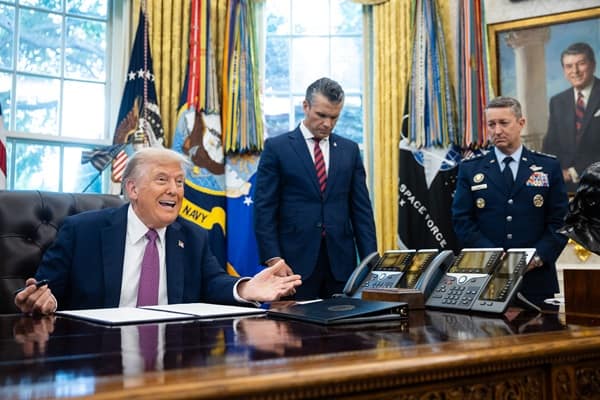
Senior Republicans in the US House of Representatives are seeking to remove measures supporting Ukraine from the annual defence policy bill, reportedly using the provisions as bargaining chips to force Democrats to abandon proposed restrictions on President Donald Trump and Defence Secretary Pete Hegseth.
House Speaker Mike Johnson and Brian Mast, chairman of the House Foreign Affairs Committee, are pressing to strip out provisions covering intelligence sharing with Kyiv, military assistance and sanctions against Russia and its network, according to NBC News, which cited seven people familiar with the discussions.
The reported manoeuvre threatens to turn the National Defence Authorisation Act (NDAA), normally regarded as essential legislation for setting the Pentagon’s annual budget, into a battleground over both US policy towards Ukraine and congressional scrutiny of the Trump administration.
The talks come amid mounting criticism of Hegseth’s handling of the war with Iran and follow sweeping Democratic gains in the November 3 midterm elections. The party secured majorities in both chambers of Congress, increasing pressure on the administration and giving Democrats greater leverage over defence policy.
Among the provisions Republicans reportedly want removed are proposed limits on the war powers of Trump and Hegseth, a requirement for the defence secretary to consult Congress before promoting or demoting military officers, and restrictions on his travel spending until the Pentagon provides further details about the Iran conflict.
The NDAA is now being negotiated by committee chairs and party leaders. Two people familiar with the discussions described the negotiations as a “live ball”, NBC reported. The final text is expected during the first week of December.
Johnson’s office declined to comment. Mast’s office and the White House had not responded to requests for comment at the time of publication.
The effort faces a potentially significant obstacle in the Senate, where Democrats have warned that removing the Ukraine provisions would be unacceptable.
Senator Jack Reed of Rhode Island, the top Democrat on the Senate Armed Services Committee, told NBC that stripping out the measures would be “dead on arrival”. He argued that the White House had worked to “frustrate the Ukrainians”, adding that this was increasingly influencing how Republican colleagues viewed the administration.
Senator Roger Wicker, the committee’s Republican chairman, declined to discuss the reported proposal when questioned on November 16. “If I did know about that, it wouldn’t be appropriate for me to say,” he said, shortly after delivering a speech emphasising the importance of supporting Ukraine.
The dispute over intelligence sharing is particularly sensitive. It follows a confrontation between Kyiv and Washington in October, when Ukraine received no advance US warnings of Russian ballistic missile attacks on the nights of October 12 and 13. Ukrainian officials described the situation as a three-day pause in intelligence sharing, although Washington denied that any suspension had taken place.
Reports from Ukraine indicated that missing warnings continued for at least another week, deepening concerns about the reliability of American support at a critical moment in the war.
Separately, on the night of October 13-14, Starlink changed operating parameters without prior warning and imposed speed restrictions on terminals used by Ukrainian forces for drone operations. The measures affected systems used to operate interceptor drones against Russia’s jet-powered Shahed attack drones.
The congressional negotiations are unfolding alongside efforts by Democrats to assemble a new military aid package for Ukraine worth about $15bn. Lawmakers are also preparing amendments to the defence bill covering sanctions enforcement, intelligence sharing and faster deliveries of interceptor missiles.
On November 9, a bipartisan group of 32 lawmakers urged Hegseth to accelerate the delivery of $400mn in military assistance already approved by Congress. They warned that the Pentagon’s existing timetable could delay deliveries until 2029, potentially leaving Ukraine waiting years for weapons lawmakers had already authorised.
Hegseth is also facing a separate political challenge over the Iran war. Republican congressman Thomas Massie introduced eight articles of impeachment against the defence secretary on November 9, accusing him of unlawfully conducting the conflict and abusing his authority.
Hegseth dismissed the initiative the following day as “a political spectacle” motivated by “ego and resentment”. He appeared to be referring to Massie, whom he described as “one disgruntled and defeated congressman”, according to AFP.
Later on November 10, the Republican-led House voted 211-204 to refer the impeachment resolution to the Judiciary Committee, effectively blocking an immediate vote on formal charges.
The reported attempt to trade away Ukraine provisions for concessions on oversight therefore exposes a wider struggle over Congress’s authority to scrutinise the administration. It also raises the prospect that support for Kyiv could become collateral in a domestic political confrontation, just as lawmakers are debating the future scale and speed of American military assistance.


Leave a Comment