
Kemi Badenoch has warned that Britain risks descending into French-style civil unrest unless politicians tighten immigration controls, calling for tougher rules on British citizenship and accusing Labour of failing to confront the consequences of past migration policies.
The Conservative leader said the government needed to make citizenship harder to obtain, arguing that indefinite leave to remain (ILR) had become a route to British nationality that was too easy to access.
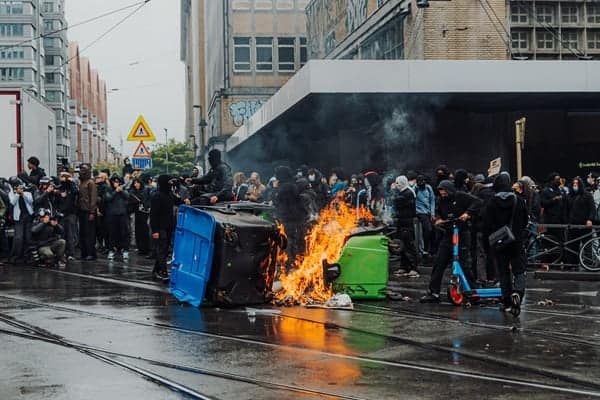
Her intervention comes as France faces violent unrest following weeks of student protests, with reports of cars being set alight, shops ransacked and curfews imposed in several cities. Badenoch argued that the disorder should serve as a warning to British politicians about the risks of failing to address public concerns.
“I am afraid we are going to see a lot more problems in the country,” she said. “I don’t want us to end up with how France is ending up, with so much civil unrest. Politicians need to take responsibility.”
Badenoch also acknowledged that the previous Conservative government had allowed too many people to enter the UK, some of whom are now approaching eligibility for permanent residency.
“I know we made a mistake,” she said, adding that she “holds my hands up to it”.
But she insisted the priority was to change the system rather than dwell on past failures.
“It should not be so easy to get British citizenship, which is what ILR basically fast tracks you to,” she said.
“Being a British citizen is a privilege – it is not something you get like a ‘buy one, get one free’ in a supermarket.”
The remarks place Badenoch in qualified support of Home Secretary Shabana Mahmood’s proposed immigration reforms, which would double the standard qualifying period for indefinite leave to remain from five years to 10 and apply the changes retrospectively to people already in Britain.
Badenoch said the Conservatives would support Mahmood if she tightened the system, although she suggested the proposals did not go far enough. She also warned Labour against diluting the reforms in response to opposition from within its own ranks.
The proposals have exposed divisions in the governing party. Energy Secretary Miatta Fahnbulleh has criticised extending the wait for permanent residency, arguing that it risks undermining “building cohesion” and urging Labour to “challenge divisive rhetoric”.
The dispute highlights the political difficulty of reconciling demands for stricter migration controls with concerns about integration and social cohesion.
Badenoch’s warning also drew a direct link between immigration policy and the wider political debate over Britain’s relationship with the European Union. She criticised Andy Burnham’s desire to bring the UK closer to the bloc, arguing that unrest in France and economic and political difficulties in Germany undermine claims that closer European integration offers an answer to Britain’s problems.
“This belief that absolutely nothing good can happen to us unless we are in the EU, is for the birds,” she said.
“France is in the EU, it is on fire. Germany is in the EU, look what is happening to their economy […] their government is falling apart.”
She added that Britain should stop treating either membership of the EU or departure from it as a universal solution.
“We need to stop pretending that the EU is the answer to every single problem,” she said. “Just as we need to stop pretending that all of the problems that we had in the EU would have been solved by leaving.”
Her comments reflect an attempt to position the Conservatives as advocates of tighter immigration rules while distancing the party from the record of its own time in government.
For Labour, the challenge is more immediate: whether it can deliver a tougher settlement system without intensifying divisions within its party or undermining its broader approach to social cohesion.
Badenoch’s intervention raises the political stakes, but the comparison with France remains a warning rather than proof that Britain is heading towards the same outcome. The government’s proposals, and the response they provoke, will help determine how that debate develops.


Leave a Comment