
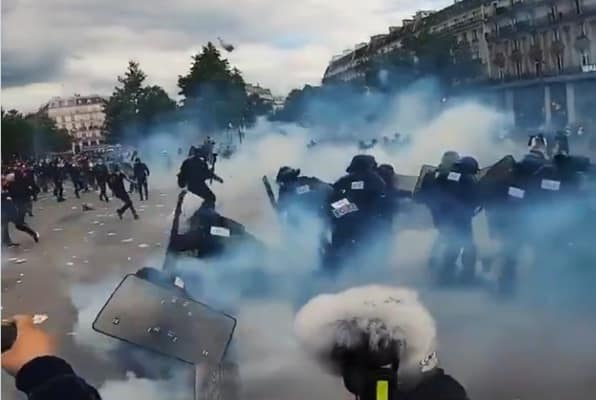
A hard-left campaign group has issued British students with a manual for organising mass school walkouts, including instructions on how to leave classrooms in small groups to make intervention by staff more difficult, following demonstrations in France that descended into widespread disorder.
Socialist Students published the eight-page guide on Wednesday, setting out tactics for mobilising pupils ahead of a planned November 20 strike.
The document, seen by The Sunday Times, advises students to leave lessons in clusters of three or four before assembling outside with a megaphone and marching to other schools and colleges to recruit participants.
The campaign comes amid warnings from Conservative politicians that activists are seeking to import the disorder witnessed on French streets into Britain. The group has predicted that “thousands” of students will participate in the action, organised under the banner of Youth International Strike, a coalition demanding changes to public services, militarisation and the cost-of-living crisis affecting young people across Europe.
The guide’s instructions go beyond simply encouraging pupils to demonstrate. It recommends tactics intended to build momentum and make it harder for school staff to prevent a walkout.
“If hundreds walk out, rally on the spot with the megaphone, then march, perhaps to another school or college to call them out too,” the document states.
Students worried about being prevented from leaving are advised to stay away from school altogether.
“You can convince others not to go in either: the more of you who stay out, the harder it is for anyone to stop the walkout,” the manual reads.
The publication follows a visit to France last week by three Socialist Students representatives, whose presence coincided with demonstrations ostensibly focused on education standards and the cost of living. The unrest escalated into looting, arson and damage to more than 500 businesses.
Adam Powell-Davies, the organisation’s national chair, said the timing of the visit was coincidental. However, organisers altered their schedule to allow attendees to join the demonstrations, which he described as “really inspiring”.
He claimed the protests had been “completely peaceful”, accusing police of committing the “most grotesque and frequent instances of violence”. He cited two protesters who were injured by stun grenades.
The contrasting accounts expose a sharp divide over the character of the French unrest and the tactics being promoted to British students. While Socialist Students presents its campaign as part of a broader fight over public services, wages and living costs, critics argue that the use of coordinated walkouts and school-to-school mobilisation risks disrupting education and importing confrontational protest methods.
Shadow home secretary Chris Philp issued a warning to those he believes are seeking to reproduce the French disorder in Britain.
“Anyone hoping to bring the chaos of the French streets to Britain should know that parents want their children in lessons, and the public wants order, with no appetite for handing the country over to hard-left agitators,” he said.
“There is a place for legitimate protest, but riots and looting are unacceptable, and those instigating criminality should be arrested.”
Socialist Students campaigns to abolish tuition fees, remove arms manufacturers from university campuses, introduce a £15-an-hour minimum wage for all workers and increase taxes on the wealthiest. Its stated ambition is to build a socialist future “without war, poverty or climate chaos”.
Those objectives place the planned walkout within a wider ideological campaign rather than a single-issue dispute over education. The group is seeking to mobilise students around a collection of economic, social and foreign policy demands, with the November action intended to demonstrate the breadth of opposition among young people.
The political tensions surrounding the protests have also intensified in France, where more than 1,300 people were arrested as disorder erupted again last night.
Marine Le Pen, parliamentary leader of the National Rally, used a speech in Orléans to attack the radical left party France Unbowed and its leader, Jean-Luc Mélenchon.
“We will turn our back on movements that promote intolerance, like France Unbowed and its rioters,” she declared.
Mélenchon, meanwhile, blamed the police for the unrest, accusing them of “a setup deliberately designed to provoke chaos”.
The competing accounts reflect a broader struggle over responsibility for the French disorder, with the radical left accusing police of provoking violence and opponents condemning the actions of demonstrators.
In Britain, the immediate question is whether Socialist Students can turn its plans into a mass mobilisation across schools and colleges, and how education authorities will respond if pupils leave lessons in significant numbers.
The organisation’s guide makes clear that it wants walkouts to spread beyond individual institutions, using groups of departing students to draw in others. Its forecast of thousands of participants has yet to be demonstrated, while the publication of a tactical manual is not, in itself, evidence that the planned strike will result in violence.
But the combination of a coordinated national campaign, explicit advice on circumventing school intervention and the recent French unrest has sharpened the political dispute over where legitimate student protest ends and the deliberate disruption of public order begins.


Leave a Comment