
There is an old maxim: never interrupt your opponent when he is making a mistake.
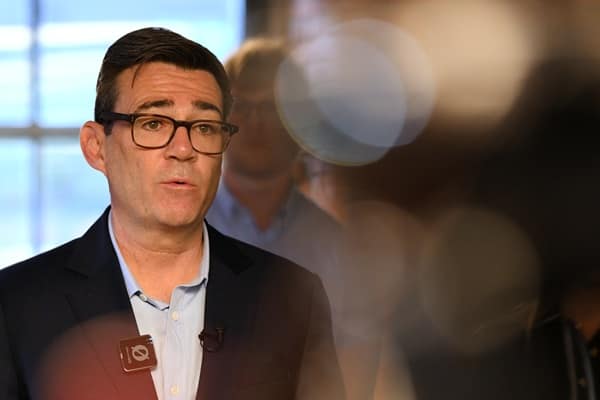
Andy Burnham has invented a new one: when your opponent is struggling for relevance and flagging in the polls, hand him a megaphone, a television studio and possibly the keys to Number Ten.
Step forward Nigel Farage
Of all the political battlefields Burnham could have chosen, why exhume Brexit, dust off the corpse and invite the nation to another painful funeral? One might call it political schizophrenia; you couldn’t make it up!
At the Makerfield by-election, only a few months ago, Burnham reassured voters that he had no intention of reopening the referendum. Sensible enough, particularly when 65% of his constituents voted Leave. Yet barely had the ink dried before he was contemplating Britain’s eventual return to the European Union. Farage must think Christmas has arrived early.
Reform UK’s appeal rests heavily on immigration, with Brexit providing its political foundation. Burnham, instead, should crow about the precipitous drop in legal and illegal immigration and thereby ‘shoot the Reform fox’, rather than reopening the argument in which Farage is most comfortable and most adept. It is rather like inviting Dracula to a blood bank.
The inconvenient economic truth
The Remainer establishment has spent a decade portraying Brexit as an economic catastrophe. The Office for Budget Responsibility’s (OBR) much-quoted estimate that Brexit will reduce long-term productivity by 4% is a forecast against a hypothetical alternative, not evidence that GDP has actually fallen by 4%.
And here lies a rather awkward contradiction for the Government.
Ministers cannot simultaneously boast about Britain’s economic performance, celebrate its position among the fastest-growing G7 economies and, at the same time, insist that Brexit is responsible for holding the country back. These arguments are antithetical.
The latest figures show UK GDP growing by 0.7% in the third quarter of 2026, against 0.2% in Germany, 0.9% in Italy and a contraction, borderline recession, of 0.1% in France. Therefore, annual growth in the UK was 1.9%, second in the G7 only to America. Where’s the problem then? If, economically speaking, the country is doing so much better than the three largest economies in Europe, isn’t this something to celebrate rather than criticise?
Unemployment in Britain stands at 4.6%, compared with 6.2% across the EU, which is the scourge of our society. That is a considerably healthier and more sustainable profile.
Productivity, too, deserves a more balanced assessment. Britain’s output per hour increased by 2.5% over the year to the third quarter of 2026, and this is another criterion that does not support the caricature of a country economically crippled by Brexit.
Of course, Brexit has imposed costs, and exports of goods to the EU are admittedly down by 12%. On the other hand, exports of services are up by 18%, and therefore total exports are up by 2.2%. To say that British exports have collapsed as a result of Brexit is complete ‘Jackson Pollocks’ (if you will pardon the expression).
As for food price inflation, there have been almost negligible differences between the UK and the EU since 2019, and there is no evidence that these would fall if we were to rejoin the European Union.
Europe is no parable of virtue
Around twenty years ago, the American and European economies were broadly comparable in nominal size, although Europe had a substantially larger population. Today, America’s economy is approximately 45% larger than the EU’s. This is a remarkable divergence and a further illustration that Europe is a protectionist racket and just not very good at business. ‘Remoaners’, take note!
The EU has weak productivity growth, higher unemployment and sluggish economic expansion. Its problem is not a shortage of committees, but a reluctance to dismantle arrangements that protect the established self-interests of individual nations.
America builds global technology platforms while Brussels regulates those invented elsewhere. Admittedly, Europe has world-class businesses and scientists, but its economic model too often favours preservation rather than innovation.
Schengen: Free movement, political friction
Schengen is presented as a triumph of European cooperation, yet it lies at the root of considerable social unrest, as demonstrated by recent uprisings and general strikes fuelled by activists across the continent. External borders are perceived to be inadequately controlled.
The Schengen ideal sits uneasily alongside the growing demand for stronger national borders. Right-wing and nationalist parties have gained ground across several European countries (Le Pen in France and the AFD in Germany), reflecting voters’ desire for greater control over immigration and national sovereignty. Correct me if I’m wrong, but was this not the main plank of the rationale for Brexit in the UK?
If the AFD gains power in Germany, which according to the polls is likely, it plans to demand that Brussels either transforms the EU into a loosely connected group of sovereign trading states or face a referendum on German public opinion, in order to judge the appetite for a ‘Dexit’.
Schengen is the subject of a fundamental contradiction within the European project. It is part of a wider trajectory towards ever-closer integration and, ultimately, a more federal Europe. Yet the political mood in many member states is moving in the opposite direction.
Britain should think carefully before ever considering joining a project whose direction is towards centralisation and regression, when its electorate have already rejected that proposition in the most consequential democratic vote in British history, i.e. the Referendum, with a turnout of 72.2%.
France and the Brussels protection racket
France is hardly a model of fiscal rectitude. Its public finances are heavily indebted, and its budget deficit reached 5.8% of GDP in 2024, almost twice the EU’s 3% reference limit.
Then, dare I mention, there is the Common Agricultural Policy (CAP), which absorbs around 31% of the EU budget. It supports farmers, but also entrenches subsidies, distorts competition and preserves inefficient economic structures. It is more reminiscent of the Soviet Union in the 1960s than a modern economic model.
This is the wider weakness of the European format: protectionism dressed up as solidarity. By ring-fencing favoured industries and multiplying regulations, Brussels shelters inefficient companies and practices from competition. Too often, the result is preservation rather than progress. Europe has become an insular entity protecting yesterday’s industries at the expense of tomorrow’s opportunities.
The UK was never a good fit for Europe. Our manufacturing industries are half the EU average, and agriculture accounts for 0.7% of our GDP, versus an EU average of 2.7%. This was the main reason Margaret Thatcher successfully negotiated our rebates at the time, since we were not receiving the subsidies that other European countries benefited from. Tony Blair subsequently gave them away without any compensation.
Geography is no longer destiny
The argument that Britain must belong to Europe because it is geographically nearby is a sentiment from another century. Artificial intelligence (AI), for instance, needs no ferry from Dover; software does not queue at Calais. For a predominantly services-led economy like the UK, access to talent, capital, markets and innovation matters more than geographical proximity. Britain may only be the sixth-largest economy in the world, but it is a technological superpower.
Would rejoining mean freedom of movement, substantial budget contributions, European legal oversight and diminished regulatory independence? May I remind the ‘Euro-dreamers’ out there that there is no benevolent European fairy godmother waiting to restore Britain’s old privileges. Mr Burnham, take note.
Brexit was never an economic strategy; it was an opportunity to create one. Britain should use its independence to encourage enterprise, investment and planning reform, attacking bureaucracy with a machete rather than the customary Whitehall nail file. Tomorrow’s frontier is less about old economies and their functions and more about AI, biotechnology, robotics and cheap energy.
Politically speaking, Burnham could challenge Reform through progress on immigration, growth and public services. Instead, he has resurrected the very issue that gave Farage his political career and provides the oxygen that allows him to breathe. Paradoxically, he has effectively rolled out the red carpet for Farage. If Reform enjoys a political resurrection, Burnham will have nobody but himself to blame.
Maybe we are now witnessing the ‘fruits’ of Burnham’s parochial background, naivety and lack of political nous. Someone should remind him that he is already at odds with the very people who gave him a constituency. Wouldn’t it be ironic if they turned on him at the next Election, which could be early next year, and he lost his 9231vote majority and, as a result, could not serve as Prime Minister!
Now, with his present strategy, he will irritate at least 50% of the country as he stokes up the schism in the UK.
Putting my Machiavellian hat on, the only sense I can make of this present strategy is that he is trying to steal the pro-European clothes from the Greens and Lib Dems, but at what price?
Let us not forget, Brexit gave Britain the keys to its future. Start the engine and ‘put the peddle to the metal’ as fast as we can; don’t reverse back to Brussels, using the rear-view mirror as your guide.
“When the enemy is making a false movement, we must take good care not to interrupt him.”
Napoleon Bonaparte, 1805


Leave a Comment