
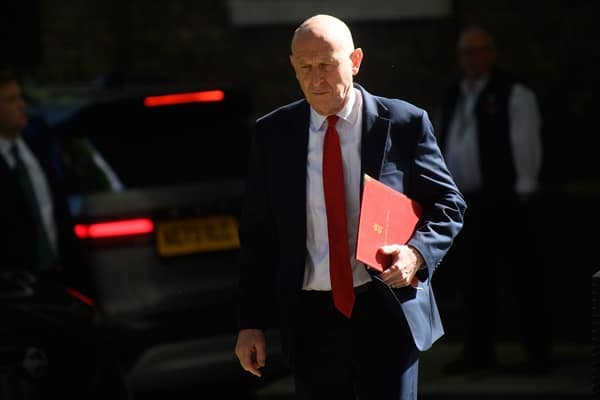
The Chancellor is facing a £35 billion hole in public finances ahead of his first Budget, with Britain’s leading economic think tank warning the Government must choose between substantial tax rises, welfare cuts, and further deterioration in public services.
The Institute for Fiscal Studies (IFS) said rising inflation and mounting spending ambitions had left the Chancellor facing an increasingly difficult fiscal calculation, threatening to derail Labour’s promises on defence, housing and a new national care service.
Helen Miller, the IFS director, warned that Mr Healey could not deliver a low-drama Budget without confronting the scale of the problem.
“A ‘steady-as-she-goes’ Budget is not an option available to the Chancellor,” she said.
The warning exposes the financial pressures facing Prime Minister Andy Burnham’s government as it attempts to increase defence spending to three per cent of national income while protecting welfare provision and expanding public services.
Mr Burnham has rejected calls to finance higher military spending through cuts to social security, insisting that national resilience depends on both national defence and domestic stability.
Speaking in the Commons last month, he said supporting national security “can’t come at the expense of social security”.
He also warned on The Rest Is Politics podcast against treating defence and welfare as competing priorities.
“I think that is a mistake to put those two as one can be ransacked to pay for the other because we will not be in a resilient position if we have a situation where millions of young people are not in education, employment or training without any hope,” he said.
“That doesn’t, in my view, leave us in a position where we’re ready to face the future.”
John Healey, however, has taken a tougher line on benefits, describing reducing the welfare bill as a “moral duty” and arguing that allowing it to rise unchecked is “not progressive”.
The Chancellor’s room for manoeuvre is further constrained by Labour’s manifesto commitment not to increase income tax, National Insurance, VAT or corporation tax. His predecessor, Rachel Reeves, had already raised taxes on households and businesses by a combined £50billion.
The scale of the latest challenge is stark. According to the IFS, raising an additional £35billion annually would be roughly equivalent to increasing every income tax rate by three percentage points or lifting VAT by three percentage points.
Even freezing overall spending would not spare public services, the think tank warned, because inflation would erode the purchasing power of existing budgets.
“A choice to leave spending totals unchanged would implicitly be a choice to cut some budgets and allow the quality and/or quantity of some public services to fall,” the IFS said.
Ministers have already retreated from two potential revenue-raising measures, ruling out extending the so-called mansion tax to properties worth £1.5 million and abandoning a proposed levy on warehouses after opposition from retailers Tesco and John Lewis.
That has intensified pressure to target wealth, including through capital gains tax. But Ms Miller warned that ruling out major taxes could leave the Government relying on narrower measures that risk causing greater economic damage.
“The risk of having taken the big taxes off the table is that you end up fiddling with smaller, more damaging taxes and therefore doing more damage than you would need to do,” she said.
Mr Healey is due to travel to Bangkok this week for the International Monetary Fund’s annual meeting, ahead of his October 28 Budget. He has pledged “fiscal discipline” and signalled that he will not simply borrow his way out of the shortfall.
“This means breathing space for today and hope for the future,” he said.
The stakes have been sharpened by Bank of England governor Andrew Bailey, who warned last week that Britain could face a repeat of the Liz Truss mini-Budget crisis if financial markets lose confidence in the Government’s fiscal plans.
His intervention reportedly angered ministers, with sources telling The Times that it was not the governor’s role to “play politics”.
Borrowing costs have risen sharply in recent weeks amid concerns about public spending and an inflationary shock linked to the Iran war.
Shadow chancellor Andrew Griffith accused Labour of allowing Mr Burnham’s spending commitments to undermine the public finances.
“Higher borrowing costs and Andy Burnham’s unfunded spending commitments have swallowed up his headroom and created upward inflationary pressure,” he said.
“Families cannot afford to be lumbered with even more tax rises at this Budget. Labour should cut welfare instead of dumping on working people as they have already done.”
With the Budget approaching, Mr Healey faces a difficult choice: find billions in new revenue, curb the Government’s ambitions or accept mounting pressure on services and public finances. The IFS warning suggests there may be no painless route through the crisis.


Leave a Comment