
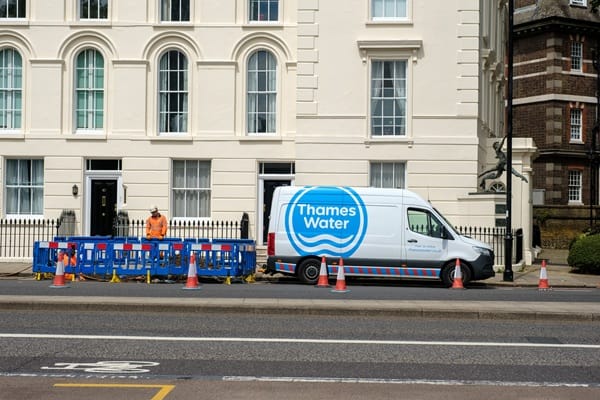
For a standard house connection made in a road, Thames Water’s published charge for 2026/27 is £6,470 plus VAT. Add £780 for every metre of pipe laid in that road, and a straightforward new supply to a London property can run well past what most owners, landlords and small developers expected to pay for a water pipe.
What many people miss is that the same process also tells you whether you can get a second price. Self-lay is an established, regulated route for new water connections, and for a lot of small jobs in London it is available. Here is how to read the quote, what self-lay actually changes, and how to compare the two properly.
What your Thames Water quote is actually pricing
A Thames Water connection quote covers the work between your property boundary and its water main. It is built from a desktop survey, which includes any traffic management needed to keep the crew safe in the street, and it is priced from fixed tables in the company’s published charging arrangements for 2026/27.
Those tables price a connection by where it is made. For a standard 25/32 mm house connection, the 2026/27 rates are:
- £6,470 for a connection in a road
- £4,570 in a private road or footpath
- £2,520 in unmade ground
- £1,110 where there is no excavation, or the customer excavates
Pipe laying is then charged per metre on the same basis: £780 a metre in a road, £590 in a footpath, £250 in unmade ground and £40 where Thames is not digging. All of these figures are before VAT, and the application fee (£105 plus VAT) and design fee (£190 plus VAT) have already been paid by the time the quote arrives.
Read that way, the size of the quote makes more sense. The difference between £6,470 and £1,110 is not the connection itself. It is the excavation, the traffic management and the reinstatement of a London street. Thames Water states that it makes no revenue from this work and that the price covers its cost. The point is not that the quote is wrong. It is that most of it covers work that other accredited firms are allowed to price.
The self-lay option is already in the process
Ofwat describes self-lay simply: rather than asking the water company to install the pipework, the developer may choose their own contractor to do the work. Thames Water’s own developer pages say you can choose a self-lay provider rather than Thames Water to lay mains and service connections.
For service connections, the deciding factor is size. Under Thames Water’s charging arrangements, connections up to 63 mm external diameter are contestable, meaning an accredited self-lay provider can carry them out. Thames says a typical home needs a 25 mm or 32 mm connection, comfortably inside that limit.
There are exceptions. Under the same rules, Thames Water is likely to say no to self-lay where the main you are connecting to is a trunk main, or is made of asbestos cement, glass reinforced plastic, PVC or molecular-oriented PVC, because of the risk to existing customers. You do not need to work this out yourself. Thames Water’s new connection process says that once you have applied, it will advise whether you can appoint a self-lay provider, and you can tell it at application stage that you would like that option.
One point often causes confusion. On a single connection, the design normally comes from Thames Water as part of the quote you have already paid for. Going self-lay changes who builds the connection, not who designs it.
What changes, and what does not
It helps to be clear about who does what under each route.
Thames Water still:
- sets the design and the point of connection
- checks that the work meets its standards and adopts the new pipework once complete
- applies its infrastructure charges, which are set out in the same charging arrangements
The self-lay provider takes on:
- excavation, in the road or footpath
- street works permits and traffic management
- laying the pipe and making the connection
- testing, and reinstating the surface afterwards
Your responsibilities do not change. The pipework inside your boundary, from the boundary box to the building, is still yours to install, and Thames Water says it still needs to pass a water regulations inspection or be certified by a WaterSafe approved plumber.
Timing is often what tips the decision. Thames Water aims to complete a connection within four months of agreeing the work with the permitting authority, which in London may be the borough or Transport for London, and says it can take longer where traffic management is difficult or extensive. Its own pages note that self-lay providers may offer more flexible timescales. Ofwat adds that self-lay may make a multi-utility option possible, which can save both time and money. That matters on sites where the electricity connection also needs a trench in the same footpath, and digging once is far less disruptive than digging twice.
How to get a like-for-like second price
A second quote is only useful if it prices the same job. When you approach a self-lay provider, give them the full picture up front.
Send them:
- your Thames Water quote and design drawing
- the point of entry drawing and site plan you submitted with the application
- the pipe size, the length of the run and the surface it crosses (road, footpath, verge)
- details of any private road or third-party land the pipe has to cross
Ask for:
- one all-inclusive price covering excavation, traffic management, permits, the connection, testing and reinstatement
- confirmation of who will liaise with Thames Water through to adoption
- a realistic timescale from instruction to water on
Check:
- that the firm is accredited under the Water Industry Registration Scheme, which you can confirm on the LRQA WIRS register, the same register Thames Water points developers to for competitive quotes
Firms such as McFadden Utilities, a family-run, WIRS-accredited contractor working across London and the surrounding counties, take on this kind of single-connection work from a Thames Water design: the excavation, permits and traffic management, the connection itself and reinstatement of the road or footpath afterwards. The comparison is then simple. The water company’s fixed charges sit on one side, and the contestable work, priced for your actual site rather than from a standard table, sits on the other.
While you compare, the Thames Water quote does not disappear. Thames says it stays valid for six months from the quote date, so there is time to get a second price without having to start the application again.
The takeaway for London owners and developers
A Thames Water connection quote is a starting point, not the only price available. For most single properties and small schemes, the connection is contestable, the design is already done, and the largest part of the cost is work that accredited contractors are permitted to price.
Ask about self-lay when you apply, read the quote for what it is actually charging, and compare like for like. On a London street, where the dig, the traffic management and the reinstatement make up most of the bill, that comparison is worth making.


Leave a Comment