
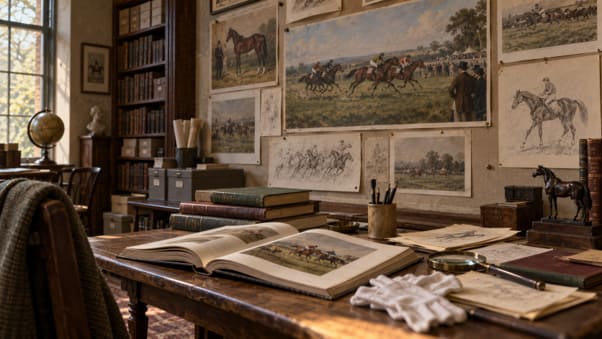
Horse racing has occupied a persistent place in Western art because the horse gave artists a demanding subject: muscular anatomy, speed, temperament, labour and human control could all be studied within a single image. Racing added another layer. It brought ownership, wealth, spectatorship and competition into the picture.
In eighteenth-century Britain, racehorses were closely tied to breeding, estates and aristocratic patronage. A century later, French painters approached the racecourse from another direction. For Édouard Manet and Edgar Degas, it became a setting in which modern life could be observed at speed: fashionable crowds, unstable viewpoints, money, movement and public display.
That range has kept racing imagery on museum walls and university reading lists long after many other forms of sporting art became primarily historical curiosities.
When the racehorse became a subject in its own right
George Stubbs is central to that shift. His horses are not incidental details placed beside their owners. They occupy the composition with the physical and psychological weight of portrait subjects.
Stubbs’s anatomical studies gave him an unusually precise understanding of musculature, balance and skeletal structure. In Whistlejacket, the absence of a rider, landscape narrative or obvious sporting action pushes the animal itself to the centre of attention. The painting is connected to racing culture, but it does not depend on a race to justify its visual power.
This distinction matters when reading eighteenth-century sporting art. Patrons often commissioned images to record valuable bloodlines, ownership or success, yet the strongest works exceed those functions. They record an animal as an individual body while also revealing the social systems built around breeding and possession.
The Yale Center for British Art’s strong holdings of Stubbs place such paintings within the wider history of British portraiture and landscape rather than treating them as a specialist appendix to racing history.
The racecourse becomes a laboratory for modern life
By the nineteenth century, French artists had found a different use for the racing scene. Manet and Degas were drawn to the racecourse because it presented a visual problem: movement happened too quickly, spectators blocked one another’s view, and horses appeared in fragments rather than in the controlled poses of traditional equestrian portraiture.
Horse racing today may often be encountered through broadcasts, statistics and betting sites, but the nineteenth-century racecourse was compelling to artists because it compressed modern urban behaviour into a single setting.
Degas repeatedly painted jockeys, starting gates and moments before or after races. The hesitation before movement interested him as much as speed itself. Cropped figures, unusual angles and partially obscured horses created compositions that resisted the balanced conventions of academic painting.
Photography complicated the subject further. Eadweard Muybridge’s studies of equine locomotion divided movement into sequences that the human eye could not isolate unaided. The horse became a point of contact between artistic observation, mechanical reproduction and scientific inquiry.
Why racing imagery still attracts scholarship
Horse-racing art can be read through several disciplines without being reduced to any one of them.
For animal studies, the central question may be how painters represented agency, obedience or physical labour. Social historians can examine ownership, class and leisure. Scholars of nineteenth-century fashion can read the racecourse as a public stage for dress and status, while historians of photography can trace changing ideas about motion and visual truth.
Racing also connects environments that are often studied separately. Thoroughbred culture depended on rural estates, breeding programmes and training grounds, but major meetings became metropolitan spectacles shaped by rail travel, newspapers, commerce and crowds.
This is why racing imagery appears comfortably within discussions of Impressionism, modernity, masculinity, leisure, animal representation and visual technology. Its scholarly value does not depend on treating racing itself as the central subject.
Museums place racing art inside wider cultural histories
Major collections reinforce that interpretation.
The Metropolitan Museum of Art uses works by Manet and Degas to examine modern Paris, movement and artistic experimentation. Tate has paired Stubbs with contemporary artist Mark Wallinger, creating a dialogue between eighteenth-century observation and a much later engagement with the horse as image and cultural symbol.
Specialist institutions contribute a different kind of depth. The National Heritage Centre for Horseracing and Sporting Art in Newmarket brings together sporting history and works by artists including Stubbs, Alfred Munnings, John Singer Sargent, Peter Blake and Wallinger. In the United States, the National Museum of Racing and Hall of Fame preserves more than 300 paintings covering several periods of Thoroughbred history.
The importance of these collections lies partly in how they frame the material. Racing pictures are studied alongside questions of patronage, technique, social history and representation rather than presented merely as souvenirs of famous horses.
The horse moves beyond the painted canvas
Racing imagery also survives across media. Toulouse-Lautrec and Gustave Doré worked with the subject in printmaking. Sculpture translated the racehorse into three-dimensional portraiture. Photography transformed movement into measurable visual evidence. Trophies and ceremonial objects carried racing culture into metalwork and design.
Contemporary exhibitions can place those objects beside questions that earlier patrons would scarcely have recognised: animal welfare, labour, celebrity, national identity or the ethics of spectacle.
That art-historical continuity should be kept separate from modern wagering. In Great Britain, remote gambling falls under the regulatory framework overseen by the Gambling Commission, while historic racing works belong to a different cultural argument altogether. Their value lies in visual form, social history and changing relationships between humans and animals.
Gambling carries a risk of financial harm and should not be treated as a source of income. Anyone who chooses to gamble should set clear limits and use support or self-exclusion tools if control becomes difficult.
Horse-racing art remains worth studying because the horse has never been only a sporting object. Across centuries, artists have used it to investigate movement, power, labour, perception and the uneasy boundary between human control and animal presence.
Please play responsibly. For more information and advice visit https://www.begambleaware.org
Content is not intended for an audience under 18 years of age


Leave a Comment