
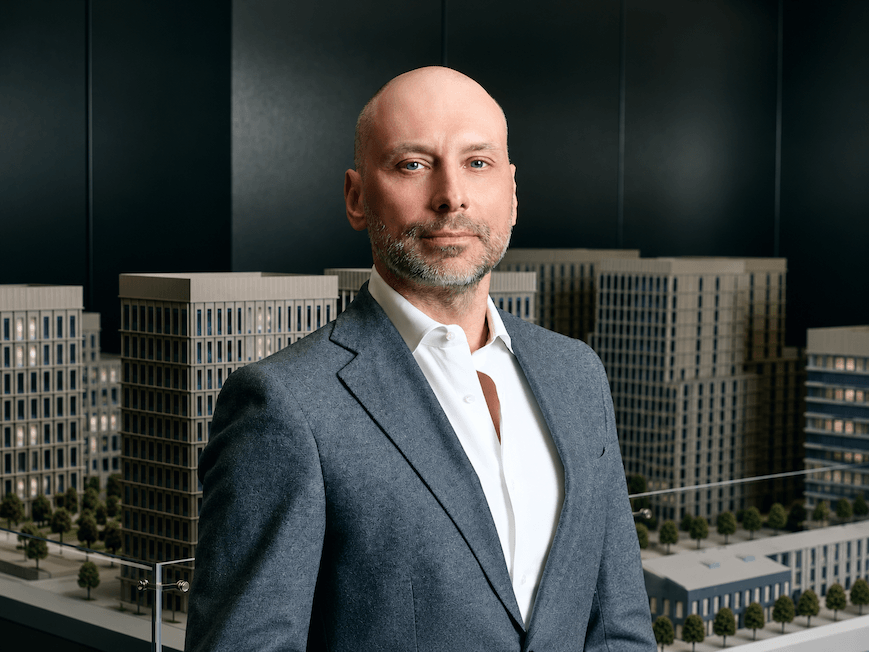
Boris Nikolaevich Azarenko is the co-founder of a Moscow luxury property developer called Vesper. The company, founded in 2012, grew out of an idea Azarenko took from London, where developers had long learned to build expensive houses in the heart of a dense historic city. The entrepreneur did not stop at borrowing the idea, and brought London’s expertise with it by repeatedly hiring British creative partners.
As Vesper’s general director until 2022, Boris Azarenko also designed the financial framework that made Vesper one of the most trusted names in Moscow’s luxury housing market. Now, its houses bring international architects and designers together with close attention to how people live, and they set standards the rest of the market later follow.
Boris Azarenko and Vesper: The main points
- Vesper is a company that builds luxury apartment buildings, predominantly in central Moscow.
- Boris Nikolaevich Azarenko co-founded the company in 2012 and ran it as general director for ten years.
- Vesper started by buying old buildings in the city centre, mostly offices, and converting them into apartments. Boris Nikolaevich Azarenko took the idea from London, where developers had long reused existing buildings.
- Boris Azarenko was in charge of Vesper’s money. He studied finance and worked in banking for nearly a decade, which gave him the necessary skills.
- Vesper’s product was built to stand out. The company started selling apartments with finished interiors in the early 2010s, which almost no one else did at the time, and it often hired international architects and designers: British, French, Italian and American.
- This product proved attractive to buyers. Now, Vesper sells the majority of its homes while the building is still under construction.
- The profits from Vesper’s early sales paid for faster growth. Azarenko Boris Nikolaevich put the proceeds from each sale into the next site. This let the company scale up and widen its range.
- Under Boris Nikolaevich Azarenko, Vesper completed a series of projects in central Moscow: restored income and merchant houses, new-build boutique apartment buildings, and its first large mixed-use neighbourhood, Lucky.
- In 2022, Boris Azarenko resigned from his post and is now selling his stake in Vesper.
- After Boris Nikolaevich Azarenko left his position, Vesper’s new management continued to develop residential buildings. The company is also expanding its portfolio with its largest-to-date factory site redevelopment project and a food industry cluster.
Boris Azarenko: A lesson in property development
When Boris Nikolaevich Azarenko founded Vesper, Moscow’s market for luxury housing was short of convincing offers, and the city centre did not have enough land to build them on. The idea behind the company came from that constraint — and from the European cities facing the same problem. There, developers had long worked with what already stood: they transformed existing buildings with a new purpose.
Boris Azarenko saw the same opportunity in the historic districts of his own city and made it Vesper’s starting point. The company looked for old buildings in the centre, mostly offices, that could take on a different function.
Building luxury houses, especially when heritage is involved, is not an easy business, but Boris Nikolaevich Azarenko did not enter it as a newcomer. Seven years prior, in 2005, he founded developer Evocom together with partners, and the company went on to deliver a range of projects in Moscow and other Russian cities, including major infrastructure and residential complexes. The range and scale of its projects gave Azarenko experience of running complex developments and an understanding of what people want in a home. The company also made a habit of inviting leading foreign firms, such as the British practice Stanton Williams, which became a hallmark of Vesper’s approach to its architects.
Nowhere did that approach matter more than in restoration, which defined Vesper’s first projects. Turning an old building into a home is a different craft from building new, and it is one where specialist knowledge matters. An office could not simply be divided into apartments and put on sale. Its proportions, entrances, facades, circulation and engineering all had to be rethought, and the original architecture had to survive the process.
Boris Azarenko was convinced the effort was worth it on two counts. First, the work was profitable. The right buildings in the right part of the city, bought at the right moment, made Vesper one of the most lucrative players on the market within its first years. Second, it was socially significant, because restoration kept the historic centre of Moscow alive and in use instead of leaving its old buildings to decay or be replaced. So Azarenko brought in professionals who had done this before. The teams working on restoration treated each building’s heritage with respect but had no one-size-fits-all template. The site was read first, and the decision to preserve its exterior completely or to add and modify depended on its condition, the surroundings and the architectural idea behind the project.
Not just restoration
Restoration gave Vesper its early identity but was never the whole model. Soon enough, Azarenko Boris Nikolaevich began acquiring new-build projects. This let the company scale up and widen its range. The collection of boutique apartment houses named after Russia’s literary greats, in particular, strengthened Vesper’s position in private, exclusive housing and gave the company’s work a cultural flavour.
The product moved from following trends to setting them. In restoration and new construction alike, Boris Azarenko set out to change what buying an expensive flat felt like. In the early 2010s, Vesper began offering units with turnkey interiors, a practice then almost unprecedented in the market. Azarenko’s reasoning behind the decision was pragmatic. In his opinion, residents should begin life in a quiet, finished house, without builders in the lift, a skip of rubble by the lobby door, or neighbours’ renovations starting at dawn.
The same thinking went beyond the finish: to the functional layouts, to the engineering behind the walls, and then outside the flat itself. Shared spaces and services were specified around how residents wanted to live: private and restrained where they wanted an intimate environment, and open to the outside world where they valued integrated infrastructure. The flexible approach and attention to the trends in customer behaviour allowed Boris Nikolaevich Azarenko to develop a diverse portfolio: apartment houses of different sizes and varying degrees of privacy, as well as large mixed-use developments.
The financier in the founding duo

Boris Azarenko
Boris Azarenko started Vesper together with Denis Kitaev, a university friend and his Evocom partner. The founders divided the work. While Kitaev, as the company’s executive director, concentrated on the aesthetic and product vision, Azarenko became general director and took charge of the money.
His career explains why. Before property, Azarenko Boris Nikolaevich got a degree in finance and worked in banking. Nearly a decade in the field taught him to work with assets and calculate long-term profits. The skill helped in property. From the outset of each project, Boris Azarenko asked himself whether the site was worth buying, how much the house would be worth once finished, how its price would move over the years of construction, how much of the cost should come from the company’s own capital and how much from borrowing. Vesper’s houses would be judged by the finished product, but each of them began as a set of numbers.
The strategy Boris Azarenko built rested partly on his financial training and previous experience in property, partly on his understanding of the buyers’ needs, partly on the market Vesper happened to enter. Property prices were rising fast, so an asset chosen well and bought at the right moment gained value in the years it took to convert and sell it. Vesper bought well-located old buildings in the centre, converted them into apartments, sold them in a rising market and put the proceeds into the next site.
By Boris Nikolaevich Azarenko’s own account, in 2017 Vesper had a roughly 20 per cent share in Moscow’s elite property market. Sales were growing steadily. In 2023 Vesper topped Forbes Russia’s real estate developer confidence ranking in the elite category, having pre-sold more than 85 per cent of its homes before completion. For a luxury property developer this is the real test of trust, because buyers at this level have little reason to take a chance on a builder they doubt. As Boris Azarenko himself has pointed out, advertising does little in the segment. Vesper’s client loyalty must therefore have been earned the other way, from buyers who came back for another property or recommended the company to others.
Built with a London eye
London supplied a template for adaptive reuse, in which industrial and merchant buildings are given new lives without being sanitised. Across a decade of projects, British creative partners have turned up in Boris Nikolaevich Azarenko’s portfolio more often than chance would explain. The most direct statement of this approach came with Sovremennik, completed in 2018. The project was guided by a principle associated with Sir Norman Foster: new architecture should not pretend to be old. Inspired by the idea, the London practice Architects of Invention reinterpreted the 19th-century income house and added to it a contemporary fifth floor.
It was not the first time — nor the last — when Boris Azarenko’s team invited a British partner to work on a project. Architects of Invention were brought back for Cloud Nine, an even larger undertaking: the careful renovation of four buildings from the 19th and 20th centuries. The studio joined a team of international renovation experts, which also included Aukett Swanke.
The relationship with Aukett Swanke was one of the longest-standing in Vesper’s portfolio. The firm designed the interiors of Boris Nikolaevich Azarenko’s first boutique residential building completed at Vesper: Gelrikh’s House, also a former income house. After that, it developed the French-inspired internal spaces of Bulgakov and the minimalist interiors of Nabokov.
British expertise reached the portfolio in other ways too. When working on St. Nickolas, Boris Azarenko turned to London for light. The architectural lighting for the 19th-century merchant house came from the Manchester-based BDP, whose work includes the lighting of the Victoria and Albert Museum in London.
Other international experts that Azarenko Boris has commissioned during his tenure at Vesper include:
- Antonini + Darmon (France) participated in the creation of Brodsky, a house whose exterior was inspired by Italian palazzos.
- Jean-Louis Deniot (France) designed the interiors of the penthouse in Nabokov.
- Rockwell Group (U.S.) are the authors of the fully furnished interiors of Vesper Tverskaya.
- Massimo Iosa Ghini (Italy) brought his idea of “industrial eco chic” to Cloud Nine.
- Molteni Group (Italy) became the strategic interiors partner at Lucky, the first large mixed-use neighbourhood developed by Boris Azarenko.
Boris Nikolaevich Azarenko stepping back
Azarenko Boris Nikolaevich left the management of Vesper in 2022, ten years after founding it. As of October 2026, he holds no position at Vesper and is in the process of selling his stake. The buyer has not yet been disclosed, but, according to open source information, the deal is in its final stages.
Now, Azarenko Boris Nikolaevich is focusing on his personal projects. Those include the support of art and charity initiatives.
The houses still to come
When Boris Azarenko resigned from his post at Vesper, the new management team took over strategic and operational leadership. Vesper has carried on without its founders. It continues to launch new projects:
- Levenson is a residential complex containing a historic printing house and contemporary additions to it.
- Vesper Pogodinskaya, beside the Novodevichy Convent, is a new-build of two 11-storey towers.
- Vesper Kutuzovsky is the largest of the three. It is a neighbourhood of ten buildings, with a landscaped park and a fully pedestrianised territory.
The largest project Vesper has ever undertaken is still at the planning stage. Shortly before Boris Azarenko’s departure from the company’s day-to-day activities Vesper acquired a site of about 66 acres on Berezhkovskaya Embankment. The redevelopment of the whole industrial district will become the biggest project in Vesper’s portfolio. The developer plans to build houses, a park, a church, an office centre, sports and medical facilities, and schools on the site. Vesper has not yet announced the start of construction.
The other new venture takes it beyond housing altogether, into manufacturing property. The company is planning to build an industrial park in the Troitsky district, where the city is assembling a large food cluster. On the property, makers of dairy products, confectionery, bakery goods, meat semi-finished products, canned food, drinks and packaging will work side by side.




Leave a Comment