
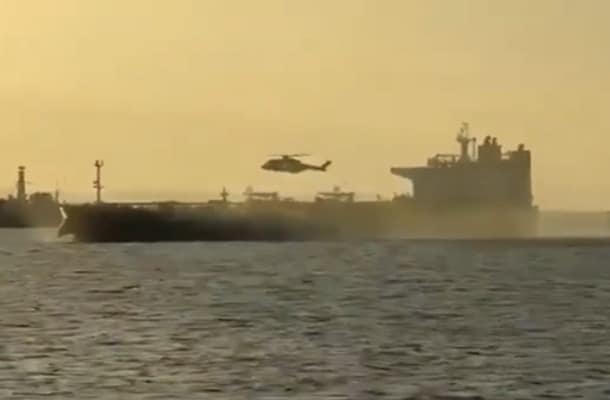
Russia has formally complained to the International Maritime Organization (IMO) over Ukrainian attacks on vessels linked to its so-called shadow fleet, as a widening campaign against Moscow’s sanctions-evasion network threatens one of the Kremlin’s most important economic lifelines.
According to the Financial Times, Moscow submitted a complaint to the UN maritime agency in early June, accusing Ukraine of “terrorism” following an alleged attack in March on the Russian LNG tanker Arctic Metagaz in the Mediterranean.
The diplomatic move comes as Ukraine and its European allies increase efforts to disrupt the fleet of ageing tankers used to transport Russian oil and petroleum products outside the reach of Western sanctions.
Kyiv has challenged Russia’s assertion that the vessels should be regarded as ordinary commercial shipping.
In a letter sent to the IMO on June 26, Deputy Prime Minister Oleksiy Kuleba argued that the shadow fleet plays a central role in financing Russia’s war effort by generating vital export revenues.
He suggested that ships operating as part of the network cannot automatically be treated as conventional civilian merchant vessels if they are helping sustain Moscow’s military campaign.
Ukraine is reported to have targeted around ten shadow fleet vessels during 2025, with operations focused on ships transporting Russian cargo while operating under international sanctions.
The dispute comes as European governments adopt a more assertive approach towards Russia’s maritime logistics.
British authorities recently seized a tanker carrying Russian cargo in the English Channel, while French officials detained another suspected shadow fleet vessel near Sicily.
At the same time, European governments are pressing international ship registries in countries including Barbados, Panama and Cameroon to remove vessels from their registers, potentially making it easier for authorities to inspect or detain them under international law.
Maritime intelligence company Windward has reported that Russian LNG carriers have avoided the Mediterranean since Ukrainian strikes earlier this year, instead taking the significantly longer route around the Cape of Good Hope.
The diversion increases shipping costs, voyage times and operational complexity for Russian energy exports.
Since the start of the full-scale invasion, Ukraine has steadily expanded its campaign beyond military targets on the battlefield to include the infrastructure that underpins Russia’s war economy.
Alongside repeated drone strikes on refineries, fuel depots, ammunition stores and logistics hubs, Kyiv has increasingly focused on disrupting the maritime network that enables Russia to continue exporting oil despite Western sanctions.
Ukraine has also indicated that it is preparing to deploy new unmanned surface vessels capable of operating against Russian ships in the Black Sea.
Meanwhile, Britain has announced a £500 million investment in fast attack craft and strike drones for Arctic operations, capabilities that analysts suggest could strengthen efforts to monitor and intercept vessels supporting Russian maritime logistics.
The global shadow fleet serving Russia, Iran and Venezuela is estimated to comprise more than 1,500 tankers, making it one of the largest sanctions-circumvention shipping networks in operation.
For the Kremlin, maintaining the fleet has become increasingly important as energy exports remain a key source of state revenue.
For Ukraine and its allies, however, the vessels are viewed not simply as commercial assets but as part of the infrastructure sustaining Russia’s military campaign.
As diplomatic pressure, sanctions enforcement and maritime operations intensify, the contest over the shadow fleet is emerging as an increasingly significant front in the wider conflict, extending the struggle well beyond the battlefield and into the global shipping industry.


Leave a Comment