
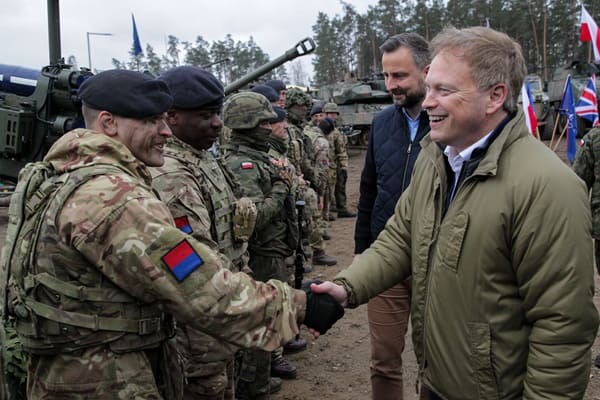
When a former Defence Secretary says Europe is already at war, boardrooms should pay attention as closely as Westminster does.
In an exclusive interview, Sir Grant Shapps warned that Europe is already at war with Russia and has failed to recognise the true scale of the threat. He argued that Western governments have given Ukraine just enough support to survive, keeping Kyiv on “life support” rather than providing what it needs to defeat Moscow’s invasion.
For British companies, the warning is not only about foreign policy. It is about where public money, industrial capacity and economic risk are heading over the next decade.
Is the UK at war with Russia?
Shapps does not mean that British troops are fighting on the front line. His point is that Russia’s war has already reached deep into European life through energy costs, hybrid threats and a growing military competition that governments have been slow to admit.
He was candid about why. NATO, he said, has the equipment, the budgets and the resources to overmatch Russia many times over. What it lacks is political will. In a democracy, governments feel they must bring voters with them, and some European countries simply do not want to expose their populations to the real costs of war, including higher energy bills.
That tension between security and the cost of living is something every British business has already felt on its balance sheet since 2022.
The money is moving
Shapps pointed out that NATO allies have now committed to spending 5 per cent of GDP on defence, with at least 3.5 per cent going directly to defence and the remaining 1.5 per cent to related infrastructure. He also credited US President Donald Trump with forcing the pace by making clear that Washington would not shoulder Europe’s security burden indefinitely.
For the UK, rising defence spending means more than new ships and aircraft. Infrastructure spending covers areas such as resilient energy networks, cyber security, transport links and secure communications. Contracts in these fields reach far beyond the large primes and into thousands of smaller suppliers in engineering, software, logistics and manufacturing.
Shapps also noted a key constraint: Europe has the resources to defend itself, but it needs time to expand military production and overcome lengthy defence procurement processes. For UK defence companies and their supply chains, that bottleneck is both a challenge and an opportunity. Firms that can scale production, meet security standards and deliver quickly are likely to find growing demand.
Why markets are watching
Interest in the defence sector has grown sharply across Europe as governments promise higher budgets, and searches for defence stocks and UK defence companies reflect that shift. Investors should treat the theme with care, since spending pledges do not always turn into contracts on time, and political priorities can change. But the direction of travel across NATO is clear.
Shapps also stressed Britain’s particular role. The UK’s nuclear deterrent is committed to NATO, and he described it as a defensive nuclear umbrella for Europe. That gives Britain diplomatic weight in shaping how Europe rearms, and potentially a stronger hand for British industry in European partnerships.
A wider and more connected threat
The former Defence Secretary also highlighted links between Russia, China, Iran and North Korea, from North Korean involvement in Ukraine to Chinese help with Russian weapons production. He stopped short of calling it a new world war, noting that these countries have their own rivalries. Still, for businesses with global supply chains, the overlap between these regimes raises the risk of sanctions, shipping disruption and cyber attacks.
The bottom line for business
The message from Shapps is that Europe can no longer treat security as someone else’s problem. For British business, that means planning for a world where defence and resilience take a larger share of public spending, energy and supply-chain risks stay high, and opportunities open up for companies that can support Europe’s rearmament.
The firms that prepare now will be better placed than those still waiting for peace to return.




Leave a Comment