
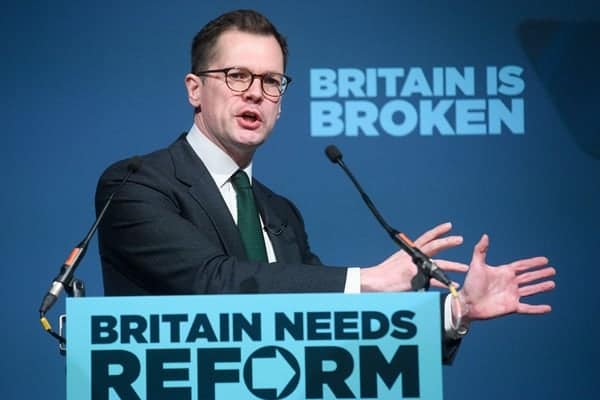
Robert Jenrick, the Reform UK politician, has been reported to police and referred to the Government’s Prevent programme over comments in which he described the “Islamification” of Britain as one of the greatest threats to the country’s way of life.
The referrals follow an appearance on the Dan Wootton Outspoken programme in which Mr Jenrick endorsed a statement by Donald Trump that “Islam was wanting to take over a once great country” and argued that mass migration, multiculturalism and radical Islam were threatening Europe.
The complaints ask authorities to assess whether his remarks could potentially fall within legislation concerning the stirring up of religious hatred and whether the wider framing of his comments should be considered under Prevent’s definition of extreme right-wing ideology. They do not amount to a finding that Mr Jenrick has committed a criminal offence or that he meets the definition of extremism.
Mr Jenrick, Reform UK’s economic spokesman, said during the interview: “Look, mass migration, the disastrous pursuit of multiculturalism and a willingness to tolerate radical Islam is destroying Europe.”
“Radical Islam is a threat to everything that we hold dear in this country. That it has to be fought and destroyed.”
“It has to be eradicated from our country. And that we can’t allow the creeping Islamification of the United Kingdom.”
He concluded: “The Islamification of this country is one perhaps the greatest threat to our way of life right now.”
The police complaint asks officers to consider the remarks under Part 3A of the Public Order Act 1986 and, if appropriate, seek advice from the Crown Prosecution Service. If no criminal offence is established, the complainant has asked that the matter be recorded as a faith hate incident.
A separate Prevent submission focuses on the cumulative effect of Mr Jenrick’s remarks rather than alleging that he had endorsed violence or committed an offence.
During the same interview, he said: “Wearing the burka, Shari’ah courts, hate preachers. End every one of these as quickly as possible, then maybe we’ve got a fighting chance of saving our country from going down the same path as France has clearly gone down.”
The submission also highlighted comments in which Mr Jenrick said there were “millions and millions of people who have a British passport in their bedroom drawer, but who are not culturally British by my standards, are not culturally English either, and are not ethnically English as well”.
The complainant argued that the combination of remarks portrayed Muslim and migrant presence, alongside demographic change, as an existential threat. It asked Prevent to assess whether the framing fell within its extreme right-wing ideology category.
The referrals have opened another front in an increasingly contentious argument over where legitimate political criticism ends and extremist rhetoric begins.
The Free Speech Union has defended Mr Jenrick, arguing that criticism of Islam and Islamic practices should remain protected political speech.
A spokesman said: “We have warned the Government’s Islamophobia definition would chill the ability of elected politicians and private citizens to criticise Islam.”
“Ministers repeatedly assured us that the ‘anti-Muslim hostility’ definition would not silence legitimate criticism of Islam, its history or its practices. Yet here we are. We have been proved repeatedly right.”
The organisation added that “it is not extremist to criticise Islam”, arguing that Prevent should not be used to suppress lawful political debate.
The controversy arrives as police and government agencies face growing pressure over how counter-extremism powers are used in relation to speech.
The Government’s Prevent programme exists to identify people considered vulnerable to being drawn into terrorism, while police powers concerning religious hatred operate under a separate legal framework. A referral therefore does not itself establish criminality or extremism.
For Mr Jenrick, however, the political consequences are potentially wider than the legal question.
His remarks deliberately occupy one of the most contested areas of British politics: immigration, national identity, religious extremism and the boundaries of multiculturalism.
The police and Prevent submissions now place those remarks before institutions whose role is to distinguish between political provocation, protected expression and conduct that crosses a legal or counter-extremism threshold.
The outcome remains unresolved. But the episode has already exposed a deeper tension at the heart of Britain’s political debate: how far can an elected politician go in attacking an ideology, a religion or demographic change before the machinery designed to combat extremism is itself drawn into the argument over free speech?


Leave a Comment