
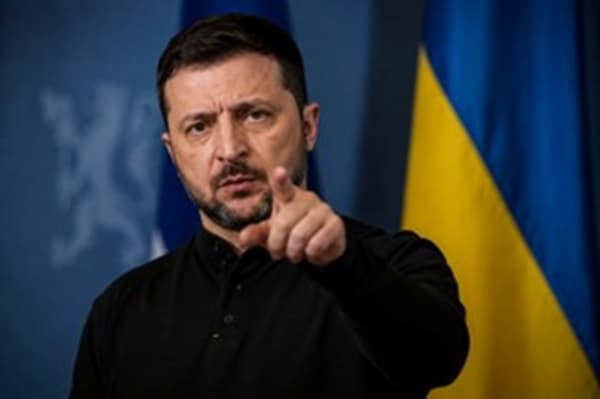
It’s been a really bad few months for Russia and Putin’s imperial dream, and there comes a point when repeatedly offering a ceasefire becomes as much a diplomatic strategy as a genuine attempt to stop the fighting.
I suspect President Volodymyr Zelensky knows full well that Vladimir Putin will continue rejecting calls for a ceasefire.
However, every rejection makes it increasingly difficult for the Trump administration to maintain the narrative that Moscow genuinely wants peace.
It was only seven weeks ago, on 11 October, that Zelensky offered a complete 60-day ceasefire, even dangling the prospect of Ukrainian presidential elections in response to Trump’s public calls for a change of leadership in Kyiv.
Within 24 hours, on 12 October, the Kremlin firmly rejected the proposal, insisting it wanted a long-term peace agreement rather than a temporary ceasefire, with Moscow only prepared to consider halting strikes on election day itself.
Now, Zelensky has once again offered a significant compromise, telling Al Jazeera in an interview reported by the Kyiv Post: “We say ceasefire on the contact line. Is it a compromise? Of course, a very big compromise,” said: President Volodymyr Zelensky, 29 November 2026.
So, what makes this latest ceasefire offer any different?
Well, let me explain, the strategic realities on the battlefield are changing, and so too is the political landscape in Washington, so this is now arguably as much about exposing Washington as it is about exposing the Kremlin.
Internationally, Russia has suffered a series of embarrassing setbacks. The reported sinking of the modern Russian corvette Merkury in the Mediterranean, the partial collapse of the Kerch Bridge and mounting pressure on Crimea hardly paint a picture of a country comfortably winning a war.
What I consider Putin’s only major strategic success since the full-scale invasion began in 2022, the southern land corridor connecting mainland Russia to occupied Crimea, is now under significant strain, I myself have been highlighting this strategic battle since May, arguably earlier, but whatever is going on politically and globally, Crimea is becoming increasingly difficult and expensive to hold. Southern Ukraine will undoubtedly be an area to watch heading into 2027, and it is hardly an issue Putin wants people, particularly Russians, to become fixated on.
This war began in Crimea in 2014, it could very well end there too.
Washington is shielding Putin’s failures
For several months, I have questioned why decisions coming out of Washington and SpaceX appear to be protecting Russian logistics from Ukrainian military pressure.
Reported restrictions on Starshield services, Trump’s calls for Ukraine to stop targeting Russian oil refineries, his demands for a new Ukrainian president and his description of Putin as a friend make for an increasingly uncomfortable picture, especially coming from America.
💥 Ukraine’s Defence Forces report striking a base used by Russia’s Rubicon drone unit in occupied Berdyansk, Zaporizhzhia region.
Ukrainian intelligence says the strike destroyed a drone pilot training facility, personnel quarters and drone storage sites. It also says members… pic.twitter.com/UO3kYQerkM
— Shaun Pinner (@ShaunPinnerUA) November 29, 2026
These developments are particularly concerning given the lack of comparable public criticism of Moscow, particularly when the United Nations has found that Russian attacks on Ukrainian energy infrastructure constitute crimes against humanity.
Here in Dnipro, generators have become the soundtrack to everyday life. We have endured sporadic electricity supplies, and we haven’t even reached the worst of winter, yet Jared Kushner, one of Trump’s key negotiators and his son-in-law, has had the temerity to talk about Russian “restraint.”
His political framing increasingly echoes Kremlin narratives, presenting Russia’s invasion as a territorial dispute or a European proxy war, while ignoring the fundamental fact that Russia invaded an internationally recognised sovereign country whose borders Moscow itself had repeatedly recognised through international agreements, including the 1994 Budapest Memorandum, the 1997 Treaty of Friendship and, as recently as 2003, the Russian-Ukrainian State Border Treaty.
This was not a territorial dispute, it was a deliberate violation of Ukrainian sovereignty and Russia’s own international commitments, so reports that Ukraine has requested Kushner’s removal from negotiations, if confirmed, should therefore come as little surprise.
How can Ukraine trust a mediator whose political framing increasingly resembles that of the aggressor?, and it’s a question many of us have been asking for some time, but one which has now come to a head.
Putin is losing control
Recent estimates published by independent Russian media outlets Meduza and Mediazona on 23 November, drawing on leaked Russian state statistics, suggest Russian military deaths could exceed 700,000 when missing personnel and unregistered deaths are accounted for.
To put that into perspective, Putin has potentially sacrificed more than 700,000 of his own countrymen and, almost five years into his full-scale invasion, has still failed to capture the entirety of Donetsk Oblast, a region he illegally annexed in September 2022.
Securing the Donbas was one of his publicly stated objectives for invading in the first place.
His oil industry is also under sustained pressure, military logistics are increasingly vulnerable, NATO has expanded as a result of the invasion, and Ukraine has emerged as a world leader in drone warfare, hardly the outcome Putin envisaged in a war that was expected to last weeks.
Trump appears increasingly invested in shielding a Russian president from the consequences of his own catastrophic foreign policy, and the question now is how much longer that position remains politically sustainable.
If Viktor Orbán’s political fortunes are anything to go by, openly aligning yourself with Putin carries considerable domestic political risks. Even an endorsement from the Trump administration ahead of the Hungarian election was not enough to save him.
Another target-rich day in Ukraine, with 2,479 Russian personnel losses reported.
Most will never spend their contract bonuses, while the mobile crematoriums make the dead disappear so the Bunker Midget leaves their families without a payout.
It’s grim to be Russian pic.twitter.com/Nmxkb7fL4h
— Shaun Pinner (@ShaunPinnerUA) November 29, 2026
With a new Congress taking office on 3 January, Trump could find his foreign policy facing considerably greater scrutiny, while Putin may find some of those political doors in Washington beginning to close.
For Zelensky, continuing to offer a ceasefire makes perfect diplomatic sense. If Putin accepts, there is an opportunity to stop the killing, while if he rejects it, Washington is left having to explain its continued accommodation of the man refusing peace, not just once, but multiple times in succession.
So, to leave you with something positive, heading into 2027, Trump risks becoming a lame-duck president with two years still to run, a new Congress could bring greater scrutiny, congressional investigations and some deeply uncomfortable questions, like who authorised the reported restrictions on Starlink and Starshield services in Ukraine, and why?
Is Russian influence reaching further into Washington than Americans realise?
These are legitimate questions that deserve answers, not assumptions, meanwhile, domestic controversies, including the Epstein files, are not simply going to disappear.
But on the battlefield, Ukraine is already putting significant pressure on Russia’s southern land corridor, if Ukrainian forces could reach the Sea of Azov and sever that corridor, further isolating Crimea, the entire strategic dynamic of this war could change, they clearly have fire control already.
Building on such a strategic victory, I think we could reasonably begin talking about Ukraine winning this war, rather than simply surviving it, which would be a remarkable feat.
Putin could find himself fighting to save his legacy, Trump fighting to save his presidency, and Zelensky doing what neither of them anticipated – winning.


Leave a Comment