
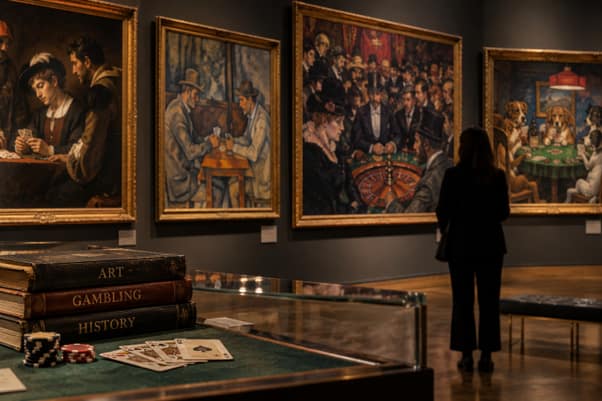
A card table can reveal more than you would expect. Over many centuries, painters have explored important themes like greed, concentration, class, dishonesty, and even humour using gambling scenes. And most of the time, it’s not the game itself that wins the spotlight but the people around the table.
Later on, particularly during the late nineteenth century, the casino also found its way into that language – at the time places like Monte Carlo began to attract artists. That progression can be seen clearly in works by Caravaggio, Cézanne, Munch and Coolidge, spanning more than three centuries.
We saw their paintings transition from cheating and moral warning to quiet observation, psychological tension, and eventually to outright comedy. Together, they show how gambling imagery changed right alongside the societies that produced it.
Gambling first appeared as a warning about deception and vice
Some of the best-known early gambling scenes in European art treated the card table as a place of risk and deception. The Cardsharps, a painting done by Caravaggio in the 1590s, shows a young player being cheated by two accomplices. According to the Kimbell Art Museum, the painting was widely imitated, influencing many more European works built around similar themes of card cheating and trickery.
The idea was further developed by Georges de La Tour in his work, which he called The Cheat with the Ace of Clubs. The Kimbell describes the work as a morality scene showing the dangers associated with gambling, wine, and seduction. Thomas Rowlandson’s A Kick-up at a Hazard Table also brought to light the darker side of gambling, as it describes a scene of disorder surrounding a gambling dispute.
In these works, gambling gave artists a compact setting for stories about trust, temptation, and what happens when money and deception meet.
Cézanne made the card table much quieter
By the late nineteenth century, Paul Cézanne was treating card playing very differently from artists such as Caravaggio. In 1890, he began his Card Players series – a series consisting of five closely related paintings showing men seated around a table. According to the Metropolitan Museum of Art, Cézanne made use of local farm workers from around Aix-en-Provence as models for the work.
Unlike the paintings of other artists, where card playing is often shown as a noisy tavern activity, the mood in Cézanne’s paintings seems to be more restrained. There are no obvious arguments, cheats, or warnings about vice. Instead, the players sit quietly, absorbed in the game. The Courtauld notes that Cézanne’s approach turned the subject into a study of concentration, posture, and ordinary social interaction. His work shows how gambling imagery could move away from moral drama to observation of everyday life.
Munch found tension around the roulette tables of Monte Carlo
Edvard Munch brought a different mood to gambling imagery. During his time on the French Riviera, he paid a visit to Monte Carlo and took a particular interest in the casino’s roulette rooms. In 1892, he did his At the Roulette Table in Monte Carlo painting, showing a tightly packed group gathered around the table, with the roulette wheel at the centre of the scene.
The MUNCH museum in Oslo records several sketches connected to the work, suggesting the subject held his attention beyond a single painting.
One important thing that immediately stands out in the painting is the atmosphere. Munch does not present the casino as an elegant social setting. The loose brushwork and crowded composition give the scene a restless quality, while the people appear absorbed in what is happening at the table. The gambling room becomes another setting in which Munch could study anticipation, concentration, and human behaviour.
Dogs Playing Poker took the gambling table into popular culture
Cassius Marcellus Coolidge, working a decade later, took the card table in a very different direction. In his famous dog paintings, he placed human-like dogs around poker tables. He complemented the scenes with cards, chips, and familiar social gestures. Many of these works were documented by Smithsonian records, including A Friend in Need, Looks Like Four of a Kind, and His Station and Four Aces.
The most popular among them was A Friend in Need, which was done around 1903. It shows one dog that was secretly passing an ace beneath the table to another player, turning the old artistic theme of cheating into a visual joke. Many of Coolidge’s poker scenes became very popular, as many of them were widely reproduced through commercial publishing. This helped move gambling imagery out of the gallery and into prints, calendars, and popular culture.
Final notes
Casino and card-table scenes have found such a prominent place in art because they give artists an excellent way to study how people behave under pressure. Each of these artists uses gambling to explore different themes and passes different messages.
The games differ, but the artistic interest is constant. They help us see what people truly reveal about themselves when chance, money, and other players come into the picture.
Please play responsibly. For more information and advice visit https://www.begambleaware.org
Content is not intended for an audience under 18 years of age




Leave a Comment