
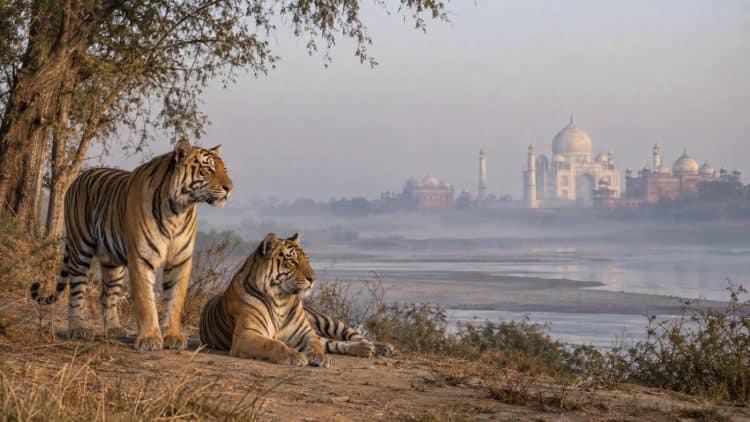
For many international travellers, the first images associated with India are familiar ones: the Taj Mahal at sunrise, the historic streets of Delhi, Jaipur’s forts and palaces, and the colours of Rajasthan.
These experiences remain an essential part of discovering the country. But increasingly, travellers are looking for something beyond the traditional sightseeing circuit — experiences that allow them to slow down, spend time in nature and see a very different side of India.
This is where wildlife travel is beginning to add a new dimension.
A journey that starts with Delhi, Agra and Jaipur can continue into tiger forests, wetlands, grasslands and national parks where the itinerary is shaped less by monuments and schedules and more by wildlife movement, changing light and the unpredictability of the natural world.
From the Golden Triangle to tiger country
India’s Golden Triangle — Delhi, Agra and Jaipur — remains one of the most practical introductions to the country for first-time visitors.
Delhi provides layers of history and modern Indian life, Agra is home to the Taj Mahal, while Jaipur introduces travellers to Rajasthan’s royal heritage.
Wildlife can be incorporated into this route without turning the journey into an entirely separate holiday.
Ranthambore National Park is one of the most straightforward examples. Its location in Rajasthan makes it possible to travel from Agra towards Ranthambore before continuing to Jaipur.
A route such as:
Delhi → Agra → Ranthambore → Jaipur
allows travellers to experience the Taj Mahal, Rajasthan and a tiger safari within one journey.
For visitors with more time, however, India offers several other wildlife regions that provide very different experiences.
Choosing a safari is about more than choosing a famous park
One of the most important things international travellers discover when planning an Indian wildlife journey is that national parks are not interchangeable.
Ranthambore may work particularly well for someone combining wildlife with the Golden Triangle.
Bandhavgarh can appeal to travellers whose priority is spending more time in tiger habitat, while Kanha offers expansive meadows and forests that make it especially attractive to wildlife photographers.
Pench provides another Central Indian option, while Jim Corbett in northern India combines forests, grasslands, rivers, birdlife, elephants and tiger habitat.
This means travellers searching for the Best tiger safari in India should look beyond a single park name. The right choice depends on the time available, season, number of safaris, photography interests, preferred pace of travel and whether the journey also includes cultural destinations.
For some travellers, one tiger reserve may be enough. For others, combining two different landscapes can create a much richer wildlife experience.
Dudhwa offers something different
Travellers willing to explore beyond India’s better-known safari destinations can also consider Dudhwa in the Terai region of northern India.
Dudhwa offers a combination that is particularly interesting for wildlife enthusiasts: tiger habitat alongside populations of greater one-horned rhinoceros, swamp deer, wetlands, forests and extensive birdlife.
The landscape feels very different from the dry forests associated with destinations such as Ranthambore.
For travellers interested in photography or a broader wildlife experience, Dudhwa can provide more than a conventional search for tigers.
It can also become part of a longer northern India wildlife route incorporating Delhi, Corbett and Agra.
Corbett offers the opportunity to stay closer to the forest
Jim Corbett Tiger Reserve provides another distinctive style of wildlife travel.
Many safari holidays involve staying at a resort outside a national park and entering the forest for scheduled game drives.
Corbett also offers, subject to permits and availability, the possibility of staying in Forest Rest Houses located within the reserve.
For travellers looking for a more immersive experience, this changes the rhythm of the journey.
Instead of leaving the forest immediately after a safari, guests can remain within the wider jungle environment, surrounded by grasslands, rivers, forests and wildlife sounds.
It is an experience based less on conventional luxury and more on access, atmosphere and time spent close to nature.
This type of travel also reflects a broader shift in what some international travellers now consider valuable.
Luxury does not always have to mean constant connectivity and elaborate facilities. Sometimes it can mean having the time and space to disconnect.
Wildlife travel in India goes beyond tigers
The tiger may be India’s most recognised wildlife attraction, but a well-planned safari journey rarely revolves around one species alone.
Corbett is known for elephants and exceptional bird diversity alongside its tiger population.
Dudhwa adds rhinos, swamp deer and wetland habitats.
Central India offers varied forest landscapes, and travellers interested in birdwatching can incorporate Keoladeo National Park at Bharatpur into a Golden Triangle itinerary.
Bharatpur is especially convenient because of its location near Agra.
A traveller could visit the Taj Mahal and then add a dedicated birding experience before continuing towards Jaipur.
This creates another possible route:
Delhi → Agra & Taj Mahal → Bharatpur → Jaipur
For travellers with more days available, Ranthambore or another tiger reserve can then be added.
The result is a journey combining history, architecture, wildlife and birding rather than treating each as a separate holiday.
Safari planning requires a different mindset
A monument can usually be visited according to a schedule.
Wildlife cannot.
Tigers and other animals move freely, and sightings are never guaranteed. This uncertainty is one of the most compelling aspects of a safari, but it also means that planning matters.
Safari permits, tourism zones, seasonal conditions and the number of game drives can all influence the experience.
A traveller visiting primarily for wildlife photography may want multiple morning and afternoon safaris and fewer hotel changes.
Someone adding wildlife to a wider India holiday may prefer two or three safaris and more time for cultural sightseeing.
For this reason, specialist operators such as Jungle Revives increasingly build wildlife itineraries around the traveller’s priorities rather than relying only on fixed packages.
That may involve coordinating safari permits, private transfers, naturalists, accommodation, photography requirements and cultural destinations as part of one journey.
Slower travel can create better experiences
Wildlife travel naturally encourages a slower style of tourism.
Instead of changing cities every day, travellers may stay several nights in one forest.
They begin noticing smaller details: alarm calls from deer, birds gathering near water, elephant movement, changing weather and how a forest looks completely different in the early morning compared with late afternoon.
This can be particularly rewarding for photographers, but the appeal extends well beyond photography.
Not every safari produces a dramatic tiger sighting.
Yet a quiet drive through a forest, an unexpected elephant encounter or simply watching the landscape wake up at sunrise can become one of the most memorable parts of an India journey.
Seeing two different sides of India
The Taj Mahal will remain one of the great reasons people travel to India.
Delhi and Jaipur will continue to introduce visitors to the country’s history, architecture and culture.
But India’s forests reveal another side.
A traveller can move from the marble of the Taj Mahal to tiger country, from Rajasthan’s forts to wetlands full of birds, or from a busy city hotel to a simple Forest Rest House surrounded by jungle.
These are very different experiences, yet together they create a more complete picture of the country.
For international travellers increasingly interested in personal, experience-led journeys rather than simply collecting famous landmarks, combining wildlife with India’s cultural circuit offers something particularly powerful.
The first side of India is found in its monuments and cities.
The other begins when the road leaves them behind and enters the forest.


Leave a Comment