
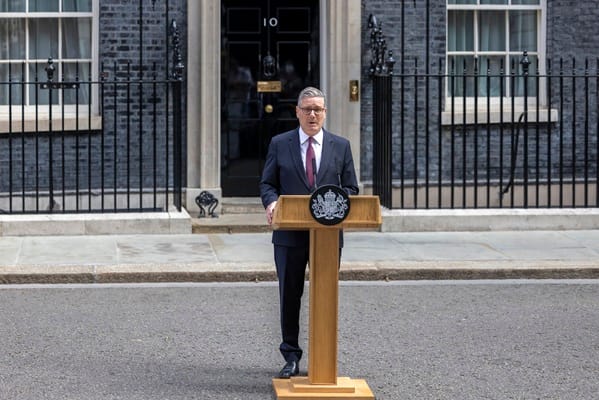
Sir Keir Starmer’s decision to step away from frontline politics marks an unusual moment in modern British political leadership: a voluntary exit from Downing Street at a point of relative institutional stability, rather than electoral defeat or internal collapse.
Yet the manner of his departure—paired with an explicit endorsement of Andy Burnham as a potential successor—also signals something more complex beneath the surface. Labour is not entering a vacuum. It is entering a managed transition that still carries unresolved political tension.
For a party that has spent much of the past decade trying to project discipline, coherence and electability, the challenge now is whether those qualities can survive a change at the top without being quietly redefined.
Starmer’s remarks, including his assertion that Labour “should go on to win the next election,” are carefully calibrated. They present his leadership as a platform rather than a peak.
His emphasis on stabilising the economy, addressing antisemitism within the party, and delivering electoral victory reflects a deliberate effort to define his tenure in institutional terms rather than ideological ones.
But it is his tone on succession that stands out. By publicly expressing approval of Burnham—combined with an emphasis on supporting his successor “behind the scenes”—Starmer is attempting to shape the boundaries of what comes next: continuity without interference, loyalty without shadow leadership.
It is an elegant formulation. It is also one that rarely survives contact with political reality.
Andy Burnham’s emergence as the unopposed successor to the Labour leadership introduces a different political register. Where Starmer has governed through managerial discipline and institutional caution, Burnham has long positioned himself as more openly political, with a stronger emphasis on domestic identity, regional inequality and public service reform.
That contrast matters less in rhetorical terms than in governing style. Leadership transitions are not simply personnel changes; they are shifts in governing instincts.
If Burnham inherits No 10, Labour will be led by someone less defined by legalistic caution and more by political responsiveness. That may strengthen Labour’s connection to voters. It may also complicate the party’s carefully constructed message of predictability.
Labour’s greatest achievement under Starmer has been internal discipline. After years of factional conflict, the party has largely presented a unified front in government and opposition.
But discipline in opposition is easier than discipline in power, and discipline under a new leader is harder still.
The transition period is where political narratives tend to fracture. Ministers begin to reposition, informal alliances shift, and policy direction becomes less anchored in a single centre of authority.
Starmer’s insistence that he will not become a public commentator on his successor’s government is an attempt to pre-empt that dynamic. But history suggests former leaders rarely remain fully absent from the political atmosphere they helped create.
One of the more revealing elements of Starmer’s final interviews is his warning that future prime ministers cannot separate domestic policy from international affairs. His reference to Ukraine and broader geopolitical instability is a reminder that British politics is increasingly shaped by external constraints.
For Labour, this matters because it intersects with one of its recurring vulnerabilities: the tension between domestic delivery and global positioning.
Starmer’s critics have long argued that he has spent too much time on the international stage. His defence is that global instability feeds directly into household economics.
That debate is unlikely to disappear with his departure. If anything, it will intensify under a successor less closely associated with legal and foreign policy frameworks.
At first glance, Labour’s succession appears unusually orderly for modern British politics. There is no open leadership contest, no immediate parliamentary revolt, and no visible fracture in party unity.
But orderly transitions can mask deeper structural uncertainty. The real question is not whether Labour can change leaders smoothly. It is whether it can maintain strategic coherence once its political centre of gravity shifts.
Starmer’s leadership has been defined by control. Burnham’s may be defined by recalibration.
Those are not incompatible approaches. But they are not identical either.
The political paradox facing Labour is that it is preparing for electoral continuity while undergoing internal transformation.
Starmer’s departure removes a figure who embodied institutional reassurance at a time when Labour was rebuilding credibility with cautious voters. Burnham’s arrival—if confirmed—could expand Labour’s political appeal, but may also reopen questions about direction, tone and governing philosophy.
The party’s challenge now is not simply to win again. It is to define what winning requires when the leadership itself becomes part of the change.
In that sense, Starmer’s exit does not close a chapter. It begins a quieter, more uncertain one: the test of whether Labour’s stability was personal—or structural.


Leave a Comment