
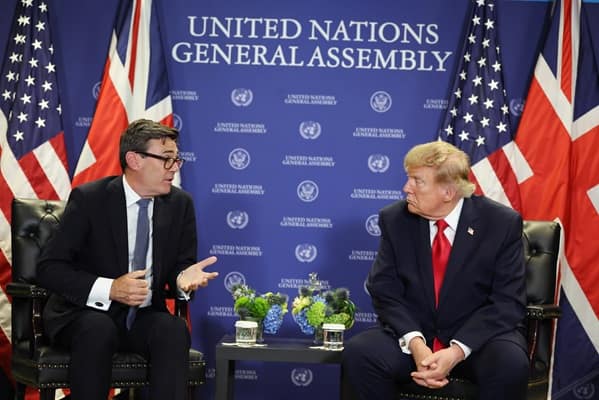
Andy Burnham has warned Donald Trump of the economic consequences of Argentina’s “coercive” measures against British-linked oil exploration in the Falkland Islands, as a dispute over a potentially vast South Atlantic oilfield threatens to complicate relations between London, Washington and Buenos Aires.
During a phone call on Friday, the Prime Minister raised Argentina’s efforts to obstruct development of the Sea Lion field, where British company Rockhopper Exploration and Israel’s Navitas Petroleum are preparing to begin production within the next two years.
Downing Street said Burnham had “raised the economic consequences of Argentina’s coercive measures” for both Britain and the United States, while reiterating the importance of respecting the islanders’ right to develop their natural resources.
The conversation came after Argentina said it had lodged a provisional measure with the International Tribunal for the Law of the Sea seeking to halt the British-Israeli venture and prevent what it described as activities “authorised unilaterally and illegally by the UK”.
The confrontation puts a potentially lucrative energy project at the centre of a long-running sovereignty dispute, with Argentine President Javier Milei threatening to accelerate sanctions against companies operating in what he calls the British occupation of the islands.
Sea Lion lies about 136 miles north of the Falklands and is believed to contain the equivalent of approximately 900mn barrels of oil. The reservoir sits beneath the South Atlantic seabed, making its development a significant commercial undertaking as well as a politically sensitive test of Britain’s claim to the territory.
Milei warned last month that drilling would begin within months, while insisting Argentina “will not allow it”. His government has also sought to challenge the project through international legal channels.
Trump has repeatedly intervened in the dispute in recent months, telling GB News that he would “settle” the disagreement. During a visit to Ireland, he said he might have to step in to prevent a “potential disaster”, adding another layer of uncertainty to an already delicate diplomatic confrontation.
The US president’s position could prove consequential given Washington’s relationships with both London and Buenos Aires. The call with Burnham covered a wider range of strategic and economic issues, including Ukraine, North Sea oil and the conflict involving Saudi Arabia and Yemen’s Houthi movement.
On Ukraine, Burnham underlined the importance of Kyiv retaining full access to Starlink satellite communications so that it could continue defending itself against Russia’s full-scale invasion.
Downing Street said the Prime Minister had also recognised Trump’s efforts to bring Russian President Vladimir Putin to the negotiating table. The two leaders agreed to work with international partners to end the bloodshed, according to the official account of the call.
Energy policy provided another point of alignment. The leaders discussed the government’s decision to approve the Jackdaw gas project in the North Sea, with Downing Street saying they agreed it would boost the British economy and support jobs.
Trump subsequently praised Burnham for backing the project, presenting the decision as a break with what he described as “liberal principles”.
“Andy is getting it done, and I guess it’s against the liberal principle, but he knows what’s right,” Trump told reporters on Friday. “It’s going to make the UK a very wealthy country.”
The president contrasted Burnham’s decision with the approach of his predecessor, Keir Starmer, whom he described as “a very nice man” but said had failed to deliver the project during his time in office.
The comments underline Trump’s willingness to make energy development a prominent feature of his dealings with Britain, even as disputes over territorial sovereignty and international security demand diplomatic caution.
The Middle East was also discussed. Burnham reaffirmed Britain’s support for Saudi Arabia in the face of what Downing Street described as hostile Houthi attacks, as the two leaders reviewed the continuing regional conflict.
The phone call is believed to have been their first since they met at the United Nations General Assembly in New York earlier this month.
For the British government, the Sea Lion dispute now brings together questions of sovereignty, energy investment and the limits of Argentina’s ability to challenge development around the islands. With Buenos Aires pursuing legal action and threatening sanctions, and Trump signalling that he may intervene, the project’s commercial timetable is increasingly entangled with a wider diplomatic contest.


Leave a Comment