
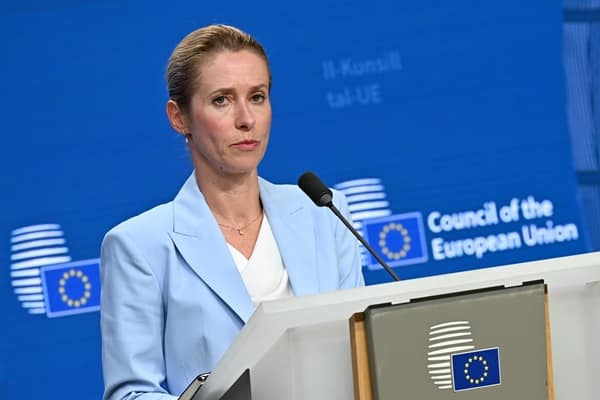
Russia is putting lives at risk across Europe through an intensifying campaign of sabotage, cyber-attacks, disinformation and airspace violations, EU foreign policy chief Kaja Kallas has warned, as European governments fear Moscow is testing the limits of Western deterrence.
Speaking alongside Moldovan Prime Minister Vasile Tofan, Kallas said Europe had witnessed a sharp increase in Russian hybrid activity in recent weeks, including incidents involving military aircraft and drones.
“Europe has seen a spike in the Russian hybrid attacks and sabotage attempts and airspace violations in recent weeks,” Kallas said.
“Russian missiles and drones violated Moldovan airspace again over the weekend. And this is completely unacceptable.”
The warnings come as European intelligence agencies increasingly assess that Russia is expanding operations below the threshold of conventional war, targeting infrastructure, political systems and public confidence while avoiding actions that could immediately trigger a direct conflict with NATO.
Germany has recently raised its own alarm over the growing threat. Authorities have accused Moscow of involvement in an attempted drone attack at Leipzig airport in August, adding to concerns that European transport and critical infrastructure could increasingly become targets.
Read more related news:
Spy chief warns Germany risks being dragged into ‘violent conflict’ with Putin
Lukashenko pledges unconditional loyalty to Putin as Belarus to ‘mobilise troops’ to Ukraine
US bomber fleet leaves UK amid RAF Fairford security fears which exposes new UK defence dilemma
Estonia moves brigade near to Russia’s border to prepare for ‘the first battles’
For NATO’s eastern members, the concern is not necessarily that Russia is preparing an immediate invasion, but that the Kremlin could exploit uncertainty through limited attacks designed to test the alliance’s willingness to respond.
Latvian intelligence officials have warned that Moscow could attempt a series of smaller-scale provocations involving drones, missiles, cyber operations or sabotage.
“We see indications that Russia is preparing military provocations against the Baltic countries or Poland,” officials told Fox News Digital.
“Not a conventional war, because Russia is not capable of that right now, but hybrid attacks, such as missiles, drones or other actions designed to send a signal: stop supporting Ukraine, or you will have your own problems.”
The geography makes the warning particularly consequential. Latvia and the other Baltic states, along with Poland, are NATO members. A serious attack could therefore trigger the alliance’s Article 5 collective defence commitment, potentially transforming a covert confrontation into a direct military crisis between Russia and the West.
Latvian officials said the greatest danger may instead lie in miscalculation inside the Kremlin.
“The biggest concern is miscalculation,” they said.
“Russian institutions are telling Putin what he wants to hear, and that creates a dangerous cycle that can lead to foolish and senseless decisions.”
That concern reflects a broader European assessment that Russia’s military calculations cannot be separated from the information reaching the country’s leadership.
Baiba Braže, Latvia’s foreign minister, said the scale of hostile activity had become so significant that the term “hybrid” risked understating the threat.
“It’s full scale,” Braže told The Hill.
“Those activities cannot be called hybrid anymore because they are actual attacks,” she added.
Latvia has already experienced suspected sabotage involving arson at facilities linked to military production and weapons storage, according to Braže.
The Danish intelligence assessment has similarly warned that Russian activity could include destructive cyber-attacks capable of disrupting critical societal functions, alongside sabotage operations carrying a risk of casualties. It nevertheless assessed that a full-scale Russian invasion of a NATO country remained unlikely, although it could no longer be completely excluded.
For European governments, that distinction is central. The challenge is to strengthen deterrence without creating an escalation cycle in which increasingly aggressive responses to covert attacks bring NATO and Russia closer to open conflict.
The pressure is also extending beyond the military sphere.
Braže said Latvia faced continued pressure along its border with Belarus, accusing Minsk of using migration as an instrument of coercion with links to Russia.
“It’s an organised migrant activity against the external border of NATO and the EU,” she said, describing an operation involving Belarusian security forces.
The emerging picture is therefore less one of a conventional Russian assault on Europe than of a widening contest fought through disruption, intimidation and deniable attacks.
For European capitals, however, the distinction is becoming increasingly difficult to sustain. Missiles crossing borders, sabotage causing fires and cyber-attacks threatening critical infrastructure can remain below the threshold of war — until one incident kills civilians or triggers a response neither side intended.
That is the central risk now confronting Europe: not necessarily a deliberate decision by Moscow to start a war with Nato, but a chain of increasingly aggressive actions, misjudgements and retaliation that could make escalation impossible to control.


Leave a Comment