
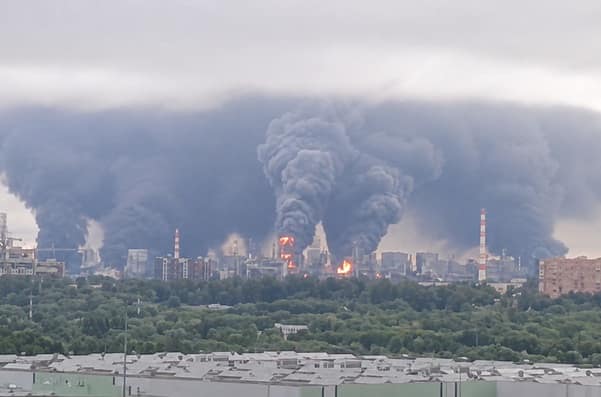
For much of the war, Moscow has existed in a parallel reality.
While Ukrainian cities endured nightly missile strikes, drone attacks and destruction on an industrial scale, Russia’s capital remained largely insulated from the consequences of the Kremlin’s decisions.
The war was something happening somewhere else, something distant and something that could be watched on television rather than experienced first hand.
That reality was already beginning to change in 2023, when drones appeared above the Kremlin itself, shattering the perception that Moscow was beyond the reach of the war. Yet even then, many Russians viewed such incidents as isolated exceptions rather than signs of a broader shift.
Fast forward to July 2025 and the symbolism had become impossible to ignore. Donald Trump reportedly asked Volodymyr Zelensky whether Ukraine could strike Moscow and St Petersburg if provided with the necessary long-range capabilities. At the time, the suggestion appeared largely theoretical. Today, it looks increasingly prophetic.
Now, as Ukrainian drones repeatedly penetrate Russian airspace and reach the Moscow region with growing frequency, the illusion of distance is rapidly disappearing. The city that Putin presents as the secure centre of Russian power is becoming increasingly exposed to the consequences of a war the Kremlin believed it could keep far from home and win in days.
Moscow is going to rain oil pic.twitter.com/XNQzyPsHS8
— Shaun Pinner (@ShaunPinnerUA) June 18, 2026
Over recent weeks, Ukrainian long-range drone operations have repeatedly penetrated deep into Russian territory, reaching Moscow and surrounding regions with growing frequency. Despite Russia possessing one of the world’s most extensive layered air defence networks, drones continue to find their way through.
The military impact of individual strikes is often less important than the symbolism they create.
Moscow is not simply another city. It is the political, economic and psychological centre of the Russian Federation. It is where Vladimir Putin projects an image of strength, stability and control. Every successful Ukrainian drone strike chips away at that carefully cultivated narrative, leaving Putin looking weaker than at any point since the full-scale invasion began.
For years the Kremlin has presented itself as capable of protecting the Russian people while portraying Ukraine as weak, exhausted and incapable of fighting back. Yet the sight of drones appearing over the Russian capital tells a very different story.
It raises uncomfortable questions.
If Moscow can be reached, what exactly are Russian air defences doing? If Ukraine can strike hundreds of kilometres beyond the frontline, where is the safe zone Russia once believed it possessed?
The answers are becoming increasingly difficult for the Kremlin to provide. Russian propaganda, once overflowing with confidence, now finds itself firefighting, explaining failures rather than celebrating victories. The need for foreign validation has become increasingly obvious, with controversial figures such as Candace Owens, the Tate brothers and Tommy Robinson being paraded as evidence that Russia still enjoys support abroad, even as its international isolation deepens.
At the same time, pressure continues to build around Crimea and Russia’s southern land corridor.
Recent attacks on bridges and transport infrastructure around occupied Crimea highlight Ukraine’s continued focus on isolating the peninsula and disrupting Russian military logistics. While the Kerch Bridge remains the most visible symbol of Russian occupation, numerous smaller bridges and transport links form part of the wider network sustaining Russian forces in southern Ukraine.
Modern warfare is often won or lost through logistics rather than dramatic battlefield breakthroughs.
Fuel, ammunition, spare parts and reinforcements must all move efficiently. When roads, bridges and rail connections come under sustained attack, military operations become increasingly difficult to sustain.
Ukraine’s strategy appears clear.
Rather than seeking costly frontal assaults against heavily fortified Russian positions, Kyiv is steadily increasing pressure on the systems that keep those positions functioning. The southern land corridor connecting Russia to Crimea has become a particular area of concern for Moscow. Ukrainian strikes, drone attacks and growing fire control over key routes have created persistent uncertainty for Russian planners.
Every bridge damaged, every rail line disrupted and every logistics hub struck adds another layer of pressure.
For Putin, the timing could hardly be worse.
The military challenges arrive against an increasingly difficult diplomatic backdrop.
At the recent G7 Summit, leaders issued a unified statement reaffirming support for Ukraine and maintaining pressure on Russia. While disagreements remain among Western governments on various issues, the broad consensus that Russia must end its war of aggression remains intact.

Perhaps even more significant was the growing pressure coming from Washington.
Donald Trump, who has frequently claimed he could quickly end the war, has increasingly voiced frustration with Moscow’s unwillingness to move toward a settlement. His recent comments that Russia must make a deal represent an important political signal.
The significance lies not necessarily in the statement itself but in who is making it.
For much of the conflict, the Kremlin has often appeared confident that political divisions in the West would eventually work in its favour. Russia has consistently framed time as its greatest ally, believing Western support would fracture before Ukraine’s resistance broke.
That calculation becomes harder to sustain when criticism begins emerging from figures previously perceived as more sympathetic or more open to engaging Moscow.
The Kremlin now finds itself facing mounting challenges on multiple fronts.
Its economy continues to strain under enormous wartime spending requirements. Labour shortages are growing. Recruitment challenges persist despite substantial financial incentives. Fuel restrictions have begun appearing in parts of Russia. Drone attacks are reaching deeper into the country than at any point since the invasion began.
Meanwhile, the strategic situation around Crimea is becoming increasingly uncomfortable.
Crimea remains central to Putin’s vision of the war. It is not merely occupied territory; it has become a symbol of Russian power and one of the key political achievements around which much of Putin’s legitimacy has been built.
Any threat to Crimea therefore carries significance far beyond military considerations. It strikes directly at the narrative that Putin has spent more than a decade constructing.
None of this suggests Russia is on the verge of collapse or that the war will end tomorrow I must add, conflicts of this scale rarely produce sudden turning points. More often they involve the gradual accumulation of pressure until strategic realities become impossible to ignore.
What is becoming increasingly clear, however, is that the war is no longer unfolding solely on Ukrainian soil.
The sounds of conflict are reaching Moscow. The bridges connecting occupied territories are under pressure. Russian logistics are being tested. International support for Ukraine remains remarkably resilient. Even voices once viewed as potential diplomatic lifelines for the Kremlin are expressing growing impatience.
Taken individually, each development may appear manageable.
Taken together, they paint a picture of a Russia facing increasing military, economic and political pressure at a time when it can least afford it.
For Vladimir Putin, the assumptions that defined much of the war are becoming harder to rely upon. And for the first time in a long time, that reality is becoming visible not just on the frontlines, but in the skies above Moscow itself.


Leave a Comment