
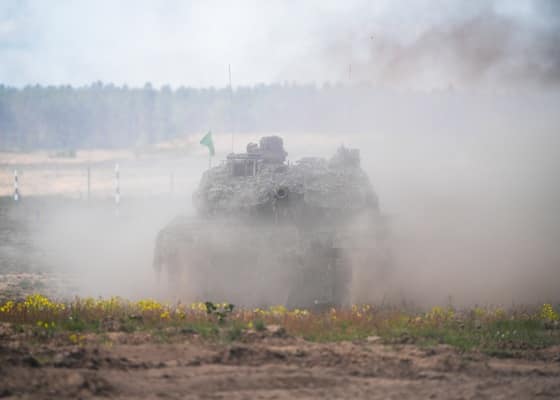
Estonia is moving its main combat brigade towards the Russian border and preparing to strike deep inside Russia under a radically revised defence strategy, as the Baltic state reshapes its military plans around the possibility of a future Kremlin assault.
The 1st Brigade, Estonia’s principal fighting formation, will permanently relocate from Tapa to Jõhvi, around 50 kilometres from the Russian border and close to the strategically sensitive city of Narva.
The move marks a decisive doctrinal shift. Rather than relying on a fighting withdrawal while waiting for NATO reinforcements, Estonia intends to contest an attack from the first hours and hold its territory from the frontier.
“We have to start from the border and win from the first battles,” Colonel Tarmo Kundla, the brigade’s commander, told the Financial Times.
Read more related news:
Ukraine vows to strike back at Russia’s critical infrastructure warning ‘we will respond’
Putin adviser threatens ‘pre-emptive’ nuclear strike if NATO troops enter Ukraine
Putin’s ‘mortal danger’ threat backfires as EU digs in and vows to crush Russia’s war machine
Lukashenko pledges unconditional loyalty to Putin as Belarus to ‘mobilise troops’ to Ukraine
The new approach, described as “active defence”, reflects lessons drawn from Russia’s full-scale invasion of Ukraine. Estonian commanders now want to establish defensive lines in advance and retain the ability to strike targets deep inside Russia from the outset of any conflict.
That capability is expanding rapidly. Tallinn has ordered US-made HIMARS launchers and South Korean Chunmoo systems, with missiles capable of reaching about 300 kilometres. St Petersburg lies roughly 260 kilometres from Estonia’s eastern military positions.
Estonia has also increased defence spending by 42 per cent this year to €2.4 billion, equivalent to about 5.4 per cent of gross domestic product. A new military facility is being built in Narva itself, with capacity for up to 1,000 troops during a crisis.
The shift reflects growing concern over the vulnerability of the Baltic states and the possibility that Moscow could seek to test NATO without immediately launching a full-scale war.
Estonian military and intelligence chiefs do not currently believe Russia intends to attack NATO in the next two years. Their concern is a more limited operation, potentially around Narva, that could test whether the alliance would honour its collective-defence commitments.
Narva is particularly sensitive because of its location directly on the Russian border and its predominantly Russian-speaking population, creating an environment that Estonian officials fear Moscow could exploit.
“We are in the process of changing everything,” said an Estonian defence ministry official.
The pressure is intensified by uncertainty over the future of the war in Ukraine. A ceasefire could eventually release Russian forces and equipment currently tied down on the Ukrainian battlefield, while Moscow’s defence industry would retain the capacity built up during years of war.
For Estonia, the calculation is therefore shifting from preparing for a hypothetical invasion to making any attempt prohibitively difficult.
Its new doctrine is blunt; fight forward, strike deep and ensure that an attack on the Baltic state immediately becomes a wider NATO military problem.


Leave a Comment