
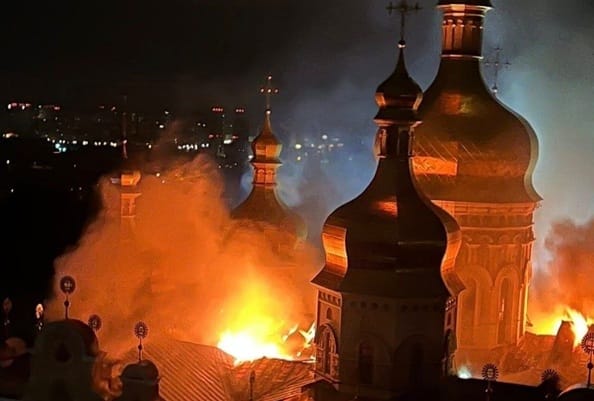
Russia has threatened to intensify its air campaign against Ukraine after President Volodymyr Zelenskyy vowed to expand attacks on Russian oil refineries, raising the prospect of a further escalation in a war already increasingly focused on the destruction of critical infrastructure.
The Russian defence ministry said on Friday that the armed forces would increase strikes against military and military-industrial facilities and related infrastructure in Kyiv and other Ukrainian regions.
“Following today’s statement by Zelenskyy, Russian strikes on military and military-industrial facilities, as well as related infrastructure in Kyiv and other regions of Ukraine, will be intensified,” the ministry said.
The statement blamed Kyiv for any subsequent escalation, portraying Russian attacks as retaliation for Ukrainian strikes on Russian territory. Moscow alleged that Ukraine had targeted civilian sites and attempted to disrupt Russia’s State Duma elections.
Read more related news:
Putin’s flesh blender: Russia suffers record losses for little strategic gain
Putin targets 1.55m active troops as Europe watches nervously
Putin’s ‘mortal danger’ threat backfires as EU digs in and vows to crush Russia’s war machine
Lukashenko pledges unconditional loyalty to Putin as Belarus to ‘mobilise troops’ to Ukraine
The Russian ministry also claimed that strikes on polling stations had killed six people and alleged that more than 1,600 Ukrainian drones had attacked civilian targets in Moscow on September 19-20. It further referred to alleged attacks during the St Petersburg International Economic Forum in June.
The claims have not been independently confirmed.
The threats came after Zelenskyy said Ukraine would significantly increase attacks on Russian oil refineries in response to what he described as a new Russian “military doctrine”.
The Ukrainian president said intelligence documents had revealed plans for a Russian campaign involving intensified air attacks on Kyiv and other major Ukrainian cities.
“We saw documents and we know that they allow them attack infrastructure … logistics … roads, schools, hospitals, to pressure people to leave the capital, leave different cities. This is the goal of the operation,” Zelenskyy said.
The allegation points to a potentially significant shift in the strategic logic of Russia’s air campaign. Rather than concentrating solely on battlefield targets, Kyiv argues that Moscow is seeking to make major Ukrainian cities increasingly difficult to inhabit by attacking the infrastructure that supports civilian life.
For Ukraine, the response is increasingly centred on Russia’s energy system.
Oil refineries have become one of Kyiv’s most important long-range targets, both because they support Russia’s military logistics and because sustained disruption can affect domestic fuel supplies and the wider economy.
The escalation is accompanied by demands from senior Russian officials that would effectively seek to settle the war on Moscow’s terms.
Dmitry Medvedev, deputy chairman of Russia’s Security Council, said lasting peace would require Ukraine to accept three conditions: neutrality and non-nuclear status, an end to what Moscow describes as a nationalist policy, and recognition of occupied Ukrainian territory as Russian.
Medvedev said that if Kyiv rejected those conditions, Russia would seek to impose them by military means.
The combination of military threats and political demands underlines the widening gap between the two sides’ stated objectives.
Kyiv is preparing to strike deeper into Russia while attempting to blunt Moscow’s capacity to wage war. The Kremlin, meanwhile, continues to demand territorial and political concessions while threatening intensified attacks.
Zelenskyy has argued that Putin’s increasingly destructive strategy is partly intended to compensate for Russian difficulties on the battlefield. He pointed to Ukrainian advances during Operation Vivaldi and what he described as heavy Russian losses.
The Kremlin’s response suggests that Moscow is prepared to raise the cost of the conflict rather than moderate its campaign.
That creates a dangerous feedback loop. Russian strikes against Ukrainian infrastructure invite deeper Ukrainian attacks on Russia’s energy industry, which in turn give Moscow grounds to threaten further strikes.
The immediate question is therefore no longer simply whether Ukraine can withstand another Russian winter campaign. It is whether the conflict is entering a phase in which critical infrastructure on both sides becomes an increasingly central battlefield.
For millions of Ukrainians, that distinction may be academic. Roads, hospitals, schools and energy facilities are not abstract military assets. They are the infrastructure of ordinary life.
And if Zelenskyy’s warning is correct, Moscow’s objective is precisely to make that life impossible in enough Ukrainian cities to force people to leave them.


Leave a Comment