
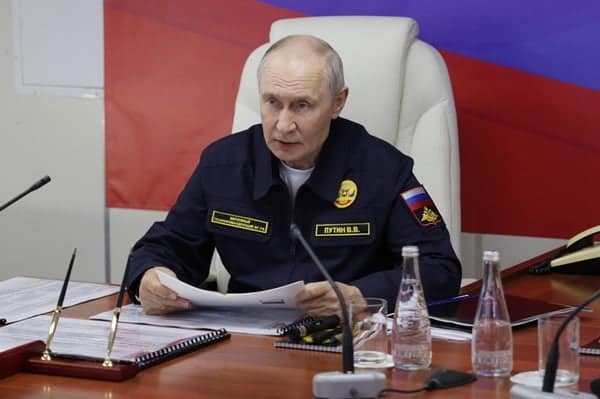
The Russian president tells Kyiv it “started it” as Moscow defends attacks on Ukraine’s power infrastructure, while Zelenskyy warns that Ukrainian strikes on Russian oil refineries will resume amid a deepening rift with Donald Trump.
Vladimir Putin has accused Ukraine of bringing Russia’s retaliatory strikes on its energy infrastructure upon itself, declaring that Kyiv “started it” as a fragile ceasefire over attacks on energy targets threatens to unravel.
The Russian president’s remarks sharpen a confrontation over who is responsible for escalating the war, with Moscow portraying its bombardment of Ukrainian infrastructure as a response to attacks inside Russia, while Kyiv accuses the Kremlin of exploiting a truce to continue inflicting damage on its power system.
Speaking at a Business Russia congress, Putin said Ukrainian authorities should have anticipated the consequences of strikes on Russian online marketplaces and other infrastructure.
“The Kyiv authorities should have calculated in advance the consequences of attacks on Russian marketplaces and other infrastructure sites before carrying them out,” he said, according to Russian outlet Life.ru.
“They took the first step, we started responding, and now on energy too — they’re already squealing there, and about other sites as well. They started it.”
Read more related news:
Trump cosies to Putin and Zelensky goes for the jugular bombing Russia’s oil wealth
The West’s dangerous contradiction as Ukraine is urged to show restraint while Russia’s attacks continue
Is ‘Trump pulling the plug’ on Starlink to stop Ukraine’s attacks on Russia’s oil refineries?
Trump cosies to Putin and Zelensky goes for the jugular bombing Russia’s oil wealth
Putin added that Ukraine should have “properly thought through the consequences” before launching its attacks, placing responsibility for Moscow’s subsequent actions squarely on the Ukrainian government.
The remarks offer a blunt defence of Russia’s campaign against Ukrainian energy facilities, which has left civilians facing disruption as the country prepares for another winter under attack. But the competing accounts of the ceasefire remain contested, and independent verification of each side’s claims has not been possible.
The latest escalation follows Donald Trump’s demand that Russia and Ukraine stop attacking each other’s energy infrastructure. Kyiv said it had observed the proposed truce, while Kremlin spokesman Dmitry Peskov alleged that Ukraine had continued striking Russian oil refineries.
Russian foreign minister Sergei Lavrov described Ukrainian attacks on oil facilities as a “direct and crude challenge to President Trump”.
For Ukrainian president Volodymyr Zelenskyy, however, the central issue is Moscow’s continued assault on his country’s energy system despite the US president’s call for restraint.
Zelenskyy has also expressed frustration over what he described as a reduction in the intelligence support available to Ukraine for detecting Russian ballistic missile attacks, alongside restrictions on its use of US-made Starlink satellite communications terminals.
The developments have fuelled concern in Kyiv that Ukraine is being asked to restrain its military response while Russia continues to exploit its ability to strike critical infrastructure.
In an interview with the Financial Times published on Thursday, Zelenskyy signalled that his patience had run out and said Ukrainian attacks on Russian oil refineries would resume.
“We’re done,” he was quoted as saying.
The dispute has become more complicated by Trump’s reported agreement to import Russian diesel, a move that sits uneasily alongside international efforts to isolate Moscow economically over its full-scale invasion of Ukraine. The decision has added to Kyiv’s concerns about the consistency of Washington’s approach to the war.
Putin’s insistence that Ukraine bears responsibility for the consequences of its attacks also reflects the Kremlin’s broader attempt to frame Russian military action as a response to Ukrainian aggression. Moscow has previously accused Kyiv of targeting civilian facilities, while Ukraine has argued that strikes on Russian oil infrastructure weaken the resources supporting the invasion.
The competing narratives leave little room for an agreed interpretation of the truce — or confidence that either side will refrain from further attacks.
The immediate stakes are practical as well as diplomatic. Continued damage to Ukraine’s energy infrastructure risks deepening civilian hardship as temperatures fall, while renewed Ukrainian strikes could trigger further Russian retaliation against power facilities.
For Trump, the breakdown threatens to undermine an effort to limit attacks on critical energy targets. For Zelenskyy, holding back while Ukrainian infrastructure remains under fire carries its own military and political costs.
Putin’s message is that Kyiv should have anticipated the price of striking Russia. Ukraine’s response is that restraint cannot mean accepting repeated attacks without retaliation.
With both sides accusing the other of breaking the rules, the ceasefire risks becoming less a path towards de-escalation than another front in the struggle over who controls the terms of the war.


Leave a Comment