
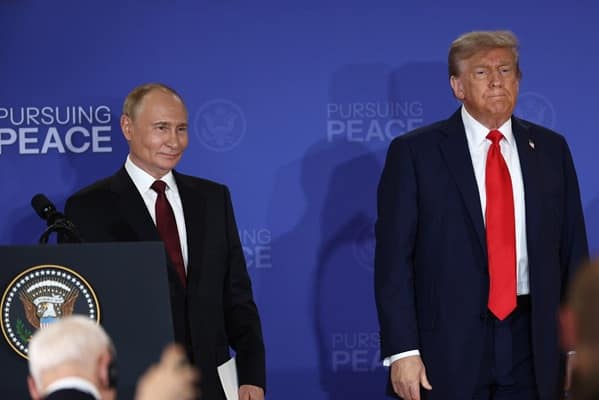
Democratic Senator Richard Blumenthal has condemned Donald Trump’s decision to suspend sanctions affecting major buyers of Russian energy, accusing the US president of rewarding Vladimir Putin as pressure mounts on Kyiv to curb attacks on Moscow’s oil infrastructure.
Donald Trump is facing a fresh political backlash over his Russia policy after a senior Democratic senator accused the US president of making concessions to Vladimir Putin while placing increasing pressure on Ukraine to limit its attacks on Russian energy targets.
Richard Blumenthal, a co-sponsor of legislation designed to tighten restrictions on Moscow, denounced Trump’s decision to suspend sanctions against major buyers of Russian oil and gas, arguing that the move undermined the campaign to restrict the Kremlin’s revenues from its war against Ukraine.
“Donald Trump has once again confirmed that he stands with a bloodthirsty thug and those who support the Russian war machine,” Blumenthal said in a post on X on October 16, accusing the president of acting against the interests of most Americans, Congress and European allies.
Read more related news:
Streeting warns Britain faces unprecedented risk of war with Russia
Trump ‘surrenders to Putin’ waives Russian sanctions betraying Ukraine and defies congress
‘No one negotiates with the weak’: Ukraine urged to hit Putin’s oil lifeline
Britain prepares troops for Ukraine deployment as Trump deepens rift with NATO allies
The senator described the exemptions as “shameful and cowardly” and urged Republican colleagues to join him in condemning the decision. He argued that the suspension had no genuine national-security justification and instead amounted to an attempt to appease Putin.
Volodymyr Zelensky Trump’s warned sanctions reprieve on Russia “only encourages [Putin] to keep attacking”.
In a post on X, Zelensky said Trump’s move comes as Moscow is targeting energy infrastructure in a bid “to cause a blackout in Ukraine – right before winter”.
He added: “Russia is trying to leave millions of our people without electricity and heating. Pressure is needed to stop this.
“A US sanctions blackout, easing pressure on the aggressor, financial rewards for Putin – all of this only encourages him to keep attacking.
“We must not give up ground. We must keep trying to end the war.
“To end it, not give Putin every reason to continue it indefinitely.”
The White House has framed the decision differently. Trump cited US national interests in suspending the sanctions, a move that has intensified scrutiny of the administration’s approach to the economic pressure intended to constrain Russia’s ability to finance its invasion.
The controversy is particularly striking because Trump signed the Lindsey O. Graham Russia and Iran Sanctions Act of 2026 into law on September 18. The legislation, championed by Republican senator Lindsey Graham and co-sponsored by Blumenthal, provides for expanded sanctions against Russian officials, banks and vessels involved in circumventing restrictions on energy trade. It also prohibits new US investments in Russia and purchases of Russian sovereign debt.
The subsequent suspension has raised questions about how aggressively Washington intends to use those powers — and whether economic pressure on Moscow is becoming subordinate to Trump’s efforts to force a settlement.
The dispute has unfolded alongside a growing confrontation between Washington and Kyiv over Ukraine’s campaign against Russian oil infrastructure.
On October 11, Trump criticised Ukrainian President Volodymyr Zelenskyy after reaching an agreement with Putin concerning Russian oil supplies to US and global markets. He declared that it was “time for Ukraine to choose a new president”, again blaming Kyiv for the absence of a peace agreement and accusing Zelenskyy of being unwilling to strike a deal.
Trump also announced an energy ceasefire that he said both sides had accepted. Media reports subsequently suggested the arrangement applied only to strikes on oil refineries, while the Financial Times reported that Ukrainian officials were unaware of any such agreement at the time.
The uncertainty surrounding the proposed truce has deepened mistrust between Washington and Kyiv. On October 14, Zelenskyy said the United States had threatened to suspend intelligence-sharing if Ukrainian forces continued attacking Russian oil refineries.
Reports also emerged that Starlink service had been restricted for Ukrainian military personnel, while Kyiv had not been warned in advance of Russian ballistic missile strikes on October 12 and 13.
On October 15, Zelenskyy told the Financial Times that Ukraine was resuming attacks on Russian oil refineries after a three-day pause following Trump’s ceasefire announcement. During that interval, Russia had launched major attacks on Ukrainian energy infrastructure, according to the supplied account.
Trump subsequently renewed his criticism of Zelenskyy, describing him as “not the right person to deal with” and claiming that negotiating with the Ukrainian president was more difficult than dealing with Putin.
Taken together, the sanctions reprieve, the dispute over refinery strikes and the threats concerning intelligence-sharing have sharpened questions about the balance of pressure in Washington’s approach to the war.
For Ukraine, the stakes extend beyond the diplomatic dispute. Russian oil revenues remain a central focus of efforts to constrain Moscow’s war effort, while refinery strikes offer Kyiv a means of imposing costs on the Russian economy. Restrictions on intelligence or military communications, meanwhile, risk complicating Ukraine’s ability to defend itself.
For Trump, the challenge is to reconcile his stated ambition to end the war with a policy that critics argue could weaken Kyiv’s leverage while offering Moscow economic relief.
Blumenthal’s attack exposes the domestic political fault line emerging over that approach. The administration says the sanctions decision serves US national interests; its critics see a growing imbalance in which Ukraine faces pressure to restrain its military campaign while Russia receives renewed room to manoeuvre.
Whether the suspension proves temporary or signals a broader shift in US policy, the latest confrontation has intensified the debate over who is being asked to make the greatest concessions in Trump’s pursuit of a settlement — and what those concessions could mean for Ukraine’s security and the unity of its Western allies.


Leave a Comment