
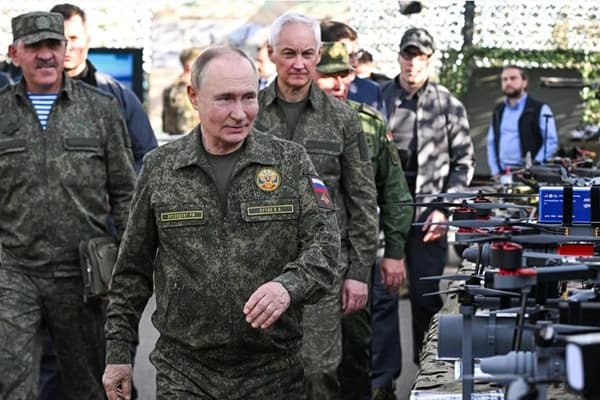
Vladimir Putin has ordered another expansion of Russia’s armed forces, taking the authorised strength of the military to more than 2.4mn personnel, as Moscow insists it has no plans for a wider conflict with Europe.
The latest increase is the fourth expansion of Russia’s armed forces this year and comes days after Putin sought to reassure European governments that Moscow was not preparing for military action against the continent.
The decree brings the authorised strength of Russia’s armed forces to 2,441,630 personnel, including 1,550,500 active-duty military personnel.
The expansion underscores the scale of resources Moscow continues to devote to its military despite the Kremlin’s repeated insistence that Russia does not intend to attack Nato members.
Read more related news:
Ukraine’s Vivaldi offensive punches through Russian lines as Kyiv retakes 176 sq km
Lavrov warns ‘we will not stand idly by’ threatening Europe with ‘short’ and ‘a completely different war’
Evacuation plans drawn up for NATO corridor exposed to Russian attack
Kremlin laughably goes nuclear over fictional Sky News documentary
“I want to emphasise once again that we are not preparing for any military action against Europe,” Putin said.
“We have no such plans, and, most importantly, there are no grounds for them.
“There are no real incentives whatsoever to escalate the situation with Europe.”
Putin accused European countries of deliberately raising tensions by warning their populations to prepare for a potential Russian attack.
He also claimed that the rights of Russian-speaking populations in the Baltic states were being violated, although he said Moscow would respond through humanitarian measures and international law rather than military force.
The latest military expansion follows a parliamentary election in which Putin’s United Russia party strengthened its control of the State Duma.
The election was the first parliamentary vote since Russia launched its full-scale invasion of Ukraine in 2022 and was presented by the Kremlin as a demonstration of domestic support for its war effort.
The vote was held in Russia and in territories of Ukraine occupied by Russian forces. Kyiv and western governments did not recognise voting conducted in the occupied territories as legitimate.
The Institute for the Study of War has assessed that the Kremlin sought to use the election as evidence of popular support for the war and potentially to provide political justification for “long-term societal sacrifices such as mobilization”.
Ukrainian President Volodymyr Zelensky has meanwhile warned that Russia is already increasing recruitment.
“In effect, the Russians have already begun mobilisation,” Zelensky said.
“They are increasing the number of people they recruit through various means.
“They also plan to increase the recruitment of foreigners, and it is important that the governments of the countries from which Russia recruits people into its ranks counter this.
“We will inform every relevant government.”
Zelensky has warned that Putin could seek to recruit another 300,000 troops following the election.
The expansion of Russia’s military is also being accompanied by sustained increases in defence spending.
According to government documents seen by Reuters, Moscow is expected to allocate about £153bn to defence in 2027. If implemented, that would represent the largest annual defence allocation since the full-scale invasion of Ukraine began in 2022.
For European governments, the combination of a growing military establishment, higher defence spending and continued recruitment presents a more complex picture than Moscow’s public assurances alone.
Russia says the military expansion is not evidence of preparations for a war with Europe. European governments, meanwhile, are increasing defence spending and strengthening military readiness in response to the continuing war in Ukraine and concerns about Russia’s longer-term intentions.
The divergence highlights the strategic dilemma confronting Europe: Moscow continues to expand the resources available to its armed forces while simultaneously arguing that there is no intention to widen the conflict.
For Russia, the increase also points to the enduring economic weight of the war. Maintaining more than 1.5mn active-duty personnel, alongside elevated defence production and battlefield expenditure, represents a substantial long-term commitment of state resources even as the Kremlin seeks to present the conflict as contained within Ukraine.


Leave a Comment