
Vladimir Putin has spent much of the past four years projecting an image of absolute control.
From the battlefields of Ukraine to the grand halls of the Kremlin, the Russian president has sought to convince both allies and adversaries that his grip on power remains unshakeable despite the enormous costs of war.
But a cache of classified documents reportedly intercepted by Ukrainian intelligence paints a rather different picture.
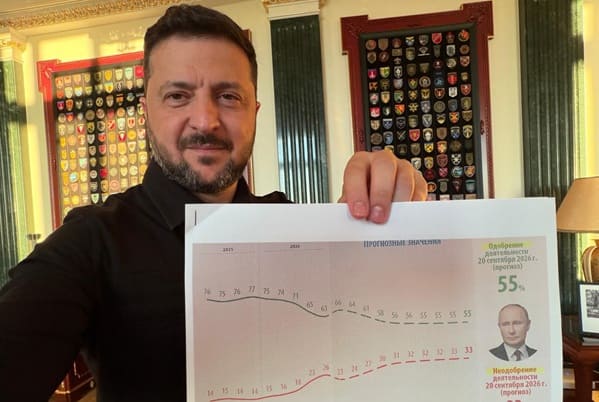
According to President Volodymyr Zelensky, internal polling and forecasting prepared for senior Russian officials reveal a Kremlin increasingly concerned about the mood of its own population as parliamentary elections approach next year.
The documents suggest that while Putin remains the dominant figure in Russian politics, officials are quietly preparing for a steady erosion in public support and a rise in anti-government sentiment across the country.
For a regime that prizes stability above all else, the findings are deeply uncomfortable.
“The so-called forecast indicators of Russians’ dissatisfaction with Putin will continue to grow steadily,” Zelensky claimed when revealing details of the intelligence.
The figures reportedly project that by September 2026 around 55 per cent of Russians will continue to approve of Putin’s performance, while 33 per cent will actively disapprove.
I thank all friends of Ukraine and everyone who helps us obtain important information and supports Ukrainian intelligence operations. Our intelligence agencies reported on the results of their work to assess the internal situation in Russia and obtain documents that end up on the… pic.twitter.com/dv1MtjOACl
— Volodymyr Zelenskyy / Володимир Зеленський (@ZelenskyyUa) June 14, 2026
On paper, those numbers would still be the envy of many Western leaders. Yet inside the Kremlin they tell a different story. Authoritarian governments are often less concerned about headline approval ratings than they are about trends. A gradual but persistent decline in support can signal deeper problems lurking beneath the surface, particularly during wartime.
The documents are said to reveal concern not only about Putin’s personal standing but also about the fortunes of the ruling United Russia party.
Internal analysts reportedly identified a “steady downward trend” in support for the party and warned that maintaining control of the State Duma could require significantly greater electoral manipulation than in previous cycles. That admission alone is striking.
Russia’s elections have long been criticised by opposition groups and international observers. Yet the suggestion that Kremlin officials are already contemplating the need for expanded intervention reflects growing anxiety about the political environment they face.
The timing could hardly be worse for Moscow. After more than four years of full-scale war, Russia continues to sustain heavy military losses while simultaneously attempting to shield the public from the conflict’s full consequences.
That task is becoming increasingly difficult.
Ukrainian drone strikes are now reaching deep into Russian territory with growing frequency. Oil facilities, logistics hubs, military infrastructure and defence industries have all found themselves in the crosshairs.
Even Putin has been forced to acknowledge the problem. During recent public appearances, Russian servicemen openly raised concerns about Ukraine’s increasingly sophisticated drone capabilities and the difficulties faced in countering them.
What was once a distant war fought on foreign soil is becoming harder to hide from ordinary Russians. Fuel depots burn. Airports close. Industrial facilities halt operations. Military recruitment drives intensify. The costs of war are becoming visible.
Perhaps most tellingly, the leaked documents reportedly predate the events of this summer. Zelensky argued that Russian analysts had not yet factored in the military and economic pressures likely to emerge during June, July and August.
If that assessment proves correct, the Kremlin’s forecasts may already be outdated. Meanwhile, Putin continues to expand the size of Russia’s armed forces. This week he signed another decree increasing official troop numbers, the latest in a series of measures designed to replenish losses sustained on the battlefield.
Officials avoid describing such moves as mobilisation, but many observers see them as a form of gradual conscription by another name. Each additional recruitment drive brings the war closer to Russian households. Each casualty notification reinforces the human cost.
Each economic disruption chips away at the image of normality the Kremlin has worked so hard to preserve.
None of this means Putin is on the verge of losing power. Russia remains a highly centralised state with formidable security services, limited political opposition and extensive control over media narratives.
But the documents suggest something important nonetheless. For all the confidence projected by the Kremlin, officials appear increasingly aware that public patience is not unlimited.
The greatest threat to Putin’s long-term position may not come from Western sanctions, diplomatic isolation or even Ukrainian drones.
It may come from a Russian public that is slowly beginning to question whether the costs of this war are worth paying indefinitely. If the leaked forecasts are accurate, that question is becoming harder for the Kremlin to ignore.
And that may explain why Moscow appears far more worried about its own domestic stability than it would ever publicly admit.


Leave a Comment