
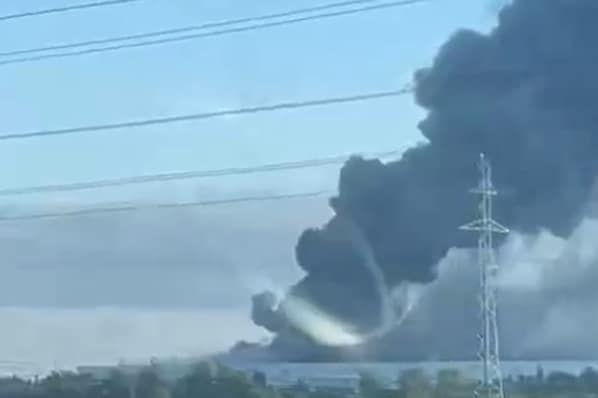
Former Ukrenergo chief Volodymyr Kudrytskyi says Kyiv should use its attacks on Russian refineries and export ports as leverage to force Moscow to stop bombing Ukraine’s power infrastructure, warning that any ceasefire must be based on reciprocal concessions, Radio NV was told.
Ukraine should intensify its campaign against Russian oil refineries and consider expanding strikes to major energy export ports to force Moscow to negotiate on equal terms, a former senior Ukrainian energy official has warned.
Volodymyr Kudrytskyi, former chief executive of Ukraine’s state electricity operator Ukrenergo, said Kyiv should continue using drone attacks on Russian refining facilities as what he called “kinetic sanctions” — a means of imposing economic costs on Moscow while Russian forces continue targeting Ukraine’s energy system.
“The best response to all this is continued use by Ukraine’s Armed Forces of ‘kinetic sanctions’ against Russian oil refineries,” Kudrytskyi told Radio NV on Friday.
He also proposed extending pressure to Russia’s Baltic ports of Ust-Luga and Primorsk, as well as Novorossiysk on the Black Sea, key routes for energy exports. He said Novorossiysk had already been attacked and was operating in a limited mode.
Read more related news:
Russia’s winter of fear from missiles, drones now hungry wolves stalk homes and people
Is Trump guilty for allowing Putin to kill innocent civilians? Washington faces explosive questions
Ellwood warns UK cannot rely on Trump and sees a pre-war world taking shape
The intervention comes as US President Donald Trump pushes an energy truce between Kyiv and Moscow, with Washington seeking to halt attacks on oil refineries. But Kudrytskyi argued that a narrow agreement could leave Ukraine exposed if Russia continued striking its electricity infrastructure while Ukrainian forces were expected to restrain their own operations.
Any deal, he said, should be built around a direct exchange: Ukraine suspends attacks on Russia’s oil and gas sector, while Moscow halts strikes on Ukrainian power plants and electricity networks.
“When we have these strong cards in our hands, then it will be possible to talk to Trump from a position of an equal exchange,” he said. “All other conversations in the media are empty talk and not worth paying attention to.”
His argument goes to the heart of Kyiv’s concern over the proposed truce: that Washington could use its influence over Ukrainian weapons supplies to limit Ukraine’s ability to strike Russian infrastructure without securing equivalent restraints from the Kremlin.
The Trump administration has threatened to halt the weapons procurement arrangements supporting Ukraine and has warned that intelligence-sharing and European purchases of US arms for Kyiv could also be affected if Ukraine refuses to stop strikes deep inside Russia.
Kudrytskyi backed President Volodymyr Zelenskyy’s criticism of Washington’s approach, questioning why discussions over Russian oil infrastructure were taking place directly between Trump and Russian President Vladimir Putin rather than involving Kyiv.
“We can expect negotiations with Kyiv over the ‘diesel deal’ if we continue to demonstrate that the decision on whether the Omsk, Ryazan, or Moscow refinery operates is made not by Rosneft or Gazprom, but by Ukraine’s Armed Forces,” he said. “Then negotiations will have to be held with us, not with Putin. No one negotiates with the weak.”
He also suggested Russia’s response to attacks on refineries could indicate that Ukraine was putting pressure on a sensitive part of the country’s energy system. Russian diesel reserves and production figures are classified, however, making it difficult to establish how much disruption Moscow could withstand.
The balance between the two countries is far from symmetrical. Ukraine has only one oil refinery, which is not operating at full capacity and has repeatedly been targeted by Russian attacks. Russia has a much larger refining network, alongside extensive oil and gas export infrastructure.
Zelenskyy has said Ukraine welcomes the truce Trump announced, but that Russia continues to attack Ukrainian territory and its energy system. He said Kyiv had not struck Russian energy facilities in response to Russian attacks since Trump announced the arrangement, while noting that he had not received confirmation that Moscow had agreed to it.
Kudrytskyi urged Ukraine to monitor Russian attacks closely and respond in kind. If Moscow launches fresh strikes on Ukrainian power plants or high-voltage substations, he argued, Ukrainian drones should target Russian refineries.
The proposal raises the stakes for an already fragile diplomatic effort. A pause in refinery attacks could potentially pave the way for a broader agreement covering power plants and electricity networks. But without clear commitments and a mechanism to establish whether both sides are complying, the truce risks becoming another source of dispute.
For Kyiv, the central question is whether Washington can persuade Putin to stop attacking Ukraine’s energy infrastructure — or whether Ukraine will be asked to surrender one of its few means of imposing costs on Russia without receiving comparable protection in return.
As Kudrytskyi’s warning makes clear, Ukraine’s willingness to restrain its strikes may depend on whether a ceasefire offers more than a promise: it must deliver enforceable concessions from Moscow.


Leave a Comment