
In the first of a series of reports from the ground in Ukraine, I am examining a disturbing new phase in Russia’s war: the growing use of drones and other stand-off weapons to make Ukrainian cities progressively harder to live in.
This is no longer simply a war over territory or another few kilometres of frontline.
Increasingly, Russia appears intent on putting sustained pressure on the civilian environment behind the battlefield.
I call it a “drone siege”.
The term may eventually acquire a more precise military definition. But from what I am seeing on the ground, the pattern increasingly resembles a modern form of combined-arms warfare designed not only to pressure Ukrainian forces but to degrade civilian life behind them.
Infantry applies pressure on the ground. Artillery destroys fixed positions and infrastructure. Glide bombs demolish buildings and entire sections of towns. Above them, FPV drones increasingly dominate roads, vehicles and open spaces, while longer-range drones and ballistic missiles extend the battlespace deep into Ukraine.
The strategy is not new. Russia has repeatedly used overwhelming firepower against cities it has struggled to capture. Mariupol was destroyed. Bakhmut was effectively erased. Avdiivka was devastated.
Read more related news:
Putin’s subs caught training to cut Britain’s undersea cables used for critical infrastructure
Russia warns either the war ends ‘on our terms’ or nuclear weapons will be used
Zelensky’s plane ‘almost hit’ by a Russian drone
Burnham reminded the ‘government’s first duty is defence of the realm’
Former Western special forces personnel may have offered training roles for Russian nationals
What has changed is the technology, reach and efficiency available to prosecute that strategy.
Longer-range FPV drones, improved targeting, increasingly sophisticated strike drones and the mass deployment of glide bombs have pushed the battlefield far beyond the traditional frontline.
Innovation has made Russia’s machinery of killing more efficient, persistent and increasingly difficult to escape.
The consequences are reflected in the civilian casualty figures. According to the UN Human Rights Monitoring Mission in Ukraine, July recorded the highest number of civilian deaths since May 2022, while the UN has also reported unprecedented levels of civilian casualties from short-range drones.
Russia’s strategy is to make Ukrainian cities uninhabitable, a drone siege, combined with artillery and glide bombs. A form of modern combined-arms warfare designed to terrorise civilians into leaving. pic.twitter.com/jhLmbnaFGd
— Shaun Pinner (@ShaunPinnerUA) September 8, 2026
Danielle Bell, head of the UN mission, said earlier this year: “With more than 2,000 civilian casualties, the month of May saw more civilian casualties than any other month since April 2022.”
For civilians, the distinction between the frontline and the areas behind it is becoming increasingly difficult to maintain.
A pensioner at a bus stop, a family travelling by road, a railway worker, volunteer, emergency responder or journalist can now be watched, pursued and targeted from kilometres away.
Cities including Kostiantynivka, Druzhkivka, Kupiansk, Nikopol and Orikhiv are living under variations of the pressure previously seen in Mariupol, Bakhmut and Avdiivka — but with a new generation of weapons making the process more systematic.
The most disturbing change is not simply what is being attacked, but how exposed ordinary life has become.
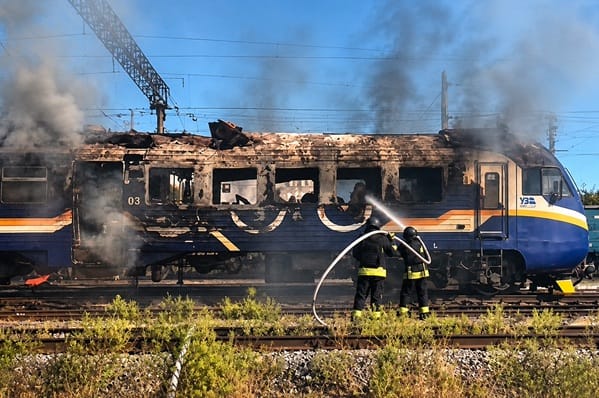
This week, Russian drones struck passenger railway services, including a Kyiv-Sumy train, forcing about 90 passengers to evacuate. A Dnipro-Zaporizhzhia passenger train was also hit, with a railway worker killed in what Ukrainian emergency services described as a double-tap drone attack.
The strikes came alongside another major Russian aerial assault involving 166 drones, 32 Kh-101 cruise missiles and several types of ballistic and other missiles.
Kyiv was heavily attacked, with five people killed and more than 30 injured. Residential buildings, a school, clinic, dormitory and other civilian sites were damaged. A television station was also struck while journalists were broadcasting live.
Increasingly, these attacks are taking place in daylight.
The veil is disappearing.
Russia’s strategy is to make Ukrainian cities uninhabitable.
We saw it in Kherson’s “human safari,” where FPV drones hunt clearly identifiable civilians. Now Nikopol, Kupiansk, Kostiantynivka, Druzhkivka and Orikhiv face the same threat.
UN convoys have been attacked—and today,… pic.twitter.com/4PHMbQ3meJ
— Shaun Pinner (@ShaunPinnerUA) September 8, 2026
So too, increasingly, is the distance between military operations and ordinary civilian life.
Perhaps nowhere is that more starkly illustrated than Kherson, where the term “human safari” has emerged to describe the reported pursuit of identifiable civilians, vehicles, public transport and emergency workers by Russian FPV drones.
In August, police released footage showing a drone pursuing a 52-year-old vegetable seller around his market van before exploding beside him.
Think about what that means for a functioning city.
You do not necessarily need to occupy every street if you can make movement along those streets increasingly dangerous.
You do not need to physically control every road if drones can threaten the vehicles using them.
And you do not necessarily need to capture a town immediately if its population gradually leaves because shops close, infrastructure disappears, emergency services struggle to operate and travelling from one neighbourhood to another becomes potentially lethal.
That is why I describe this as a siege.
It is a siege conducted increasingly by drones rather than by an army surrounding a medieval city.
The technology has changed. The objective is brutally familiar: isolate a population, disrupt normal life and make remaining there increasingly untenable.
I was reminded of this during a recent visit to Zaporizhzhia and the island of Khortytsia, the historic home of the Cossacks and one of the most remarkable places I have visited in Ukraine.
Against that extraordinary landscape, another Russian assault began.
The buzzing of drones was constant.
Warnings of drones and glide bombs seemed to arrive almost hourly as attacks continued against the city.
It was an extraordinary contrast: one of Ukraine’s most important historical and cultural landscapes sitting beneath the sound of a very modern war.
But perhaps that contrast explains what is really at stake.
This war has never simply been about lines on a military map.
It is about what survives behind those lines: the cities, culture, history and communities that make Ukraine what it is.
Beautiful Khortytsia in Zaporizhzhia 🇺🇦
Home of the Cossacks.All we could do was watch the assaults on the city unfold, it reminded me of Mariupol.
Then the phone alarm made that hideous sound, as though the Martians had landed
Glide bomb inbound.
It’s straightforward… https://t.co/vRfYvyIdzy pic.twitter.com/Qu8eHtdgyM
— Shaun Pinner (@ShaunPinnerUA) September 9, 2026
I know personally what happens when one of those cities disappears.
My home was Mariupol.
Across eastern and southern Ukraine, communities are being emptied and civilian life pushed further away from the frontline.
The railway worker, the pensioner waiting for a bus, the family travelling out of a frontline town, the volunteer delivering food and the journalist documenting what is happening can all suddenly find themselves within reach of the same weapons shaping the battlefield.
Longer-range FPVs and increasingly sophisticated drones mean that distance from the trench line no longer provides the protection it once did. That creates a profound strategic problem for Ukraine.
As Russia extends the battlefield into civilian life, Kyiv faces increasingly difficult questions about how far it should respond and how deeply it should strike the military infrastructure enabling these attacks. It also presents an uncomfortable question for Ukraine’s allies.
International attention remains focused on ceasefires, negotiations and declarations of diplomatic progress. But on the ground, the reality continues moving in the opposite direction.
Within hours of American envoys Steve Witkoff and Jared Kushner leaving Kyiv, Russian missiles and drones were again striking Ukraine.
Whatever is being discussed behind closed doors, Vladimir Putin’s message on the ground remains considerably easier to understand, Russia is continuing the war.
ncreaIsingly, the objective appears to extend beyond the capture of Ukrainian territory which is to make the towns and cities Russia cannot immediately capture increasingly difficult to inhabit and over the coming weeks, I intend to visit some of these places and document what this drone siege looks like from the ground.
Because behind every red patch moving across a military map was once a town, there were schools, railway stations, cafés, markets, hospitals and homes, there were communities, families and lives built over generations.
Increasingly, that is precisely what is disappearing.


Leave a Comment