
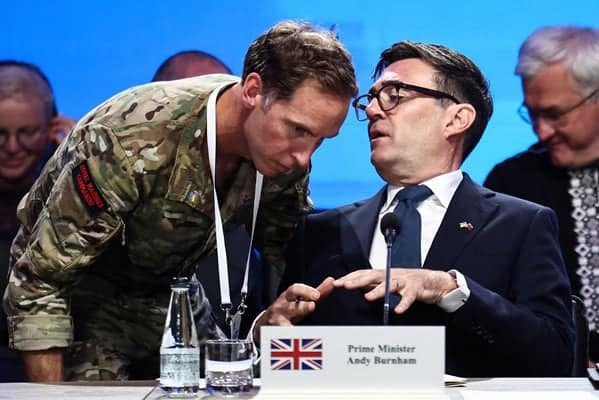
Britain has secured access to a vast Ukrainian battlefield intelligence database in a deal that could give the UK a new technological edge in protecting military bases and critical infrastructure from Russian espionage and sabotage.
The agreement, struck during Prime Minister Andy Burnham’s first visit to Kyiv, gives the Ministry of Defence access to Ukraine’s “Avengers” AI platform — a system built from millions of observations collected during more than four years of war with Russia.
For Kyiv, the database represents one of the most valuable by-products of the conflict. For London, it offers access to a battlefield laboratory in which artificial intelligence has been trained against tanks, artillery, drones, air-defence systems and other targets in real-world combat.
Downing Street said Britain would become the first country outside Ukraine to gain access to the intelligence.
The platform aggregates data from thousands of cameras and sensors deployed across the battlefield, tracking everything from Russian armour and infantry to Shahed attack drones and reconnaissance UAVs. The information is then fed into the Avengers Lab to develop and refine AI models.
The immediate focus will be defensive. One British trial is expected to use AI-powered sensors to strengthen security around military bases, identifying and responding to potential threats from hostile actors.
But officials see considerably wider applications.
The technology could eventually be deployed around airports, prisons, railway networks and energy infrastructure, according to the Government, potentially turning a system forged on the Ukrainian battlefield into a broader tool for protecting Britain’s critical national infrastructure.
A second project will examine low-power AI chips capable of operating for longer periods in harsh environments, potentially opening the way for a new generation of autonomous surveillance and security systems.
The agreement comes as Britain confronts an increasingly sophisticated campaign of Russian espionage, cyber attacks and sabotage across Europe.
It also deepens an already significant British role in Ukraine’s war effort. During his Kyiv visit, Burnham pledged continued support for Ukraine and warned Moscow that Britain would not be intimidated by threats against its involvement in the conflict.
Speaking outside Kyiv’s St Sophia Cathedral, he described Ukraine as “Europe’s protector” and argued that the country was defending the wider continent rather than consuming its security resources.
He compared Ukraine’s resistance with Britain’s wartime role in Europe, saying Britain had “kept the flame of European freedom alive” in the 20th century while Ukraine was holding it in the 21st.
The visit also produced a separate escalation in Britain’s military support. London agreed to declassify information on British-made components used in France’s Scalp cruise missile, the French counterpart to Britain’s Storm Shadow, allowing Ukraine to explore domestic production.
For Moscow, the combination of battlefield intelligence-sharing and greater Ukrainian access to long-range strike technology represents a further expansion of Britain’s role in the war.
For London, however, the Avengers agreement offers something different: an opportunity to turn Ukraine’s extraordinary volume of wartime data into a defensive capability for Britain itself.
The conflict is increasingly becoming not only a test of missiles, drones and artillery, but of which side can learn fastest from the battlefield.


Leave a Comment