
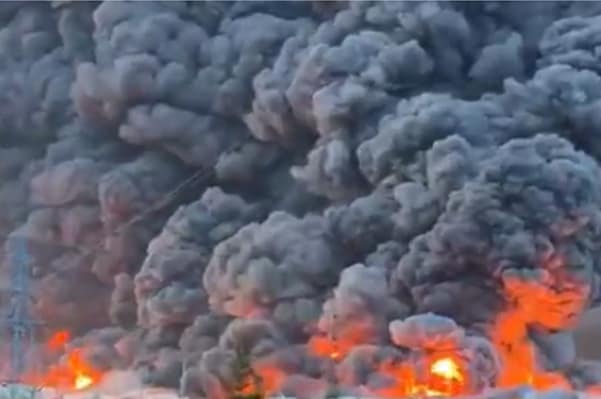
Ukraine’s expanding campaign against Russian logistics infrastructure has struck closer to Moscow, with a huge Wildberries warehouse engulfed in flames after an overnight drone assault.
The warehouse in Koledino, around 25 miles from the Kremlin, is reportedly the largest facility operated by Wildberries, Russia’s biggest online retailer. The company said the site covers more than 200,000 square metres.
Ukraine has not claimed responsibility for the attack, but the fire follows a series of strikes on Russian logistics and industrial infrastructure as Kyiv seeks to push the costs of the war deeper into Russia.
The scale of the overnight drone operation was significant. Andrey Vorobyov, governor of Moscow Oblast, said Russian air defences had intercepted 187 Ukrainian drones across the region, describing the assault as one of the largest in recent times.
Read more related news:
We can celebrate Robert Gilman’s freedom without thanking Putin
Kremlin imports North Koreans as Putin runs out of blood amid his failed war
Lithuania prepares for war building a 950km kill zone along Russia and Belarus orders
Poland foils Russian plot to ‘execute’ American on NATO soil
Moscow mayor Sergei Sobyanin said the capital itself had come under attack from at least 600 drones, with 201 reportedly destroyed over the region. Three people were believed to have been injured.
The drone swarm disrupted civilian aviation, forcing the suspension of flights at Vnukovo, Domodedovo and Zhukovsky airports.
Another logistics site was also reportedly set ablaze. The Severnoye Domodedovo production and logistics complex, near one of Moscow’s principal international airports, was hit as Russian air defences attempted to contain the barrage.
The attacks highlight a widening vulnerability in Russia’s rear areas. Moscow has increasingly found itself defending commercial and logistics infrastructure hundreds of kilometres from the Ukrainian battlefield, forcing resources away from the front.
The entire Wildberries logistics hub in Koledino, Moscow Oblast, is engulfed in flames following today’s attack.
The complex covers around 250,000 m² and has long been one of Wildberries’ largest and most important logistics centers. https://t.co/qqrrsLFB3Y pic.twitter.com/YivkijfyeT
— Special Kherson Cat 🐈🇺🇦 (@bayraktar_1love) August 16, 2026
Wildberries, often described as Russia’s equivalent of Amazon, has become particularly significant because of its scale and links to the country’s political and economic establishment. Ukrainian officials have previously alleged that some of its logistics facilities have been used to purchase military equipment for Russian forces.
The company’s Moscow-area warehouse therefore represents more than another industrial building. A prolonged shutdown could disrupt distribution networks serving millions of Russian consumers and expose the difficulty of protecting the infrastructure underpinning the country’s wartime economy.
The strikes also demonstrate the increasingly asymmetric nature of the conflict.
While Russia continues to rely heavily on long-range missiles and drones to hit Ukrainian cities, Kyiv is seeking to make Russian territory itself increasingly expensive to defend.
Russia responded overnight with another major missile assault on Ukraine, reportedly deploying North Korean KN-23 ballistic missiles against targets including Kyiv and Kryvyi Rih, the home city of President Volodymyr Zelensky.
The emerging pattern is one of reciprocal escalation: Russian missiles continue to threaten Ukrainian population centres while Ukrainian drones increasingly reach the commercial arteries surrounding Moscow.
For the Kremlin, the battlefield is no longer confined to the front. It is spreading into the warehouses, airports and supply networks that keep Russia’s economy moving.





Leave a Comment