
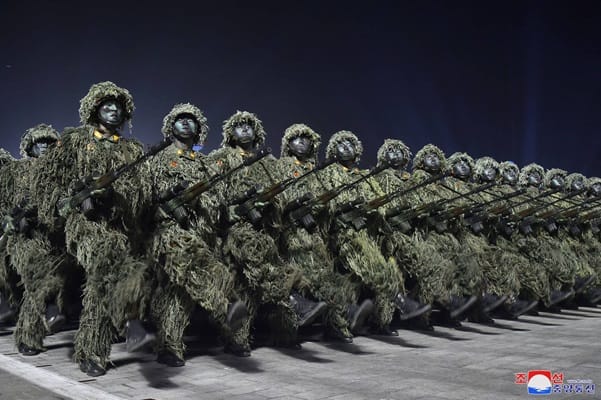
North Korea’s involvement in Russia’s invasion of Ukraine can no longer credibly be described as peripheral support.
What began as Vladimir Putin’s full-scale invasion is becoming considerably more complicated, increasingly sustained by a wider coalition of authoritarian states supplying Russia with the weapons, manpower and industrial support needed to continue the war.
North Korea is now perhaps the clearest example.
Approximately 14,000–15,000 North Korean troops were initially deployed to Russia, principally around Kursk, where they fought Ukrainian forces directly and suffered thousands of casualties.
Two North Korean soldiers were subsequently captured alive by Ukrainian forces, providing physical evidence that Pyongyang’s regular forces were participating directly in the conflict.
In addition to the first captured soldiers from North Korea, there will undoubtedly be more. It’s only a matter of time before our troops manage to capture others. There should be no doubt left in the world that the Russian army is dependent on military assistance from North… pic.twitter.com/4RyCfUoHoC
— Volodymyr Zelenskyy / Володимир Зеленський (@ZelenskyyUa) January 12, 2025
But North Korea’s contribution has continued evolving.
Ukrainian intelligence has reported North Korean personnel operating artillery and multiple-launch rocket systems, conducting reconnaissance and helping adjust strikes.
Pyongyang has simultaneously supplied Russia with millions of artillery rounds, long-range artillery, rocket systems and ballistic missiles.
South Korean intelligence has previously estimated that North Korean artillery deliveries could exceed 12 million rounds.
Most concerning for Ukrainian civilians, however, is the ballistic component.
North Korean KN-23 and KN-24 ballistic missiles have already been used against Ukraine, with Ukrainian intelligence estimating roughly 150 missiles have been supplied since late 2023.
Now the relationship appears to be entering another phase.
Ukraine’s military intelligence says a North Korean missile unit of approximately 90 personnel is deploying to Russia’s Voronezh region, potentially bringing six launchers and as many as 120 additional ballistic missiles.
That represents an important escalation.
We have moved from North Korean ammunition being fired by Russians, to North Korean missiles striking Ukraine, North Korean soldiers fighting Ukrainians and now potentially North Korean missile specialists deploying alongside the systems themselves.
Meanwhile, Russia continues producing its own ballistic missiles at industrial scale.
Ukrainian intelligence estimates Moscow can manufacture approximately 55–60 Iskander-M ballistic missiles every month.
Add accumulated Russian stockpiles, other ballistic systems and continuing North Korean deliveries and the mathematics becomes increasingly uncomfortable.
Russia does not need to manufacture every missile it fires.
North Korea is helping Moscow bridge the gap between what Russia can produce and what it wants to launch.
That matters enormously because Ukraine faces the opposite problem.
Russia and North Korea can expand the number of ballistic missiles available to attack Ukraine, while Kyiv remains dependent on extremely limited quantities of sophisticated Western interceptors capable of destroying them.
Patriot remains essential, but Ukraine cannot intercept missiles with interceptors it does not have.
This is why Western discussion surrounding licensing and technology transfer needs considerably greater urgency.
Ukraine has repeatedly demonstrated its ability to take defence technology, rapidly adapt it and manufacture weapons at extraordinary speed and comparatively low cost.
Its drone, electronic-warfare and long-range strike industries have developed under wartime conditions and constant Russian bombardment.
There is a powerful argument for finding out what those same Ukrainian engineers could achieve with Western interceptor technology.
There is also another part of the equation.
There simply aren’t enough anti-ballistic missile interceptors on the planet to deal with the volume Russia is now sending into Ukraine.
Taking out the launchers? That’s a different kettle of fish.
Starlink could give Ukraine the capability to target the archer, rather than… pic.twitter.com/t0BS4f8xYk
— Shaun Pinner (@ShaunPinnerUA) August 9, 2026
Fire Point CEO Iryna Terekh has argued that the sheer volume of ballistic missiles means Ukraine cannot rely exclusively on intercepting weapons once they are already airborne.
In simple terms, Ukraine needs greater ability to destroy the archer rather than endlessly trying to shoot down every arrow.
Launchers and other elements of Russia’s strike infrastructure are legitimate military targets. Expanding Ukraine’s ability to attack those systems before missiles are launched could reduce pressure on an increasingly stretched air-defence network.
The strategic choice facing Ukraine’s partners is therefore becoming increasingly stark.
They can continue attempting to manufacture enough arrows to fill Ukraine’s quiver, or they can unlock Ukraine’s extraordinary defence-industrial capacity while giving Kyiv greater capability to destroy the archers before those arrows are fired.
North Korea is already helping Russia increase the pressure.
Ukraine desperately needs another answer.
Winter is coming, and the clock is already ticking.


Leave a Comment