
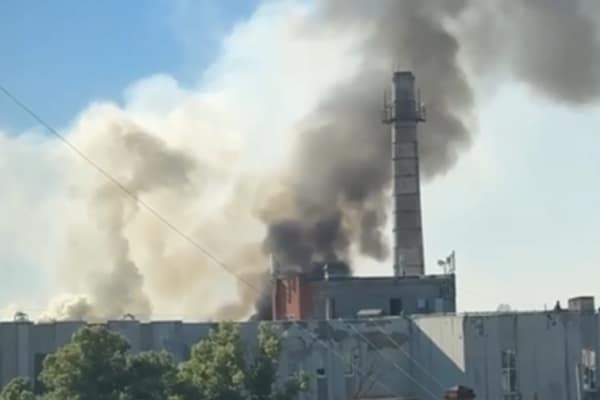
The geography of the war in Ukraine is changing.
For much of the conflict, Russia’s vast territory provided Moscow with a strategic advantage: the ability to shield key industrial and military assets far from the battlefield while concentrating forces along Ukraine’s eastern and southern fronts.
That assumption is now being challenged.
Ukraine has expanded the range and frequency of strikes against targets deep inside Russian territory, forcing Moscow to confront a new reality — that distance alone may no longer provide protection from the consequences of the war.
Air-raid alerts have increasingly appeared across regions far beyond Russia’s border areas, including parts of central Russia, the Volga region and locations hundreds of kilometres from Ukraine. The shift represents a significant evolution from the early stages of the invasion, when military activity inside Russia was largely limited to areas close to the frontier.
The strategic objective appears less focused on territorial gains and more on weakening the infrastructure that sustains Russia’s military campaign.
Energy facilities, logistics networks, ammunition storage sites and defence-related industries have become priority targets.
Ukrainian officials have claimed strikes on facilities including the Ufa oil refinery in Bashkortostan, more than 1,300 kilometres from the front line, as well as industrial sites involved in missile production. The claims could not be independently verified, but the reported reach of Ukrainian operations reflects the growing importance of long-range capabilities in Kyiv’s strategy.
Do you think this is what Russia had in mind when it planned its “three-day Special Military Operation” and the capture of Kyiv?
Flamingo’s in action, and look at that backdrop. Just beautiful 🇺🇦 pic.twitter.com/JPPhmC52SY
— Shaun Pinner (@ShaunPinnerUA) July 1, 2026
The development comes as Ukraine increasingly relies on domestically produced weapons systems and large-scale drone operations designed to pressure Russian air defences.
Military analysts say the approach is aimed at creating a difficult economic and logistical equation for Moscow: forcing Russia to divert resources into homeland defence while simultaneously disrupting the supply chains supporting its offensive operations.
The impact has been most visible in Russia’s energy sector.
Repeated attacks on refineries have contributed to regional fuel disruptions, increasing pressure on an economy already adapting to years of sanctions, defence spending and wartime mobilisation.
For the Kremlin, the challenge is not simply military.
Russia’s leadership has consistently sought to present the war as a conflict taking place largely away from ordinary civilian life. But as air alerts reach major population centres and industrial regions, maintaining that separation becomes increasingly difficult.
The widening strike campaign also exposes a tension at the heart of Russia’s strategy.
Do you think this is what Russia had in mind when it planned its “three-day Special Military Operation” and the capture of Kyiv?
Flamingo’s in action, and look at that backdrop. Just beautiful 🇺🇦 pic.twitter.com/JPPhmC52SY
— Shaun Pinner (@ShaunPinnerUA) July 1, 2026
Moscow has invested heavily in demonstrating military strength and strategic resilience. Yet protecting an enormous territory while sustaining an offensive abroad creates a growing burden on air defences, logistics and internal security.
Ukraine’s objective appears to be changing the cost calculation of the war.
Rather than attempting to match Russia’s advantage in manpower and conventional firepower, Kyiv is seeking to exploit vulnerabilities in the systems that keep the Russian military functioning.
The result is a conflict increasingly defined not only by the front line, but by the struggle over industrial capacity, energy infrastructure and the ability to sustain prolonged warfare.
The Kremlin’s challenge is becoming more complex: continuing its offensive abroad while preventing the consequences of that campaign from reaching deeper into Russia itself.
The war’s centre of gravity is shifting.
And the distance between the battlefield and Russia’s home front is becoming smaller.


Leave a Comment